About Me

My photo
I'm a woman entering "the third chapter" and fascinated by the journey.
Showing posts with label musings. Show all posts

Monday, December 21, 2020

The darkest night of a dark year

     It comes as no surprise that 2020 has been a dark and difficult year. A global pandemic and its economic fallout, a public extra-judicial execution leading to weeks of protests, gangs of armed thugs storming statehouses and threatening officials, the ugliest US election of my lifetime capped off with weeks of legal and extra-legal maneuvering by a vicious lame-duck president and threats of martial law. This year also brought the deaths of six former colleagues, three of them near my age, a former student, and two church friends. The day before Halloween, a friend died of Covid, and the list of those who have tested positive grows longer by the day. A few days ago, the son of an old friend finally succumbed to the progressive neurological illness that had been weakening him for decades. 2020 has brought a litany of losses.

    This year's winter solstice coincides with the great conjunction, the planetary lineup that has been called the Christmas Star. Many of us had hoped to head outdoors to see it, as we here in the Mid-Ohio Valley climb the Turtle Mound every year to view the solstice sunset as the Hopewell did. Unfortunately, today brought lowering clouds, rain, and what for a while sounded like ice pellets, so no stars or sunset have been visible. Today has indeed been a day of darkness, and tonight will be the longest night of the year.

    But the period of light begins growing longer tomorrow, even though our area is likely to be too cloudy for that astronomical fact to be evident. The various weather channels at least predict sun for Wednesday, with rain and snow expected to follow. And this is just December, so we can expect several more months of winter. 

Winter, of course, brings some gifts. The juncos are here, and there have been a couple of pine siskins at the feeder in the walled patio. Chickadees are omnipresent, and this downy is a regular visitor to the suet feeder.

    The major gift for all of us is the rollout of a vaccine for the novel coronavirus. People in the next county over are beginning to receive it, although our local hospital cannot manage the temperature control needed for the Pfizer and will have to wait for the less-fussy vaccine. As an under-seventy retiree, I will not be in the early groups to be vaccinated and will be spending the winter literally at home. That, too, is a gift. With no yard work to do for the next few months, I may finally sort through the last few boxes belonging to various deceased relatives, not to mention the last boxes of files and oddments brought from my campus office four years ago. The file cabinet purge and reorganization may finally be finished (just in time for another year's worth of records to need purging, no doubt). 

    Winter also brings time to just be, if we will let ourselves. That may be my next project.

Sunday, January 27, 2019

Maddening, Magical Merida


Yesterday, a friend made on my first trip to Merida in 2017 was thinking out loud about why she might not come back to this part of the world, though it ticks so many of the boxes of what she wants in a winter home: safe, affordable, warm, and full of accessible cultural activities. This year, the things that bother her (some of which I wrote about last year) have really bothered her: the barking dogs in most neighborhoods; the trash in the streets and on the sidewalks in so many areas;  the occasional burning of said trash, even in the city; the lack of promptness in many aspects of life; the crowds; the noise--from traffic, from the music that nearly every store plays at great volume, from celebrations that go on late into the night; from fireworks being set off for no apparent reason other than--hey, fireworks! 

I get it. Not being generally a city mouse, I find myself ready for quiet and green, open spaces when I head back north in the spring. The older parts of this old city are densely populated, and renovated homes sit cheek-by-jowl with piles of rubble as older construction is either rebuilt or replaced by concrete block--eventually.


Of course, old has its charms. Merida is full of historic churches


and the Beaux Arts confections that find their way into every tourist guidebook. (This one now houses an anthropology museum.)


And I must confess to being amused by this fierce watchdog wearing a pink pinafore.


Merida is a city of contradictions, as I suspect most are: wealth and poverty rubbing elbows as elderly beggars sit holding styrofoam cups in the city's restaurant and entertainment districts; beautiful colonial buildings reflecting centuries of exploitation and attempted genocide; civic pride in diversity at the same time that the descendants of the region's indigenous people are disproportionately impoverished; pampered designer dogs paraded on the Paseo while not-so-lucky canines and felines scrounge for garbage in less tony neighborhoods. 


And yet--this is a place that grabs the heart and the imagination. Every January brings a festival commemorating the city's less-than-admirable founding when the Spanish marauders of the Montejo family seized control of the Maya city known as T'ho and used the stones of its pyramids to build its cathedral, streets, and homes. For three weeks, the city's parks, streets, theaters, museums, and even shopping centers play host to arts events of most imaginable types, all of them free to anyone willing to brave the crowds (and the Plaza Grande does get crowded when Cirque du Soleil or Willie Colón performs).  Even during non-festival times, free live music is available in various parks every night of the week and on Sunday afternoons. Anyone who can afford a bus ticket (eight pesos unless one has a discount, in which case the fare is three pesos--or about sixteen cents) can find a bench, chair, or standing spot and get lost in music and spectacle--or join the dance, which lots of Meridanos seem to do.


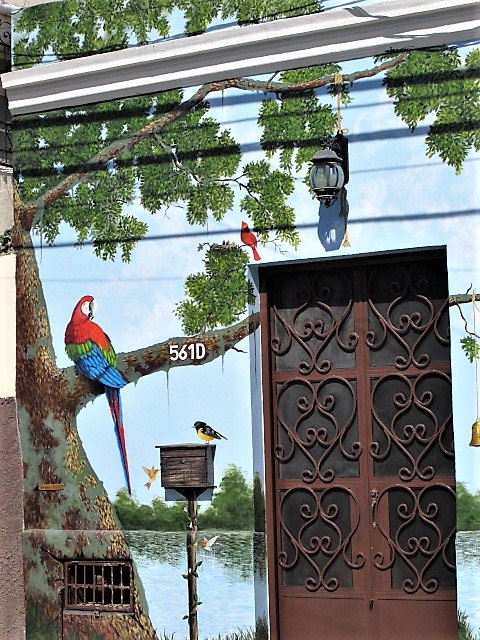
A real lure of Merida, though, is the day-to-day life here. A walk in any ordinary area can reveal treasures, like a mural turning an ordinary small house into a tropical fantasy,


 or one of children playing that carries an important message, 


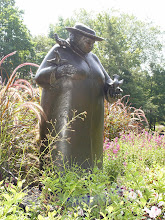
or a bronze sculpture of the spirit of ceiba, sacred tree of the Maya, out for everyone to enjoy in front of a government office tucked away on a mostly residential street.


The people are part of the magic as well. People here greet strangers on the street (rather like the Mid-Ohio Valley in Mexico, to be honest), and have no problem with elderly gringas admiring their children or their dogs. Strangers met on park benches share their stories and have thus far been totally kind despite the language barrier.  Taxi drivers share their insights and include language lessons as part of the fare. Downtown often features buskers, ranging from a truly amazing drum group to young breakdancers to living statues to a guitarist who lost his legs in a work accident in the US and shares songs and smiles in front of various theaters. A favorite example of the spirit of this place: heading back to the guesthouse, I admired the sunflowers of a neighbor who was sweeping her patio. In our mixed languages, I shared the sad information that sunflowers have a short season in Ohio and was informed that in Merida they grow todo el año porque hay mucho sol. Before I left, my new gardening buddy pressed two ripe seedheads into my hands, which I passed on to the owner of our guesthouse, who will now have sunflowers in her impressive tropical garden.


I can't not love this place.


Wednesday, September 19, 2018

Sanguisorba canadensis

Many perennials have stopped blooming by now, but in the Toledo Botanical Gardens this morning, a clump of something I did not know was working with so many bees that the stems were vibrating. 

Fortunately, the plant was labeled. It was Canadian burnet (Sanguisorba canadensis), which, contrary to its name, is found in many parts of North America, though it is rare in much of that range. As much of a wildflower enthusiast as I am, the botanical gardens are the only place I remember seeing this plant, and today I was lucky enough to see it at peak bloom.

A single glorious stem

The plant in its context in the perennial border
Burnet is in the rose family, though it looks nothing like any rose I know. While the specimen I saw is flourishing in a garden setting, in the wild it is a plant of wet prairies, meadows, swamps, and fens; it is not a plant for dry areas. The root system is woody and spreading, making it a useful plant along stream banks, where it will help hold the soil.


Moreover, our native burnet is a magnet for bees, both native species and honeybees, and its late bloom season makes it a valuable addition to the fall garden. Anyone with a damp, sunny spot should probably give it a try.

After all, what's not to like about a gorgeous plant for difficult conditions that feeds the pollinators?