About Me

My photo
I'm a woman entering "the third chapter" and fascinated by the journey.

Sunday, December 17, 2017

All is flux; nothing abides

Last year at this time, we were dealing with the slow fade of a relative in her late nineties. This year, a recent two-week period brought the deaths of a current colleague, our wonderful office manager's son, two former colleagues, and an old friend who was a fixture of the local political scene. Two memorial services were held just yesterday--a lot to take in all at once.

Spending time in this old town ("old" only by US standards, of course) is oddly comforting. Marietta got its start under that name in 1788, but several cultures have called this place home over the last few millennia. Our patio faces a street named Sacra Via (pronounced with a long "I" in these parts), or the sacred way, but the people to whom it was sacred are long gone from this area, although some of their monuments remain.

The oldest more or less intact monument is the Conus, the large Adena burial mound that, with its surrounding ring ditches, is the centerpiece of Mound Cemetery.


The Conus has not been studied by modern methods, but when the early US settlers found a skeleton buried near the summit of the mound, they chose to re-inter the bones and create their own cemetery surrounding it. Today, this perhaps-three-thousand-year-old dignitary is surrounded by the largest group of Revolutionary War soldiers to be found in Ohio, along with more modern graves.

The Adena culture was succeeded by the Hopewell, who lived in Ohio from roughly the time of the early Roman Republic to the final destruction of the western Roman Empire, a period of some 700 years. They were also serious creators of earthen monuments, as well as serious astronomers. The Turtle Mound, more formally known as Quadranou, aligns with the winter solstice sunset. It was the site of solstice observations some 1600 years ago, and for the last five, a local history group has renewed the tradition. We will be joining neighbors there this week to wait for the sun to hit just the right spot over the next hill.


Although not particularly visible in the photograph, sloped walkways led to the top of the mound and are still available for mindful walking (or childhood sledding). At the time of European settlement, an enclosed walkway led 680 feet from the Muskingum River to the mound itself, hence the name "Sacra Via."

But the sacred way was destroyed to make way for progress. Beginning in 1843, according to the sign a few yards from our house, the earthen walls, which were more than ten feet high, were removed to make the bricks that were essential to our expanding town (according to the local brickmaker who had managed to get elected to city council). Quite a few streets, probably including Sacra Via itself, are made of those 19th-century bricks, as is the Victorian Gothic church building where I attend services.

Changes. Always changes. After the Hopewell ceased to flourish, later native groups moved into our area, according to excavations at a nearby park. The Shawnee and Delaware hunted in this area and occasionally fought the white settlers, who eventually won that struggle. In the years before the US Civil War, Marietta was often the first stop for freedom seekers crossing the Ohio River from what was then Virginia. The open space below the Turtle Mound became Camp Tupper, a recruiting site for the Ohio Volunteer Infantry.

After the Civil War, Marietta underwent a building boom--probably still using bricks from all that excavated soil. The house we live in was built in the 1880s and added onto in the 1970s by wonderfully thrifty people who salvaged bricks from structures being demolished. I like to think that our brick floor and fireplace wall were once part of the earthworks: they are in just about the right place.

Through all the changes wrought by humans and the shortness of our individual lifespans, the soil is still there. Sometimes, we build with it. Eventually, we become it. That cycle seems to be constant.

Saturday, December 9, 2017

They're back, 2017 version

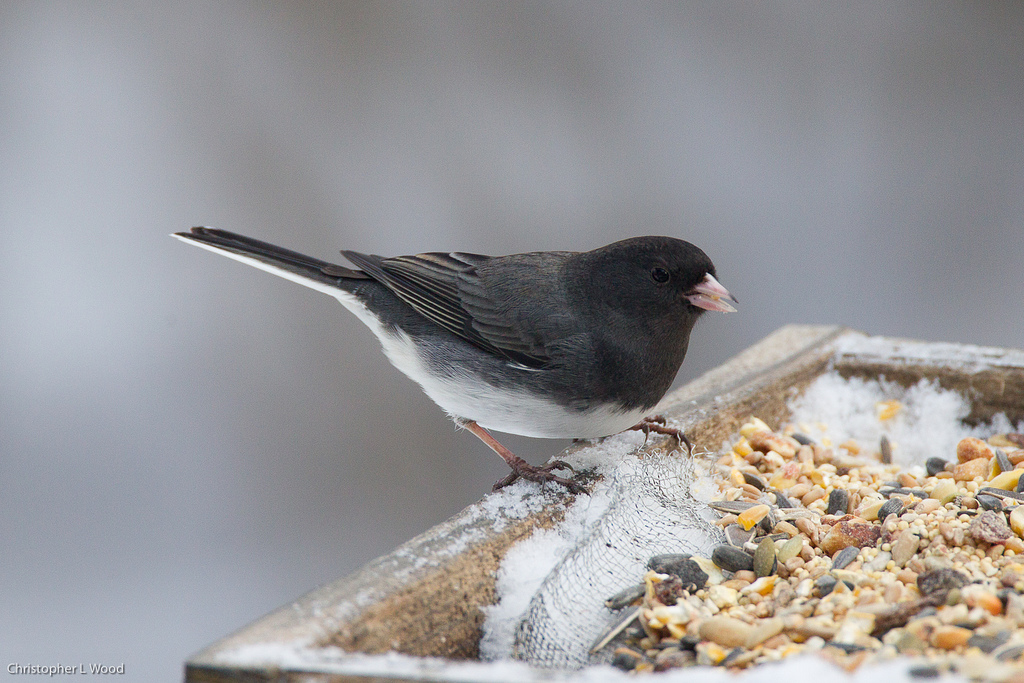
Yesterday brought the year's first dark-eyed junco, perched on the now-bare rose of Sharon hedge outside the dining room. The camera was of course nowhere to be found, but I suspect that most people in the lower 48 are familiar with snowbirds of the non-human variety. In case you aren't, here is a shot of one from the Celebrate Urban Birds section of the Cornell Lab of Ornithology website.


These handsome little sparrows spend their summers in the northwoods of Canada, then head south for the winter. While some of the humans in our part of the world might beg to differ (especially when snow is falling, as it is at the moment), significant numbers of juncos think of Ohio as the South. The junco is not the flashiest of birds, but for me, it is one of the surest signs of winter, just as the first patch of bright yellow on a goldfinch is a sure sign of the approach of summer.

Back before calendars, Google or otherwise, phenomena like these helped humans mark the seasons.

Tuesday, November 21, 2017

Still rant-ish

Today's walk found me exploring part of the Wabash Cannonball Trail, a rail-trail that runs more than sixty miles in northwest Ohio. Parts of the Wabash are segments of the North Country National Scenic Trail, but the section I walked this morning was not one of them.


Facing the other direction, the view was just as uninspiring (although I have totally come to appreciate the concept of flat places in which to walk).


To be fair, this particular section of the railroad line immortalized in the old song runs through the middle of town and is next to a popular city park, home to a playground, athletic fields, and a quite pleasant walking path along the edge of an old quarry,


but must the trail edges be mowed quite so close? As we all know, turfgrass is pretty much a biological desert.

Fortunately, most of the section I walked has been allowed to grow up, providing relatively decent habitat along the edges of farm fields, light industrial intallations, and residential subdivisions.


 This particular section was filled with hordes of little brown birds of the sorts that I can rarely identify, along with a few cardinals giving their distinctive calls.


The adjacent subdivision, taking advantage of what would certainly be a selling point for me, has created a quite nice access point for residents and others to enjoy the trail.


And then, just as I was about to get all warm and fuzzy about good neighborhood design, I discovered that every single lawn strip in the development has been planted with--you guessed it--Bradford pear, one of the worst landscape trees ever developed. And here, on the edge of the Oak Openings, one of the Nature Conservancy's Last Great Places and home to fabulous grasslands, the developers chose to plant a traffic island with Miscanthus sinensis, the horrifyingly invasive Chinese feather grass.


Grrr.

Monday, November 20, 2017

Rant alert

Shortly before sunset today, I wandered over to a favorite park to clear my head after a couple of hours spent in shopping mall hell (but one must find the right character jammies for a grandchild--there are standards to uphold). Unfortunately, my head is not what was cleared. The field between the quarry trail and the highway had been mowed.


In September, the same field looked like this.


Meadow maintenance of course involves mowing or burning to keep the area from reverting to the Great Eastern Forest it probably was at one time, but not in November.  All of those September plants, if they hadn't been mowed, would have been loaded with seeds in November. Songbirds and small rodents depend on seeds to get them through the winter. Hawks, owls, and other predators depend on a reliable supply of songbirds and rodents to get them through the winter. A naked field contains little or no food.

I know that fall and winter fields look messy and sometimes depressingly tatty, but could we not wait until the seed supply is exhausted before cutting the plants down?

Saturday, November 18, 2017

The last flower of 2017

For three years now, this aster has been the last flower blooming in our yard. This photo was taken today, November 18th, following at least one hard frost that left ice on the cars.


Have not seen any pollinators for a week or so, but this little beauty is waiting for them.

The plant has been tentatively identified as Short's aster, Symphyotrichum shortii, but plants with this flower have demonstrated a variety of leaf shapes and sizes around here, leading me to ID it variously as large-leafed aster, sky-blue aster, and arrow-leafed aster, depending on what the leaves of that particular plant have decided to do. Since all are volunteers, some in sidewalk cracks, and all are native to this area, we could have all four showing up. Or perhaps they have been getting friendly with one another, as is the way of many compositae. Who knows?


All of the plants are important nectar sources for fall bees and butterflies, as well as seed sources for birds. They are also indestructible, asking for nothing from humans save to be left alone to grow. Last year, one was blooming near the library of December 1.

It will be interesting to see how long this little guy keeps going.

Thursday, November 2, 2017

I'm lovin' it--but should I be?

It's November, and the hydrangeas in the park across the street have come into full bloom after September's drought.


The bushes in front of a neighbor's house are putting out buds.


 Fall color has been known to hang around into November, but a quick glance up the street indicates that a lot of our deciduous trees are still fully green--not a common phenomenon in my youth.


In the planting beds along the river trail, quite a few plants have rebloomed, including a spectacular echinacea cultivar,


and mandevilla is still hanging on. Mandevilla. In November. In Ohio.


This is not normal.

I am the first to confess to loving long, slow autumns. Cold makes my bones hurt, and the cold, damp, dirty air of the Mid-Ohio Valley in winter does unfortunate things to my ability to breathe. 70-degree November afternoons are a lovely thing.

But we are overdue for the first frost, which typically hits our area between October 15-20. Toledo, which generally gets its first frost by October 10, is still frost-free and had roses, heliotrope, and pineapple sage blooming last weekend. A monarch butterfly, which should have been several hundred miles further south by then, was fluttering around. That particular individual is unlikely to get to its winter home in Mexico.

Yes,I am loving all this lingering beauty, but I am not sure that these are good signs for the climate of the rest of the world.

Wednesday, November 1, 2017

The way it should be

This is what an October afternoon in the Mid-Ohio Valley is supposed to look like,


maples and assorted companions doing their ridiculously-gorgeous thing, resulting in some quite-satisfying scatterings on the grass.


Unfortunately, this was the view that many hundreds (thousands?) of people in our valley had on Saturday, October 21, when a former industrial plant used to store plastic waste caught fire.

photo courtesy of Margie Zazycki Orcutt


 This horrifying image was shot from a friend's house, several miles from the fire site. The smoke billowed for days as new hot spots burst into flame. Schools, the courthouse, and some businesses were closed for days, waiting for the fire to burn itself out and for the air to more or less clear. Agencies from two states and a volunteer citizen-science program set up air-quality monitors amid concerns over what might be in the air, since the owners of the warehouse claimed not to have complete records of what was stored in the complex. The health department urged people to keep themselves and their pets indoors as much as possible. Many people left the area for the duration. We still have no good information on what may have gotten into area streams.

Surely we can do better than this.