About Me

My photo
I'm a woman entering "the third chapter" and fascinated by the journey.

Saturday, June 16, 2012

A public good

Today I enjoyed a genuinely rejuvenating stop at a public rest area somewhere on Ohio Route 32 between Mt. Orab and Peebles. This particular rest area backs onto woods, and the great state of Ohio has seen fit to incorporate walking trails to encourage enjoyment of said woods.  Having driven two grueling hours in heavy traffic from Louisville, I was more than ready to take a break in some green space and enjoy what this pocket park had to offer.

It offered a great deal. Besides the usual clean restrooms and fountains with cold water, it had delightful diversity. Scattered around the area were beech trees that had been there long enough to grow an interesting collections of lichens and cast cooling shade on the picnic area. The birds and squirrels seemed appreciative and are probably even more so when the beechnuts develop. The edge of the path had the kind of biodiversity that defines "edge habitat" for me: maples as the tall trees, sassafrass and pawpaws (or something with that kind of leaf--I truly can't tell young pawpaws from horse chestnuts or buckeyes) in the understory, brambles that included blackberry, and a mixed collection of vines, including a large-leafed shade-loving beauty whose name I forget. And numerous azure butterflies were fluttering about--looking for violets, perhaps?

Given that both the governor and the state department of transportation would like to privatize a significant number of Ohio rest stops, let me list reasons why privatization strikes me as a bad idea:
  • The privatized rest areas along the Ohio Turnpike offer no green space. Basically, all available space is taken up with parking areas and chain restaurants all trying to sell something.
  • Imagine travelling with a carload of children. Aren't open spaces where they can run around and expend some energy better than a video arcade that demands your quarters?
  • Privatized rest areas are all about selling junk food. The current rural rest stops have quiet picnic areas and places where you can fill bottles with cold water--for free.
  • Rest stops like the one where I stopped today offer great places to give kids mini-lessons in natural history. In a five-minute walk, they could learn to identify several trees, see how raspberries and blackberries grow (and maybe even pick a few, at the right time of year), and be taught the difference between Virginia creeper and poison ivy.
The impetus for privatization comes, of course, from a shortage of funds in ODOT. The "free" water and restrooms  have to be paid for by someone: in this case, the driving public. But public amenities are a public good. I for one am happy to have my tax dollars go for beautiful, safe spaces where people can take a quiet break without worrying whether or not they remembered to bring their credit cards.

Saturday, June 9, 2012

An Interesting Mix

     This week I am in Louisville again for the reading of this year's Advanced Placement tests in English. For my particular exam, 1152 English teachers are together in one room; then another frighteningly large group of faculty are working on the literature exams. So yes, several thousand English teachers have descended on this poor city, and after nine hours in the constant company of that many colleagues, this particular introvert heads away from groups of humans, at least humans with whom I would be expected to engage in conversation.
     Fortunately, Louisville is a city in possession of an extensive waterfront and numerous pocket parks, including one directly across the street from the convention center where we read the essays written by several hundred thousand hopeful high school students. After an exploratory walk through the museum district, I found myself  ensconced on a bench in said park, contentedly observing my surroundings. The downtown areas of big cities are not my natural habitat, and being in one had me contemplating what constitutes the essence of a place.
     Louisville, I learned on my walkabout, was "discovered" by Lewis and Clark, though they of course did not stay there, and the downtown area has no evidence of any of Kentucky's early white pioneers. At street level, the structures feel modern (Postmodern, maybe? I'm not good with any artistic styles after 1920 or thereabouts), but sitting and looking up into the evening sky reveals a number of buildings with upper stories that seem much older, with the detailed cornices of the late nineteenth and early twentieth centuries. At the faraway ends of bustling contemporary streets rise church steeples that would not have seemed out of place in medieval France. Such sights delight my romantic soul.
     Downtowns have too much concrete and noise for me, but non-human life manages to exist there, too. The only birds near my bench were starlings foraging in the grass and sparrows drinking from a puddle left after plants were watered, but such brazen little avians feel appropriate in cities. Louisville of course has public plantings, highly controlled clipped boxwoods and other well-behaved shrubs, lots of urns filled with tropical color, and park areas with turfgrass where overheated AP readers can throw themselves down with their paperbacks and Kindles. But "gift plants" creep in there, too. One clipped hedge near a parking garage sported the gaudy, tropical-looking orange flowers of trumpet vine, and a concrete wall near the waterfront had poison ivy sneaking in among the parthenocissus. I'm not a fan of poison ivy, but I had to admire this specimen's gall.
   

Sunday, May 27, 2012

They're here!

I have commented before on my tendency to want what I can't have, and a creature on my want list has been the North Parkersburg Black Squirrel (Sciurus carolinensis parkersburgensis--okay, I made up the last part). While I know that the black squirrel is just a melanistic variation of an ordinary gray squirrel, I have been quite taken with the little rodents ever since I first learned of their existence a few years ago. What I learned only recently, however, is that historical biologists think that the black squirrel may have been the dominant form in the days of the Great Eastern Forest as the dark color would have given it an evolutionary advantage over its paler relatives. Deforestation and more light led to an advantage for the grays. I've seen no speculation on reasons for what seems to be a recent increase in the population of the darker squirrels.

But--at long last--the melanin-enhanced variant has found its way to our yard. This morning brought not one, but two, black squirrels racing up and down our oak trees and chasing a gray squirrel off the fence. This after the evening that had brought the return of the fireflies.

Life is good.

Thursday, May 24, 2012

Earthworms--an environmental problem?

I REALLY did not want to know that earthworms are endangering forest ecosystems in Pennsylvania, New York, and Maine. All my life, when I thought about earthworms at all, I thought of them as helpful little beings, busily aerating the soil, converting organic matter into worm castings, and fertilizing plants so I don't have to. They do those things; it just turns out that that's not all they do.

I did know (vaguely) that most earthworms are not native to North America, having been frozen out by the glaciers fifteen thousand or so years ago, save a few found in the South. Reading Charles C. Mann's 1493: Uncovering the World Columbus Created, this afternoon, I learned that some ecological historians credit (or blame, depending on your perspective) John Rolfe with introducing earthworms in quantity to our continent. Yes, the same John Rolfe who married Pocahontas and took her to England, where she promptly fell ill and died (as his first wife did when he took her to Virginia--the man did not have good luck with women). It seems that he was the first Englishman to have success with tobacco as a cash crop (yes, we can thank him for that, too) and used soil as ballast in the barrels that transported Virginia tobacco to England. When the ships landed in Virginia, they dumped English soil and English earthworms.

So why is this a problem? Most of eastern North America was forested, as much of it still is, and forests create lots of leaf litter. (Think about all the leaves raked in the fall. Pre-European settlement, those leaves tended to stay on the ground for years.) According to Dennis Burton, Director of Land Restoration at The Schuylkill Center for Environmental Education, healthy forests need their leaf litter to stay put for a while, cooling root zones, providing a safe haven for overwintering insect eggs and pupae, and decomposing slowly, gradually returning nutrients to the soil. Earthworms disrupt this cycle, churning the soil and breaking the litter down much faster than our native detritivores (and isn't that a great word?) would. Weeds sprout, and plants that need a stable forest floor (like some of our favorite spring ephemerals) decline. Without the protective cover of leaf litter, some insect species decline, leading to a decline in the number of birds. All because of feral EARTHWORMS, for goodness' sake!

Just what I needed--something else to worry about.


Monday, May 21, 2012

Today's delights

I arrived back from a week in Quebec (with students, so the trip was work, honestly) to discover (no surprise) grass that needed cutting and weeds overrunning the planting beds, so the first order of business was to clear some of the mess. This evening, however, as we ate a lovely dinner on the porch (prepared by my wonderful spouse), I was able to notice some of the positives of our messy but always lively and varied yard.  The light was fading when I finally got outside with a camera, so the picture quality isn't all I'd like, but this evening brought delights. 
This combination is one that I actually planned (what a concept), and for once the plants are blooming simultaneously: clematis "Betty Corning," the David Austin rose "Heritage," and rosa "Laguna," the last rose I bought from Wayside Gardens (nothing against Wayside, I'm just not doing a lot of roses these days).


"Heritage"

"Laguna"
Out in the meadow garden, my favorite early grass, formerly known as stipa tenuissima, is in full bloom. (I do wish the people in charge of plant names would leave them alone. My favorite asters have now migrated into a genus with a totally unpronounceable and unspellable name.)


The real delight of the day, however, was the discovery that the plant I thought was virgin's bower, clematis virginiana, had been mislabeled at the nursery. Normally, this is not a good thing, but my formerly sluggish little clematis has, in only its second year, been revealed as (ta da!) clematis viorna, a native vine that, according to the Brushwood Nursery website, blooms all summer.

Wednesday, May 16, 2012

Yes, Canada is different

I have no pictures to back up what I'm writing here, but having spent a few days in Quebec City as part of a study abroad program, I can say that many things about our northern neighbor are different. For one thing, the season here is not nearly as far advanced as it is for us in the Mid-Ohio Valley. The Roger-Van den Hende Botanic Garden here is bursting with tulips, with the teeniest of buds on the lilacs (long gone in our neck of the woods) and none at all on the iris. But the primroses! The courtyard in back of our dorm at Laval  University is filled with more varieties than I knew existed, and the botanical gardens contain even more wonders. Some of them look like alliums from a distance, while others are like nothing I'd ever seen. I doubt I'll ever try to grow them as our shade is mostly of the dry variety, but oh my.

We're also in a place where the common trees are not those we see in the Valley. This far north, the oak-hardwood forest gives way to pine, spruce, and birch (though Canada does of course contain its share of maples). One that a companion and I have wondered about is what seems to be a deciduous conifer of some kind. The bark and tiny cones resembles certain pines, but short green needles are just now growing in in tufts. We suspect larch of some kind.

But my favorite dfference is this: the parks here evidently do not weed and feed. Everywhere one looks, there are dandelions--fields, herds, gaggles of them! The Plains of Abraham and the grounds of the Citadel are covered with their sunbursts. Forget "dent du lion"; these babies are pure sunshine--and given how much it's rained since we got here, that's a good thing.

Friday, May 11, 2012

Current blossoms


May is generally a good month in the garden, but this is an odd May. The last daffodils finished just last week, the first having opened in mid-March. The few tulips we have were done in a single April week, and the irises, usually Memorial Day flowers, are closing in on the end of their season. And the early daylilies have flower stalks and buds--WAY too early! But the May flowers have indeed arrived, so herewith, a sampling of yesterday morning's offerings:
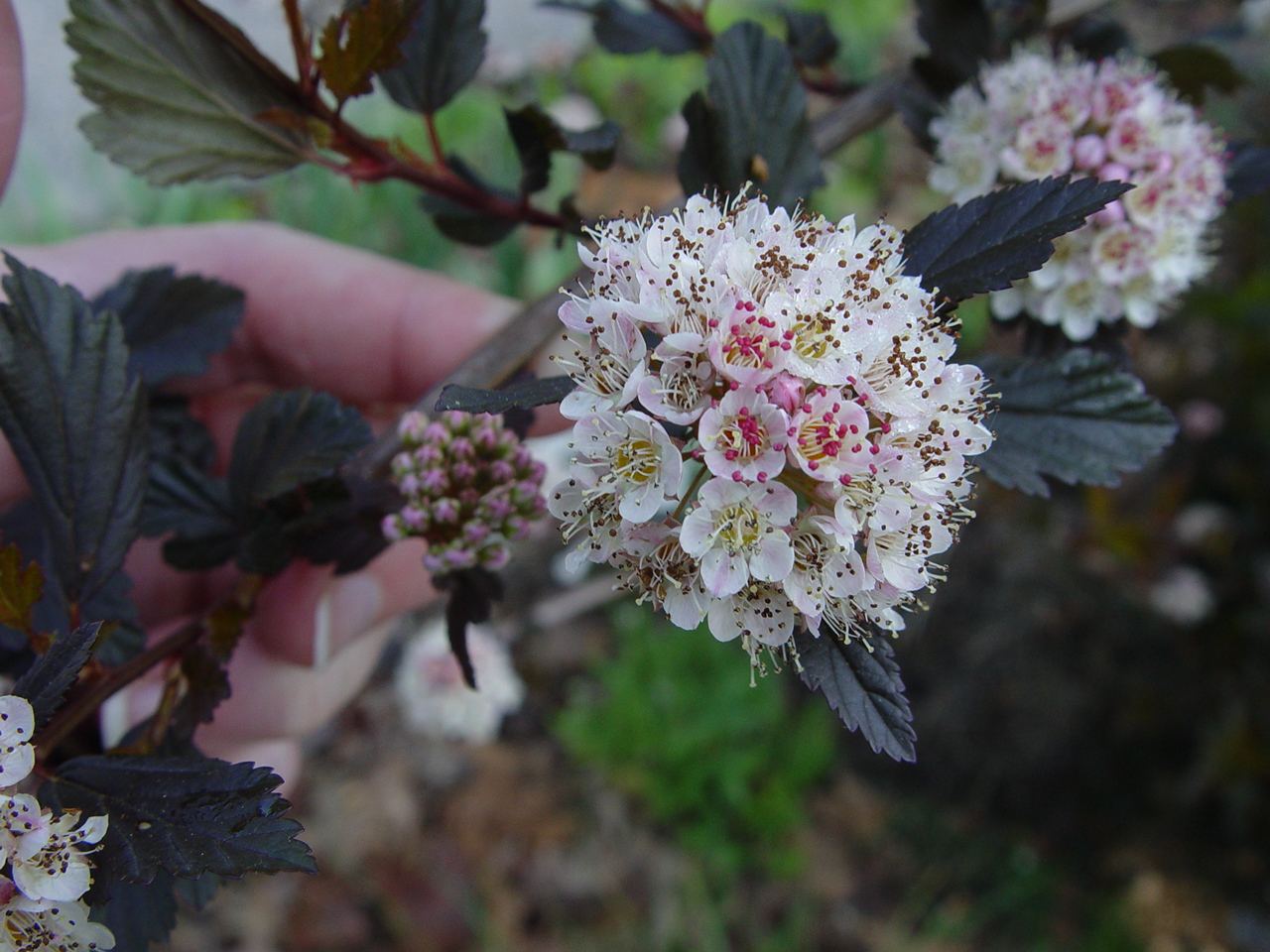
Physocarpus "Summer Wine" (detail below)


creeping thyme 

Kenilworth ivy


and clematis "Betty Corning." Some irises are still with us, 
along with a last Oriental poppy. 
 
And the roses are coming on. While the bush barely survived its transplanting last summer, "Dortmund," though dwarfed, is blooming, as is (drum roll, please)     
Madame Isaac Periere! (Ignore the black spot: it has been a VERY wet spring.)