About Me

My photo
I'm a woman entering "the third chapter" and fascinated by the journey.

Thursday, August 30, 2018

Darling Dahlias

The title of this post comes from a charming mystery series by Susan Wittig Albert, featuring members of a ladies' garden club in Darling, Alabama, during the Great Depression. Dahlias are not a major feature of the books, just the name of the club, but today the dahlia bed at the Toledo Botanical Garden became the center of my attention for a while.


Dahlias are not plants that I have grown much (anything that requires staking, regular feeding, and digging up in the fall not being something that is likely to live long in my yard), and these beds are not the sort of garden that generally appeals to me, but some days, you have to love sheer exuberance, and that is something that dahlias have.


Where does one even begin to describe such a ridiculous explosion of a blossom? Dahlias have come a long way from the daisy-like wildflowers "discovered" in the mountains of central Mexico in the seventeenth century (though flowers similar to wild species are available to gardeners in the US). Today's dahlias come in a range of heights, shapes, and bloom sizes, from miniatures that hug the ground to plants taller than my 5'6".


This gorgeous thing is called "Spartacus."


The dahlias to which I am drawn tend to be the gaudy ones, dahlia genes allowing for a greater variety of petal shapes and flower forms than most plants. The old-fashioned daisy shapes and the two varieties above are just a few of the existing dahlia types. Some form nearly round pompoms


while others grow quilled petals


and some put their energy into making their fertile flowers the eye-catching part of the blossom. (No, those large petals that draw the human eye are not the business end of a flower, which is, after all, a sex organ. The important parts are often the tiny, inconspicuous ones.)


Looking at some of the blooms on display had me wondering how these things get pollinated. More importantly, do they do anything for pollinating insects? On many of the blossoms, nothing that resembled a stamen or a pistil is immediately observable, though the plants are obviously managing to reproduce. 

Looking closely, I did finally manage to see a few insects drawn to the plants, some tiny black things in this pale yellow giant,


something on the petals of this red collarette type,


and finally, a bee finding something to her liking.


Our cultivated dahlias are unlikely ever to be major players in a wildlife garden, but once in a while, there is something to be said for pure fun.

Tuesday, August 28, 2018

Underestimating meadows

When most people think of dramatic landscapes, mountains or deep forests probably come to mind. A few may envision the wide-open spaces of the midwestern prairie, but I doubt that many people automatically get excited about the smaller patches of grassland we call meadows. (A young relative once referred to our meadow planting as "a weed bed.") A healthy meadow, however, is a thing of subtle beauty and, more importantly, a small-scale biodiversity hotspot.


This meadow, part of Wildwood Preserve in Toledo, was livelier this morning than either the trail through the floodplain forest or the Window on Wildlife this park uses to lure birds and other creatures close enough for easy observation. Because the bur oak on the edge of the meadow is one of my favorite trees, I generally take advantage of a well-placed bench to sit and commune with this old tree that I sometimes call the Prairie Sentinel (even though this area is not technically prairie as it is not dominated by tall warm-season grasses).

The most noticeable creatures were the goldfinches that seemed to be alighting in droves on every patch of thistle. This particular plant,


which looked perfectly ordinary to my human eyes, at one point had four male goldfinches (and probably a female or two that I did not see, seated as I was some distance away) darting in and out, as well as two hummingbirds (at the same time--not typical behavior for these aggressively territorial little birds), bees of various species, and several hummingbird moths.

The sea of goldenrod (which actually contained at least three species of Solidago) was providing hospitality to hordes of monarch butterflies, tanking up before their long migration to a Mexican forest they have never seen. Sulfurs, whites, and skippers were abundant, and one lovely ailanthus webworm moth was hanging out right next to the trail.


Yes, that little creature is a moth, and its caterpillars eat the ironically-named tree of heaven, so even though the extension of its range (formerly the American tropics from South Florida to Costa Rica) may be a troubling sign, any insect that will eat a noxious weed of a tree is in my estimation a good bug.

Goldenrod was not the only flower blooming today. Ironweed was going strong, accompanied by asters just starting to bud, a few liatris hanging on, and numbers of smaller, more subtle blooms interspersed among the dominant yellow. And while they were not noticeable, the grasses were there, sending their roots down several feet into the soil and helping to create the soil matrix that is the basis for all other terrestrial life. Some bird species require landscapes like this one, nesting on the ground and depending on the thick vegetation to protect their young and provide the insects that will feed them. Even birds we normally associate with trees make use of grasslands. Today, this scruffy cardinal (either molting or a particularly unfortunate adolescent male just getting his adult coloration) spent a good bit of time calling from the shrub dogwoods that form part of the edge between Wildwood's meadow and forest areas, then more time investigating the seed selection in the meadow plants.


Meadows may not get much press as exciting places to visit, but they should not be underestimated. Spending a little time in a meadow reveals much more than is visible at first glance.

Sunday, August 19, 2018

A marsh reborn

Definitely not the stately home of E. M. Forster's classic novel, Howard Marsh is the newest Toledo metropark, which opened just this year. Formerly Howard Farm, the 1000-acre property has been restored to a functioning wetland adjoining Metzger Marsh and not far from the Ottawa National Wildlife Refuge and warbler wonderland Magee Marsh. The park boasts a quarter-mile boardwalk and several miles of hiking and kayaking tails.

Because the park is so new, I wasn't sure what to expect, and at first sight, it is not immediately awe-inspiring.


The trees are youngsters, still needing protection from browsers, and most of the grasses are European, but the old farm is definitely coming back to life.

They were too far away for photography, but the entrance pond was hosting a number of waterfowl, including one of my favorites, the American coot with its ridiculous-looking white feet. Ducks were everywhere, as were seagulls which, as seagulls do, were taking advantage of human-made structures. This one seemed to have something to say about everything.


 Great egrets were everywhere, indicating that the fishing in the marsh is already pretty good, at least by their standards.


For those who enjoy peaceful landscapes, the views are already worth viewing,


and lots of life was happening everywhere.

This particular blob of floating muck (some sort of aquatic vegetation)


was the site of a lot of activity by a variety of small creatures, with life and death dramas being played out by dragonflies and whatever the tiny silvery things were--tadpoles, maybe?


Perhaps the most exciting resident of Howard Marsh, however, is one of which I did not get a good look, although my binoculars were strong enough to confirm that ospreys were indeed using the osprey platform. I suspect that these apex predators of the marshlands will be increasing their numbers.

This old farm, reborn as newly-protected wetland, is likely to make the western shore of Lake Erie even more of a wildlife mecca than it currently is. Kudos to the visionaries of the Toledo Metropark system for their ambitions plan to have a metropark within a five-minute drive of every county resident.


Sunday, July 29, 2018

Going Wild

at The Wilds, a wildlife preserve (now part of the Columbus Zoo) that has turned a former strip mine in southern Ohio into a breeding facility for endangered species, like these Southern white rhinos. The Wilds' breeding program has, in fact, been so successful that it is the only place outside Africa where fifth-generation rhino calves have been born.


While ethical arguments have been made against zoos and captive breeding, the heartbreaking truth is that some animals are now extinct in the wild and exist only because teams of scientists cared enough to breed them before they disappeared. These Pere David's deer are just one example.


To those unfamiliar with the history of this region of Ohio, The Wilds look, well, wild, with most of the facility's 10,000 acres consisting of rolling grasslands that resemble a romantic's idea of the primeval savanna. 

The reality, of course, is different. With so many rare and endangered species from various regions, The Wilds has extensive fencing, since those animals need to be protected from predators, human and other. (It would not do to have the cheetahs taking down the antelopes, as cheetahs are wont to do.) And southern Ohio is not sub-Saharan savanna. Prior to being strip-mined, this acreage was eastern hardwood forest, part of the tree cover reputed to have been so dense that a squirrel could travel from Pittsburg to Cincinnati without touching the ground (not that either city existed in those days). After strip-mining, it was a moonscape.

To be fair to AEP, the property's former owner, the company did what was legally required as reclamation. In the 1950s, it planted trees to cover the land's scars. Later, when recreating the site's "approximate original contours" was mandated, earth-moving equipment was used to shape the gentle hills we see today, and pasture grasses were planted. Both sections look reasonably decent. The browsing animals being reared here make good use of the pasture areas, and a surprising number of those trees have survived, hiding the cliffs left when the original hills were gouged for coal. But there are (at least) two problems: cool-season pasture grasses are not native to North America and do a lousy job of promoting biodiversity on this continent, and most hardwoods require a deep, rich soil to thrive. The dirt left after mining does not meet this criterion. As soil scientist Nicola Lorenz demonstrated on the day I visited The Wilds, much of this vast tract now consists of red or yellow clay subsoil covered with an inch or less of actual topsoil containing organic matter.

My visit to The Wilds was occasioned by its hosting of the Ohio Prairie Conference, which is generally held in one of the western counties of Ohio's prairie region. The Wilds was chosen as the site for this year's conference because, a few years ago, the facility's restoration ecologists began converting sections of the not-great pasture to native prairie. The results are impressive


especially when the floral diversity of the prairie areas is compared with that of the pasture-grass areas.


The prairies at The Wilds include gorgeous Ohio natives, like cup plant


and blue vervain,


which was blooming both in the prairie plantings and near the wetland, where it partners nicely with rose mallow, or wild hibiscus.


Prairie plants are not just beautiful; most have deep roots that can break up clay soil, and their annual dieback increases the organic matter needed on this disturbed land while sequestering the carbon that would otherwise contribute to climate change. They help control runoff and, perhaps more importantly, some species absorb the toxins present on a site like this.

The plant diversity introduced in the restoration has resulted in increased animal diversity. Uphill from the flowers pictured above, beavers have moved in and are busily re-engineering the landscape. Grassland birds have returned and are nesting among the prairie plants. Bees and butterflies were everywhere on the day of the conference, and the amphibians and small mammals have returned. And while not everyone will be thrilled by this development, native snakes have found their way to the site and are breeding in the prairies, as demonstrated by this very pregnant garter snake, found thermo-regulating herself under one of the sheets of corrugated metal (sneakily installed for the purpose of encouraging snakes to visit places where they can be documented).


Most visitors to The Wilds go there for the exotic animals, which are impressive, but it is good to know that this former strip mine is once again becoming a part of Wild Ohio.

Tuesday, July 3, 2018

The wealth of the kingdom

I have never been sure why the name monarch got assigned to the butterfly that bears it, since Danaus plexippus is neither the largest nor (to my eye) the most beautiful of North American butterflies, though it may have the most compelling story. But it has the name it does, and the metaphor of royalty works in its case.

A trailside sign in Lucas County's Blue Creek Conservation area notes that the park system "take[s] this prairie to the bank," since it serves as a major seed nursery. To mix metaphors, for monarch butterflies, this just-out-of-town restored prairie is a palace where a feast is being held.


While no monarchs would get close enough to be photographed, this field was full of them, nectaring and (I suspect) looking for places to lay eggs. Some prime spots had already been chosen.


"Weedy" areas are essential habitat for a variety of creatures. This particular prairie patch (and that is what it is: a hundred years ago, this area was home to an active limestone quarry and a prison farm) hosts not only butterflies but several bee species, field sparrows, finches, blackbirds, raptors, rodents, and, next to the old quarry, a variety of dragonflies, damselflies and at least one great blue heron.

To most humans, this conservation area may not look like much, but to many other creatures, places like this are some of the wealthiest "kingdoms" imaginable. They even have monarchs.


Saturday, June 30, 2018

Pollinators and Puddlers

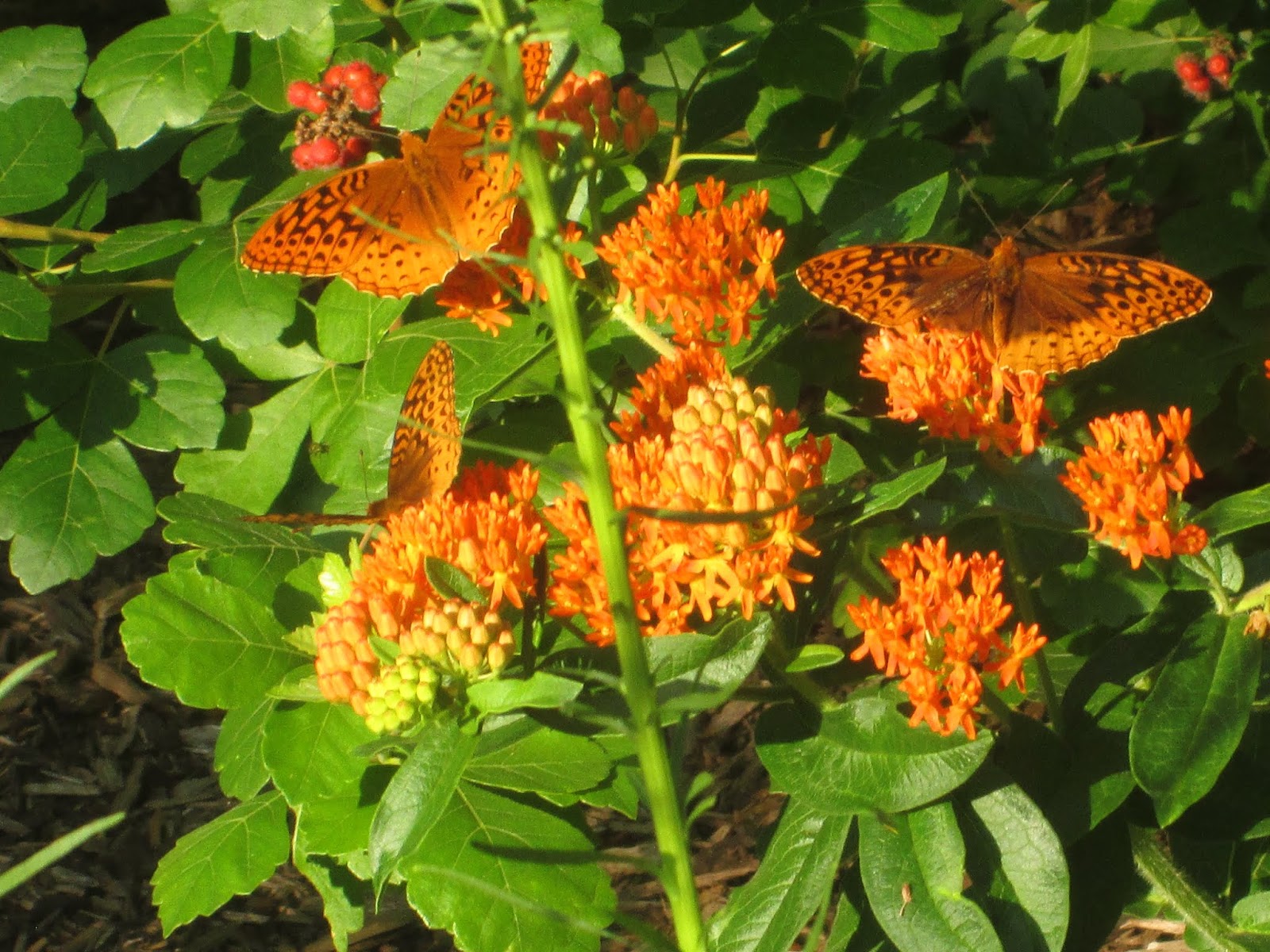
Today was a good day for insect observation. Most obvious were the fritillaries found everywhere a patch of any sort of milkweed could be found,


but the skippers were also out in abundance.


I do find their little club antennae ridiculously cute. 

The rain garden at Mallard Lake in Oak Openings Metropark is becoming an insect magnet. Created  to capture runoff from a parking area, 


it is hardly pristine habitat, and yet habitat it definitely is. 


In just a few minutes of watching, I observed not only fritillaries and skippers but several kinds of bees and wasps, some of them new to me. The plants were nothing out of the ordinary, an assortment of the yellow daisies ubiquitous to Ohio summers and a swath of small-flowered thistle, all of the clumps working with pollinators going about their business. The takeaway: if you plant it, they will come.

This was also a good day for puddling pollinators, though the boys I saw were using an area where the gravelly sand appeared dry (and visibly-damper paths were nearby). Still, this battered fritillary (out of whom someone seems to have taken a bite)


and this sootywing were finding something to their liking.


In nature, there is evidently something for everyone.

Friday, June 29, 2018

Another reason to love milkweeds (as if we needed any)

I suspect that by now nearly everyone knows about milkweeds and monarchs, though far too many people still shy away from plants that have "weed" as part of their common name, and Aesclepias syriaca does indeed have a tendency to spread itself around. In my downtown yard, wandering monarchs have to make do with swamp and butterfly milkweeds, which thus far have exhibited no expansionist tendencies. But monarchs are not the only gorgeous insects with a fondness for these plants.

This morning, the common milkweeds along the multipurpose trail at Oak Openings Metropark were being mobbed by great spangled fritillaries, often several on a single bloom cluster.


I have learned that this behavior is common in this particular butterfly, which seems to enjoy sharing meals with friends, but the sight of gaggles of orange butterflies making use of swaths of pink poofy blossoms is an impressive one (not that my point-and-shoot has enough zoom to get details of the gaggles--you will need to do your own meadow-strolling for that). The larvae of this handsome butterfly eat violets, but the adults definitely like their milkweed nectar.


Male fritillaries are reputed to enjoy the occasional snack of dog poop, but none was on offer today.