About Me

My photo
I'm a woman entering "the third chapter" and fascinated by the journey.

Sunday, February 23, 2020

Loving this plant

Could Turnera ulmifolia be a perfect plant, at least in its native range of the American tropics? (Unfortunately, it is listed as invasive in places to which it has been introduced, for precisely some of the attributes that make it a great plant in places like the Yucatan peninsula and southern Florida.) Its bright yellow flowers and serrated leaves certainly are eye-catching and lovely.


It grows in poor soil, even salty sand--and pavement cracks. Turnera is one of the first plants to show up after a hurricane due to the wide seed dispersal brought about by ants (and enthusiastic seeding) and helps to rebuild coastal dunes.


Given its habit of growing in waste places, it would seem to have a fair amount of drought tolerance, and it absolutely asks for no supplemental feeding. I have never seen a specimen battling any sort of fungal disease, despite some of the humid places in which it grows. Much less fussy than yellow roses, it blooms all year and is self-cleaning.

Even better, pollinators love it. 


In parts of the Caribbean, it is known as "ramgoat" in part because of its supposed popularity with that ungulate species. (But don't goats eat nearly anything?) Personally, I prefer its other common names, Cuban buttercup or yellow alder.

Unsurprisingly for a widespread, easy-to-grow plant (which we will not call a weed), Turnera ulmifolia has a long history in herbal medicine. It has been used as both an antibiotic and an anti-inflammatory, with some recent research indicating promise in the treatment of certain drug-resistant bacteria. Tea made from the leaves was used to treat anxiety and depression.

And something I learned from the "Plants of Love" exhibit at the Merida botanical garden: some traditional cultures used the plant as an aphrodisiac. Bright and beautiful, good for the birds, the bees, and the humans, thrives even in difficult situations--that does sound a bit like love, doesn't it? 

Sunday, February 16, 2020

This tree needs a better name

I have fallen in love with Pseudobombax ellipticum. I use the scientific name because the closest thing it has to a common English name, shaving brush tree, is, if not already meaningless, on its way to becoming so. When is the last time anyone you know used an actual shaving brush? And besides, the spectacular flowers bear little resemblance to any shaving brush that I have ever seen (of which, admittedly, there are not many). If I were to name the tree after a technological artifact, I would probably call it the fiber optic tree due to its showy stamens (though people in Mayan villages would probably not find that name particularly useful as a descriptor, either).


Photo courtesy of David Mitton

One of the Aztec names for Pseudobombax is Xiloxochitl, or "cornsilk flower," which at least makes sense. An old Spanish common name was more romantic: cabellos de angel, or "angel hair." Whatever you call the plant, it is gorgeous, and when it reaches full size (which under optimal conditions can be more than fifty feet), absolutely show-stopping.

This is a tree of semi-arid regions with poor, shallow soils, though it will flourish in regions with more regular rainfall. It is not cold- tolerant, so outside its native range of southern Mexico and Central America, it must be container-grown and brought indoors in the winter. In Yucatan, however, this deciduous tree begins blooming during the Nortes of January and continues for some time, with its outrageous pink or white blossoms putting on quite a show against the bare branches.

Like most flowering plants, though, Pseudobombax is not just pretty. It is a nectar source for hummingbirds, orioles, and a number of tropical insects, including the threatened Melipona bees. At one time, the wood was used for carving and the kapok fibers from the tree's seed pods as stuffing for pillows. In traditional medicine, a tea made from the blossoms was used to treat fevers and coughs, perhaps not surprising as the plant is now classified as a member of the Malva family, like the hibiscus used in a number of herbal teas.

And humans being what they are, the ancient Maya reportedly managed to make an intoxicating beverage from the tree. I have not seen a recipe for this concoction, suggesting that perhaps one should not attempt its production at home.

Saturday, February 8, 2020

Not just a pretty face

On a recent beach meander, I ran across a lovely plant with which I was unfamiliar (not surprising, given that my natural habitat is southeastern Ohio, USDA hardiness zone 6, nowhere near the tropics).


Turning to that treasure trove of wisdom known as the internet, I soon discovered that this beauty is variously known as Heliotropum, Argusia, Tournefortia, or Mallatonia gnaphalodes.  (Don't you love the way botanists keep reclassifying things? Don't get me started on what has happened to the plants formerly known as asters.) Given that the average person is unlikely to remember or pronounce any of those names, the plant is also called sea lavender or sea rosemary, though it is unrelated to either of those mint cousins or to the Limonium also known as sea lavender. Instead, this plant is in the borage or forget-me-not family.

The flowers are tiny but intricately beautiful.


More important than the plant's beauty, however, is its function. This is one of those wonderful spreading shrubs that will root when touching the ground, making it easy for home gardeners to propagate--or, in its native coastal dune habitat, making it a good plant for erosion prevention. Yes, this sweet little thing helps to stabilize dunes and keep the beach from washing away.

Sea lavender (or whichever of its names we decide to use) is also a major nectar source for butterflies, as a close-up of its blossoms would indicate.


The purple shading and shallow crevices are nectar guides, helping pollinators find their way to the good stuff, and ensuring the next generation of both pollinator and plant.

Beautiful and useful: what's not to like?

But an addendum: this is a place-bound shrub. My reading indicates that planted even a few miles inland from its coastal habitat, it is prone to disease. But good news for South Florida friends: it is native to the coasts of your region and is often available from native plant nurseries. Given that it is endangered in Florida (though seemingly common in Yucatan), including it in beachside gardens would seem to be a good idea.

Tuesday, February 4, 2020

Progreso gets it right

This year, my beach getaway is Progreso, the largest town on Yucatan's Emerald Coast. 


I had known that Progreso is seeking Blue Flag certification, working toward "pure water, clean coasts, safety and access for all," but I had not realized the progress (no pun intended) that has been made.

I enjoyed Progreso the first time I visited in 2017, but it felt a tad scruffy in those days--dense crowds downtown, buildings in need of paint, insufficient signage (or perhaps just a confused tourist). Today, everything is spruced up, with the current mayor personally taking part in beach clean-ups, encouraging citizen participation, increasing environmental education, and stressing the empowerment of women in personal and civic life. (I had to throw that last one in because it was part of his election platform--and he is a member of the conservative party here!) And while some area beaches are trash-strewn, Progreso's beaches are the cleanest I have seen since my long-ago childhood on Florida's Gulf coast. Most of the beach entries have been made pedestrian-only, with trash cans to facilitate cleanup and seats to promote lingering.The malecon (boardwalk, even though it's actually a concrete path) is lined with seating, and swings have been placed at various points along the beach.


Public art is popular, some of it with a definite sense of humor,


and some of it carrying a serious message, like this mural near a children's play area


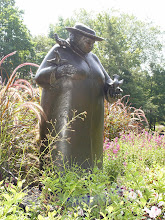
or this sculpture near the Peace Park.


The area called the International Malecon (and I have no idea why this one is more international than the other end, home to numerous shops and restaurants) boasts separate paved trails for bicyclists and joggers (though I saw many more walkers and strollers than joggers on Sunday morning, despite the triathlon event taking place beyond the pier). 


And it is not only the needs of bicyclists and joggers being considered here: the eastern edge of the malecon has been upgraded to be accessible to the mobility-impaired, creating a playa para todos, as the sign says.


Inclusion even includes a water wheelchair, something I had never seen before, free for borrowing.


Perhaps the most impressive thing about Progreso's beach from my perspective, however, is the serious effort at preservation. Not only are there sculptures and murals with a message, whole sections of the beach have been given over to native vegetation, with spaced walkways to allow beach access without damage to the dunes. 


This lovely thing is ciricote, which makes a tallish tree and produces edible fruit.


Even the tiny dinosaurs like this beach.


Progreso, you are officially one of my favorite places. 


Tuesday, January 28, 2020

Marvelous Melipona

We all love bees, right? Well, perhaps not those of us allergic to bee stings. Individuals with that problem might do well to spend more time in the region known as the Mayab, since this swath of the American tropics is home to honeybees that do not sting, members of the genus Melipona.


These little pollinators have been cultivated by the Maya for thousands of years, their honey prized for its medicinal as well as culinary properties. Bees were so important in classical Maya culture that deities were associated with them, and if a bee were accidentally killed during honey extraction, it was carefully buried.

Melipona are cavity nesters, and Maya beekeepers kept logs with melipona colonies outside their homes. This bee palapa (or meliponaria) is in the Roger Orellana Botanical Garden in Merida, Yucatan.


Every so often, a shaman blesses the bees and makes (more or less) traditional offerings that include tobacco and tequila.


Unfortunately, these bees, like many of their cousins worldwide, are in trouble, experiencing population declines in their native range. Some of the decline is due to the commercial keeping of Apis mellifera, the European honeybee. Melipona do not store their honey in combs but in wax tubes, making harvesting an exacting process. They also produce much smaller amounts of honey than do European honeybees, which (I am told) are easier to work with

A likely greater contributor to the bees' troubles is habitat loss. The Yucatan peninsula is undergoing rapid development, with the population of Merida predicted to increase by a third over the next decade. This development has led to deforestation, with the scrub forest of much of the region giving way to high rises and modern roads. Concrete does not contain much nectar or pollen. This rapid and too-often-unplanned development is threatening more than bees: a decline in insect populations has led to a decline in bird populations, and loss of pollinators is endangering some plant species that depend on insect pollination.

Gardeners in the Yucatan (like those in the US) also tend toward a preference for showy flowers, but the plants adapted to the thin soils and dry conditions here often have inconspicuous flowers. I was probably in my forties before I realized that palms bloomed


and only in the last few years noticed the insect activity in those bloom clusters. In the Yucatan, something is blooming year-round, but the blooms do not always seem garden-worthy. Fortunately, there is a native-plant movement here as there is in the States, and gardeners can play a role in providing habitat for these important pollinators. Choosing locally-evolved plants for the garden and leaving wood for nesting sites can slow--or reverse?--the decline in Melipona populations.

After all, what's not to like about a creature that aids in flower reproduction, makes fabulous honey, and doesn't sting? And that face!


But a warning: these little gals may not sting, but they will bite if their nests are threatened. Yet another reason to let them be.


Friday, January 10, 2020

Es lo mismo

      "Es lo mismo." (In English, "It's the same.") I find myself saying that a lot these days as I learn about the work of CICY (the Centro de Investigación Cientifica de Yucatan) and the Roger Orellana Botanical Garden, where I will begin leading tours later this month. The garden, founded in 1983, lists environmental education and the promotion of native plants as part of its mission, and its horticulturalists have their work cut out for them.
      When most of us hear the term "botanical garden," we expect a floral wonderland. (I am guilty of making this assumption.) However, this part of the Yucatan Peninsula has two basic seasons--wet and dry. Not surprisingly, most plants prefer not to bloom during the dry season, which is well over half the year (and the time when most of the international visitors come, since the weather is cooler). The garden's public entrance is lovely even in January, but subdued by many people's standards. (As is typical of gardens everywhere, I am being told, "Oh, but you should see it when. . . ")


      The scientist-founders of the garden set aside the central portion of this former henequin plantation as an experiment in natural succession to see what remained in soil degraded by decades of intensive cultivation (though henequin, fortunately, is a tough member of the agave family that does not require chemical inputs to grow in Yucatan, so the soil at least has not been contaminated by agricultural chemicals). What has grown in the last few decades has been a native selva seca, or dry forest, an ecosystem type that once covered much of northern Yucatan. Even though the entire  botanical garden with its multiple collections covers less than six acres, 85 species of birds and 96 species of butterflies have been documented here.


      This Yucatecan version of what would be old-field succession in eastern Ohio has the same PR problem as the northern version: i.e. lack of appreciation. While the term "trash tree" has no Spanish or Maya equivalent, the director of collections lamented that most people here have no love for this lively and biodiverse forest type.  Deforestation over much of the peninsula has caused serious population declines in a depressing number of plant and animal species, a problem shared north of the border.
      As is typical in the US (and perhaps everywhere), exotic plants are more common in nurseries and home gardens than natives are. Of course, palms from Indonesia are more exciting than any of the twenty species of palms that grow wild in Yucatan, just as English roses and Asian hydrangeas are found in more US gardens than native beauties like buttonbush and Hydrangea arborescens. One way that CICY attempts to combat biodiversity loss is its annual plant sale. Clarisa Jimenez, the garden's assistant director, states that one of the program's goals is to have at least one native species in every yard in Merida, and to that end, prices are kept low.


Prices on these lovelies begin at the equivalent of US $2.50, with six-foot palms going for less than $10. As happens at our local plant sale, bargain-basement prices do result in good plants finding new homes.
      It turns out that people in Yucatan have other traits in common with people in our neck of the woods, not reading signs among them. A not-particularly-stable limestone cave on the property has had to be fenced off to keep visitors from exploring and possibly causing a collapse.


Signs next to the aquatic garden clearly state not to feed to turtles, fish, or birds. But people do, dropping bread into the water in quantities far greater than the critters (who should not eat bread anyway) can eat, with the result that most of the water lilies that used to cover the entire water garden died from the contamination.

      People. Evidently, the same everywhere.


Wednesday, January 1, 2020

Local Wildlife in Merida

Today has been el dìa de los insectos. Being aware of the likelihood of afternoon heat, I opted to close my windows before heading out for the day, a process that in this particular guesthouse involves lifting a portion of screen. Unfortunately, sometime yesterday a colony of wasps had, unbeknownst to me, chosen to build a nest on the window ledge and did not take kindly to the disturbance. Fortunately, I escaped with only one sting, and this variety of Yucatecan wasp is not particularly venomous--nothing compared to Ohio's yellow jackets. (The wasp colony is no longer present.)

Being thus reminded that I am currently in the tropics, I purchased a botanical insect repellent before returning home, ready for an interval of reading in the garden. Needless to say, the spray missed a spot or two, and the mosquitoes found exactly those spots. Fortunately, the same garden that is home to the mosquitoes (despite efforts to leave no standing water and the like) is also home to some lovely butterflies--not that they would hold still to be photographed.

Then this evening, I discovered that a nearly-microscopic species of ant had discovered a way into a just-purchased package of tostadas. Tomorrow will involve the purchase of plain tortillas to be stored in the refrigerator (a place not conducive to crisp baked goods) and a supply of ziplock bags. The contest with the little beasts will be won.

A stroll to the city's main plaza revealed some more exotic wildlife,


like this camel that formed part of the municipal Nativity scene.

Other creatures at the Bethlehem stable would be right at home on a Mexican farm.


And the ubiquitous European rock doves (aka pigeons) were making themselves right at home in the hay the plaster animals were not using,


totally ignoring the rampaging elephant a few feet way.


Would that all creatures would coexist so peacefully.