About Me

My photo
I'm a woman entering "the third chapter" and fascinated by the journey.

Tuesday, February 4, 2020

Progreso gets it right

This year, my beach getaway is Progreso, the largest town on Yucatan's Emerald Coast. 


I had known that Progreso is seeking Blue Flag certification, working toward "pure water, clean coasts, safety and access for all," but I had not realized the progress (no pun intended) that has been made.

I enjoyed Progreso the first time I visited in 2017, but it felt a tad scruffy in those days--dense crowds downtown, buildings in need of paint, insufficient signage (or perhaps just a confused tourist). Today, everything is spruced up, with the current mayor personally taking part in beach clean-ups, encouraging citizen participation, increasing environmental education, and stressing the empowerment of women in personal and civic life. (I had to throw that last one in because it was part of his election platform--and he is a member of the conservative party here!) And while some area beaches are trash-strewn, Progreso's beaches are the cleanest I have seen since my long-ago childhood on Florida's Gulf coast. Most of the beach entries have been made pedestrian-only, with trash cans to facilitate cleanup and seats to promote lingering.The malecon (boardwalk, even though it's actually a concrete path) is lined with seating, and swings have been placed at various points along the beach.


Public art is popular, some of it with a definite sense of humor,


and some of it carrying a serious message, like this mural near a children's play area


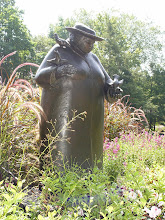
or this sculpture near the Peace Park.


The area called the International Malecon (and I have no idea why this one is more international than the other end, home to numerous shops and restaurants) boasts separate paved trails for bicyclists and joggers (though I saw many more walkers and strollers than joggers on Sunday morning, despite the triathlon event taking place beyond the pier). 


And it is not only the needs of bicyclists and joggers being considered here: the eastern edge of the malecon has been upgraded to be accessible to the mobility-impaired, creating a playa para todos, as the sign says.


Inclusion even includes a water wheelchair, something I had never seen before, free for borrowing.


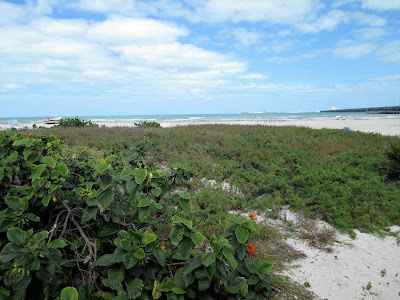
Perhaps the most impressive thing about Progreso's beach from my perspective, however, is the serious effort at preservation. Not only are there sculptures and murals with a message, whole sections of the beach have been given over to native vegetation, with spaced walkways to allow beach access without damage to the dunes. 


This lovely thing is ciricote, which makes a tallish tree and produces edible fruit.


Even the tiny dinosaurs like this beach.


Progreso, you are officially one of my favorite places. 


Tuesday, January 28, 2020

Marvelous Melipona

We all love bees, right? Well, perhaps not those of us allergic to bee stings. Individuals with that problem might do well to spend more time in the region known as the Mayab, since this swath of the American tropics is home to honeybees that do not sting, members of the genus Melipona.


These little pollinators have been cultivated by the Maya for thousands of years, their honey prized for its medicinal as well as culinary properties. Bees were so important in classical Maya culture that deities were associated with them, and if a bee were accidentally killed during honey extraction, it was carefully buried.

Melipona are cavity nesters, and Maya beekeepers kept logs with melipona colonies outside their homes. This bee palapa (or meliponaria) is in the Roger Orellana Botanical Garden in Merida, Yucatan.


Every so often, a shaman blesses the bees and makes (more or less) traditional offerings that include tobacco and tequila.


Unfortunately, these bees, like many of their cousins worldwide, are in trouble, experiencing population declines in their native range. Some of the decline is due to the commercial keeping of Apis mellifera, the European honeybee. Melipona do not store their honey in combs but in wax tubes, making harvesting an exacting process. They also produce much smaller amounts of honey than do European honeybees, which (I am told) are easier to work with

A likely greater contributor to the bees' troubles is habitat loss. The Yucatan peninsula is undergoing rapid development, with the population of Merida predicted to increase by a third over the next decade. This development has led to deforestation, with the scrub forest of much of the region giving way to high rises and modern roads. Concrete does not contain much nectar or pollen. This rapid and too-often-unplanned development is threatening more than bees: a decline in insect populations has led to a decline in bird populations, and loss of pollinators is endangering some plant species that depend on insect pollination.

Gardeners in the Yucatan (like those in the US) also tend toward a preference for showy flowers, but the plants adapted to the thin soils and dry conditions here often have inconspicuous flowers. I was probably in my forties before I realized that palms bloomed


and only in the last few years noticed the insect activity in those bloom clusters. In the Yucatan, something is blooming year-round, but the blooms do not always seem garden-worthy. Fortunately, there is a native-plant movement here as there is in the States, and gardeners can play a role in providing habitat for these important pollinators. Choosing locally-evolved plants for the garden and leaving wood for nesting sites can slow--or reverse?--the decline in Melipona populations.

After all, what's not to like about a creature that aids in flower reproduction, makes fabulous honey, and doesn't sting? And that face!


But a warning: these little gals may not sting, but they will bite if their nests are threatened. Yet another reason to let them be.


Friday, January 10, 2020

Es lo mismo

      "Es lo mismo." (In English, "It's the same.") I find myself saying that a lot these days as I learn about the work of CICY (the Centro de Investigación Cientifica de Yucatan) and the Roger Orellana Botanical Garden, where I will begin leading tours later this month. The garden, founded in 1983, lists environmental education and the promotion of native plants as part of its mission, and its horticulturalists have their work cut out for them.
      When most of us hear the term "botanical garden," we expect a floral wonderland. (I am guilty of making this assumption.) However, this part of the Yucatan Peninsula has two basic seasons--wet and dry. Not surprisingly, most plants prefer not to bloom during the dry season, which is well over half the year (and the time when most of the international visitors come, since the weather is cooler). The garden's public entrance is lovely even in January, but subdued by many people's standards. (As is typical of gardens everywhere, I am being told, "Oh, but you should see it when. . . ")


      The scientist-founders of the garden set aside the central portion of this former henequin plantation as an experiment in natural succession to see what remained in soil degraded by decades of intensive cultivation (though henequin, fortunately, is a tough member of the agave family that does not require chemical inputs to grow in Yucatan, so the soil at least has not been contaminated by agricultural chemicals). What has grown in the last few decades has been a native selva seca, or dry forest, an ecosystem type that once covered much of northern Yucatan. Even though the entire  botanical garden with its multiple collections covers less than six acres, 85 species of birds and 96 species of butterflies have been documented here.


      This Yucatecan version of what would be old-field succession in eastern Ohio has the same PR problem as the northern version: i.e. lack of appreciation. While the term "trash tree" has no Spanish or Maya equivalent, the director of collections lamented that most people here have no love for this lively and biodiverse forest type.  Deforestation over much of the peninsula has caused serious population declines in a depressing number of plant and animal species, a problem shared north of the border.
      As is typical in the US (and perhaps everywhere), exotic plants are more common in nurseries and home gardens than natives are. Of course, palms from Indonesia are more exciting than any of the twenty species of palms that grow wild in Yucatan, just as English roses and Asian hydrangeas are found in more US gardens than native beauties like buttonbush and Hydrangea arborescens. One way that CICY attempts to combat biodiversity loss is its annual plant sale. Clarisa Jimenez, the garden's assistant director, states that one of the program's goals is to have at least one native species in every yard in Merida, and to that end, prices are kept low.


Prices on these lovelies begin at the equivalent of US $2.50, with six-foot palms going for less than $10. As happens at our local plant sale, bargain-basement prices do result in good plants finding new homes.
      It turns out that people in Yucatan have other traits in common with people in our neck of the woods, not reading signs among them. A not-particularly-stable limestone cave on the property has had to be fenced off to keep visitors from exploring and possibly causing a collapse.


Signs next to the aquatic garden clearly state not to feed to turtles, fish, or birds. But people do, dropping bread into the water in quantities far greater than the critters (who should not eat bread anyway) can eat, with the result that most of the water lilies that used to cover the entire water garden died from the contamination.

      People. Evidently, the same everywhere.


Wednesday, January 1, 2020

Local Wildlife in Merida

Today has been el dìa de los insectos. Being aware of the likelihood of afternoon heat, I opted to close my windows before heading out for the day, a process that in this particular guesthouse involves lifting a portion of screen. Unfortunately, sometime yesterday a colony of wasps had, unbeknownst to me, chosen to build a nest on the window ledge and did not take kindly to the disturbance. Fortunately, I escaped with only one sting, and this variety of Yucatecan wasp is not particularly venomous--nothing compared to Ohio's yellow jackets. (The wasp colony is no longer present.)

Being thus reminded that I am currently in the tropics, I purchased a botanical insect repellent before returning home, ready for an interval of reading in the garden. Needless to say, the spray missed a spot or two, and the mosquitoes found exactly those spots. Fortunately, the same garden that is home to the mosquitoes (despite efforts to leave no standing water and the like) is also home to some lovely butterflies--not that they would hold still to be photographed.

Then this evening, I discovered that a nearly-microscopic species of ant had discovered a way into a just-purchased package of tostadas. Tomorrow will involve the purchase of plain tortillas to be stored in the refrigerator (a place not conducive to crisp baked goods) and a supply of ziplock bags. The contest with the little beasts will be won.

A stroll to the city's main plaza revealed some more exotic wildlife,


like this camel that formed part of the municipal Nativity scene.

Other creatures at the Bethlehem stable would be right at home on a Mexican farm.


And the ubiquitous European rock doves (aka pigeons) were making themselves right at home in the hay the plaster animals were not using,


totally ignoring the rampaging elephant a few feet way.


Would that all creatures would coexist so peacefully.

Sunday, December 22, 2019

The lost is found (and a preview of coming attractions)

Last winter, my supposed-to-last-me-the-rest-of-my-life one-terabyte external hard drive met a Sad Fate when it made sudden contact with the very hard tile floor of a Mexican beach house. Electronics do not do well with such treatment. Most of the files were backed up in other places, but not so, all the more recent photos. Sigh.

However, some of the photo files had indeed managed to sneak themselves into the hard drive of my laptop, where they were discovered when I opened a nondescript file. Photos from the January visit to the Roger Orellana Botanical Garden were hiding in (almost) plain sight. The gardens are not as breathtakingly beautiful as the Toledo Botanical Garden (or at least not in the January dry season), but they are one of the greenest places I have found in Merida.


With my departure for the tropics imminent, I am beyond excited, having been offered the opportunity to learn about the gardens and lead tours for English speakers. Education about tropical plants--for free? What self-respecting plant nerd would not sign up?

Part of the CICY research institute, the collections include a conservatory of desert plants from around the world,


a section including every Yucatecan palm species,


and of course numerous specimens of the agave that made 19th-century Merida one of the wealthiest cities in the world. Language lessons are included, since the informational signage includes not only the plant's scientific name but its common name in both Spanish and Maya.


Particularly interesting to me, however, are the medicinal and bee gardens. In the medicinal garden, plants are grouped and labeled by their uses in traditional medicine.


Part of the institute's work involves consulting with village shamans and attempting to isolate the compounds in particular plants that cure the conditions for which they are used. I am selfishly hoping to be present when some of the shamans visit the city, though I know approximately two words of Maya, the name of a bird and the name of the leaf that makes a favorite beverage. The shaman who blesses the bees makes interesting offerings: in addition to pottery and flowers, he gifts the cavity-nesting mellipona with tobacco and tequila.


This promises to be an interesting winter.

Saturday, December 21, 2019

On this the darkest night

I have noticed over the years that late December seems to bring posts about loss, and this one is no exception. Since June, five women in my circle of friends and acquaintances have lost their spouses to death, two suddenly, and several people lost parents. This morning I attended the funeral of a dear former colleague's mother, a woman who, I was shocked to realize, was a year and a half younger than my late first husband, whom I cannot imagine as a man in his eighties. The greatest shock, however, was the unexpected death of a friend made more than forty years ago, when we were university students. Charles was the most gifted of our cohort, his work exhibited in a solo art show the summer after graduation, an event that proved the highlight of his life. The ensuing decades were not generally kind.

The winter solstice of course calls us to consider darkness, both as literal fact and as metaphor. We often leave for and return from work in the dark. There are fewer hours in which to accomplish the outdoor tasks that managed not to get done in the months when we wanted to do them. These short days find many of us less inclined to venture out in the evenings, the dark being so dark. We spend more time at home. Many of us turn inward, away from the outer world, at least for a while.

Similar things are happening in the non-human world. While a lot of life is still pretty lively, given the action at what I foolishly call the bird feeders, many things have gone underground: roots, seeds, larvae, hibernating animals. Humans are not the only beings who retreat from the cold and dark.

Still, even though the coldest months are ahead of us, tomorrow the days will slowly--so slowly--begin to lengthen. And today, on a hydrangea noticed on my way to a solstice observance at a site where the ancient Hopewell observed the same phenomenon, there were green buds.

Monday, October 21, 2019

A curmudgeon's rant

One might think that this would be a peaceful place.


Yesterday morning, however, it was not. The prairie was alive not with the sound of music but with the sound of traffic. In a 500+-acre preserve, several hundred yards from the nearest road, the background roar was such that I found myself unable to concentrate on enjoying one of my favorite places. The same was true when I left the prairie trail for the woods, where the wind in the trees often muffles traffic noise.


But not yesterday. The urban park felt more urban than park.

In recent weeks I have become progressively more annoyed with machine noise. Second Street, where I live in an often-seemingly-idyllic small town that regularly appears on places-you-have-to-visit lists, is not a truck route, but Third Street is, and the bridge on the cross street carries truck traffic to the factories and injection wells on State Route 7. (Some times of the day, walking the street that leads to the bridge is not a good idea because the diesel fumes are so overwhelming that a bronchodilator is necessary, but that is a different rant.) The recent fracking boom has led to increased traffic and of course increased noise. Porch-sitting, one of my favorite outdoor non-activities, is no longer a joy. You can't yell "Get out of my neighborhood!" to a brine truck, and those big engines can only be quieted so much. Even the sounds of ordinary cars leave me irritable these days.

So I took advantage of a few days with nothing scheduled to get away. Unfortunately, my favorite northwest Ohio park was no haven, sitting as it does between three busy roads. However, Lucas County is full of parks, so off I went to another several miles outside of town where the roads are much less busy than they are in the city.

There, a park employee was using a gas-powered leaf blower to remove approximately twenty-five leaves from the extensive walkways surrounding the parking lot and nature center. He had hearing-protection equipment. I did not.

But at least I had remembered my inhaler.