About Me

My photo
I'm a woman entering "the third chapter" and fascinated by the journey.

Wednesday, March 27, 2019

Back to the real world

or at least, to the world where I have spent most of the last four decades. On a short walk last Friday, the sun that inspired me to do my errands was followed by ice pellets bouncing off the sidewalk with a little of what looked like snow amid raindrops, a definite contrast to the 90 degrees and sunshine that were the typical weather of the place where I spent most of the winter.


Of course, the tropics are very real. Beautiful, yes, but with their own sets of problems. Beach erosion, for one. The beach below the sea wall of our too-close-to-the-water rental house was lovely and walkable in January


but during my 2018 visit had lost several inches of sand before I headed home.


This sand cliff grew taller as the weeks passed.

Snowbird mode is a different life as well. Not having projects in Yucatan (though that situation is likely to change next year) leaves lots of time (perhaps too much) for doing basically nothing, not that people- or pelican-watching is a bad thing. In the Valley, fitting everything into the available days (not to mention the available energy) is a major challenge. Busy is better than bored (not that I get bored very often), but there are limits.

And there are definite good things about the eastern US: April is daffodil season.


And six months later, we get fall.


Tuesday, March 12, 2019

For the birds

The first robins showed up a few days ago, and judging by all the singing, twittering, and general avian sounds emanating from every tree, shrub, fence, wire, and gutter in the neighborhood, we should start seeing baby birds in the not-too-distant future. But before that can happen, the parents-to-be of most species need to build some nests, a process that requires building materials.

Most of our common songbirds (and quite a few others) use small twigs and dried grass as the basis for their nests, but such things are in short supply in overly-manicured neighborhoods. Some humans try to compensate by leaving materials such as pet hair, dryer lint, and short pieces of yarn or twine where birds can find them, but the Cornell Lab of Ornithology advises against these items. What our birds need is more of this.


If you have managed to avoid completing your fall (ha!) yard cleanup, now is a good time to cut those clumps of dead grass and leftover plant stems and use them to create an avian Home Depot.  These in-demand items can be placed in suet cages and hung in likely spots, or just left in piles on the ground if no neighbors object. They will be put to good use.

Once the babies arrive, they will need food, which generally means caterpillars or small insects, with baby hummingbirds being particularly fond of nearly-microscopic flies and gnats. The average brood of baby chickadees will need anywhere from 6000-9000 caterpillars or other insect larvae before they can leave the nest, with other species being similarly voracious. Multiply that number by the number of bird pairs in your area, and the need for insect-friendly habitat becomes obvious.

This planting is only one example of an insect- (and therefore bird-) friendly flowerbed: native plants with landing pads, nectar, pollen, and eventually lots of seeds.


Put something like this near trees and shrubs, and your yard is going to make the birds and the bees very happy.
Friday, February 8, 2019

A new favorite place

A tropical garden in an urban setting is a jewel not to be missed, and last week I and the fellow inhabitants of our guesthouse got to tour the Roger Orellana Botanical Garden. This tucked-away treasure, part of a research institute known as CICY, is an oasis for birds and other wildlife in the middle of a very busy city. Alas, a technical problem (a dropped external hard drive that will no longer open on my computer) has trapped most of that day's photos within a currently-useless piece of technology, so this single image of the entry to the gardens will have to do to provide a sense of the place.


Founded in 1983 on the grounds of an old hennequin hacienda, the garden's 2.5 hectares (roughly six acres) include a medicinal plant garden, a native plant nursery, a bird garden, a pollinator habitat, a showcase for Yucatan's twenty species of native palms, and glass houses for desert plants and tropicals from several continents. We were the only human visitors on the day we were there, but the garden was a very busy place.

Besides all the plants busily doing their plant things, the space was full of birds, several dozen species inhabiting this small site. Dragonflies were everywhere in the damp areas and water gardens, and the place was buzzing with bees. The adjoining medicinal and pollinator gardens include a bee house constructed partly of tree trunks, as many of the native bees are cavity nesters. Unlike their cousins to the north, the melipona of Yucatan produce quantities of honey and have been cultivated by the Maya for several thousand years. The bee house contained such incongruous objects as a cigarette and a shot glass, but our guide explained that a local shaman comes each year to bless the bees and make an offering.

CICY's research into the region's medicinal plants is in fact carried out in cooperation with a number of the traditional healers known as shamanes, or shamans. The village healers come to CICY with questions and plants, and the academic researchers use the information provided by local people to attempt to isolate the disease-fighting compounds in the plants used traditionally in the villages. The medicinal garden's plants were labeled with signs indicating the conditions they have been used to treat. Fascinating stuff.

As seems to be typical of worthwhile projects everywhere, the garden is understaffed and not particularly well-funded, so it is looking for volunteers for a variety of projects. My little ears perked up to learn that English-speaking tour guides are a need. Free training on the plants of the Yucatan coupled with a chance to tell stories and educate people on the biological wealth of this region sounds like a deal too good to pass up, so I think I know what I will be doing next winter.

Sunday, January 27, 2019

Maddening, Magical Merida


Yesterday, a friend made on my first trip to Merida in 2017 was thinking out loud about why she might not come back to this part of the world, though it ticks so many of the boxes of what she wants in a winter home: safe, affordable, warm, and full of accessible cultural activities. This year, the things that bother her (some of which I wrote about last year) have really bothered her: the barking dogs in most neighborhoods; the trash in the streets and on the sidewalks in so many areas;  the occasional burning of said trash, even in the city; the lack of promptness in many aspects of life; the crowds; the noise--from traffic, from the music that nearly every store plays at great volume, from celebrations that go on late into the night; from fireworks being set off for no apparent reason other than--hey, fireworks! 

I get it. Not being generally a city mouse, I find myself ready for quiet and green, open spaces when I head back north in the spring. The older parts of this old city are densely populated, and renovated homes sit cheek-by-jowl with piles of rubble as older construction is either rebuilt or replaced by concrete block--eventually.


Of course, old has its charms. Merida is full of historic churches


and the Beaux Arts confections that find their way into every tourist guidebook. (This one now houses an anthropology museum.)


And I must confess to being amused by this fierce watchdog wearing a pink pinafore.


Merida is a city of contradictions, as I suspect most are: wealth and poverty rubbing elbows as elderly beggars sit holding styrofoam cups in the city's restaurant and entertainment districts; beautiful colonial buildings reflecting centuries of exploitation and attempted genocide; civic pride in diversity at the same time that the descendants of the region's indigenous people are disproportionately impoverished; pampered designer dogs paraded on the Paseo while not-so-lucky canines and felines scrounge for garbage in less tony neighborhoods. 


And yet--this is a place that grabs the heart and the imagination. Every January brings a festival commemorating the city's less-than-admirable founding when the Spanish marauders of the Montejo family seized control of the Maya city known as T'ho and used the stones of its pyramids to build its cathedral, streets, and homes. For three weeks, the city's parks, streets, theaters, museums, and even shopping centers play host to arts events of most imaginable types, all of them free to anyone willing to brave the crowds (and the Plaza Grande does get crowded when Cirque du Soleil or Willie Colón performs).  Even during non-festival times, free live music is available in various parks every night of the week and on Sunday afternoons. Anyone who can afford a bus ticket (eight pesos unless one has a discount, in which case the fare is three pesos--or about sixteen cents) can find a bench, chair, or standing spot and get lost in music and spectacle--or join the dance, which lots of Meridanos seem to do.


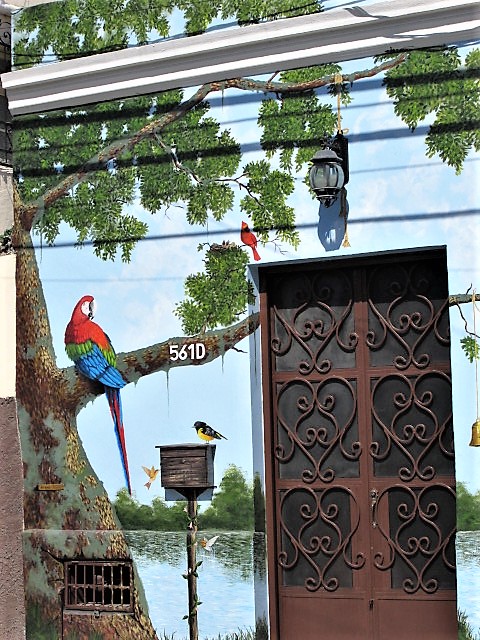
A real lure of Merida, though, is the day-to-day life here. A walk in any ordinary area can reveal treasures, like a mural turning an ordinary small house into a tropical fantasy,


 or one of children playing that carries an important message, 


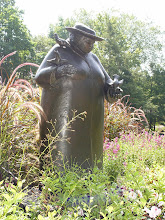
or a bronze sculpture of the spirit of ceiba, sacred tree of the Maya, out for everyone to enjoy in front of a government office tucked away on a mostly residential street.


The people are part of the magic as well. People here greet strangers on the street (rather like the Mid-Ohio Valley in Mexico, to be honest), and have no problem with elderly gringas admiring their children or their dogs. Strangers met on park benches share their stories and have thus far been totally kind despite the language barrier.  Taxi drivers share their insights and include language lessons as part of the fare. Downtown often features buskers, ranging from a truly amazing drum group to young breakdancers to living statues to a guitarist who lost his legs in a work accident in the US and shares songs and smiles in front of various theaters. A favorite example of the spirit of this place: heading back to the guesthouse, I admired the sunflowers of a neighbor who was sweeping her patio. In our mixed languages, I shared the sad information that sunflowers have a short season in Ohio and was informed that in Merida they grow todo el año porque hay mucho sol. Before I left, my new gardening buddy pressed two ripe seedheads into my hands, which I passed on to the owner of our guesthouse, who will now have sunflowers in her impressive tropical garden.


I can't not love this place.


Sunday, January 13, 2019

Flores de Yucatan, part 1

This winter finds me back in the Yucatan, which has far better winter weather than Ohio generally does (unless one is a fan of rain, mud, snow, ice, and gray skies with occasional bursts of sun). This morning my perambulation took me to Parque de las Americas, a large park in the Garcia Gineres neighborhood of Merida, home to bigger-than-average trees for this city. The park is worth its own post, but my color-hungry Northern eyes are focusing on flowers this week.

This lovely thing is growing in a neighbor's yard,


up a wall, and out over the sidewalk.


It was also full of bees, though none were willing to hold still long enough to permit much of a photo.


Thanks to the sharp eyes of a participant in a plant identification group on Facebook, this beautiful mystery-to-me plant was quickly identified as Petrea volubilis, or purple wreath vine, native to much of Central America, including the Yucatan peninsula. Not only are its flowers gorgeous in multiple stages of their existence,


they are attractive to butterflies and hummingbirds, as well as the bees I saw darting among the bloom clusters. The plant is also a traditional medicinal, with its leaves used as a wound salve and in the treatment of diabetes. In earlier times, its blooms were combined with those of another native shrub in a tea used as a morning-after drug by women seeking to avoid pregnancy.

The plant is useful even in death. Its wood is reportedly dry, fast-burning, and useful as fuel. Queen's vine (another common name for the plant) is definitely more than another pretty face.


Saturday, October 27, 2018

Finding the right balance

Total strangers tend to strike up conversations in the parks around here. A few weeks ago, an athletic sixty-something guy preparing to do a little fishing at one of the Blue Creek quarries did just that. When I mentioned my fondness for Lucas County's Metroparks, however, a rant ensued. My conversational partner had recently moved back to the area after a thirty-plus-year career as a biologist and assured me that he had never lived anyplace where people despised nature as much as they do in Perrysburg, Ohio. Never having spent time in Perrysburg, I could not evaluate my new acquaintance's opinion but was troubled by his assertion that the area's parks all needed to have the word "preserve" removed from their names. After all, the county Metropark system contains over 12,000 acres; the parks found in individual cities, towns, and villages add several hundred additional acres of green space and the state and other nature preserves found in the county an additional thousand or so--between 13,500 and 14,000 acres of preserved greenspace in a county covering 596 square miles. In contrast, my home county, at 640 square miles, boasts only 1000 acres of city, county, or state-preserved land, in addition to portions of a national forest.

As my new acquaintance's complaints continued, it became clear that his objection was to what he saw as the commercial development of the county's parks . The park system is now selling t-shirts, allowing visitors to advertise their favorite parks. The riverside and lakefront parks feature boat launches, and some now have kayak concessions. In addition to the camping that has been done for decades at Oak Openings, some recently-acquired land is about to be home to a tree house village for an Ohio version of "glamping," and a 12-mile mountain bike trail has been added. The park system even has its own page of YouTube videos.

So, I get it. These 13,000+ acres are not pristine wilderness, and the park system managers would like to encourage people from other parts of the world to travel here and spend their money and encourage area residents to recreate here instead of traveling to other places for all their outdoor adventure. They would like people to bring their children to the playgrounds and pack a picnic lunch while they're at it. The goal is to have a Metropark within a five-minute drive of all 440,000 residents of this nearly-600-square-mile county, and for the parks to get even more visits than the four million or so they got last year. There is a danger of parks being "loved to death."

And yet: these relatively few sites in a single US county contain nearly 400 species of birds at various times of the year. People from all over the world flock (pun intended) to the area every May for the spring warbler migration. The Oak Openings and the remnants of the Great Black Swamp are home to rare plant species as well as healthy populations of common ones like the hoary puccoon used in earlier centuries as a dye plant


and wild spirea, or meadowsweet, here hosting an ailanthus webworm moth.


The plant diversity of the park system's forests, prairies, and meadows hosts an enormous variety of insect life, including butterflies like this Polygonia.


Because several of the Metroparks are in fact inside Lucas County's cities and towns, someone visiting the library in Whitehouse can walk a few hundred feet and watch the sun set over the Nona France Quarry.


Wildwood Metropark is bordered by busy roads (which can often be heard despite the park's over 450 acres) on three sides, but its trails can give the wanderer a real sense of isolation, as can much of the Swan Creek Preserve, surrounded by some of the busiest roads in South Toledo.


If there is a more peaceful autumn scene on earth, I do not know where.

More good news is that forests in the park system are regenerating. While young oaks are being shaded out by maples and hickories in much of their range, some of the Metroparks are home to young oak trees like this baby along the grassland trail at Wildwood.

    
Metroparks are maintained and therefore not truly wild, though it is the presence of sun along a trail edge or in a maintained clearing that allows young oaks to grow. Portions of most parks have also been made accessible to people with mobility challenges, with paved trails available. Some parks are on bus lines, rendering them accessible to people who do not drive or do not own a car.

We need wilderness, but most people cannot (and arguably, should not) go there. Still, all people should have access to wildness, whether it is a field full of butterflies and finches, a mayapple wood, an urban river harboring ducks and herons, or a second-growth forest sporting the brilliant red of baby oak leaves. I may be wrong, but it seems to me that the construction of buildings with meeting rooms and modern plumbing in addition to their Windows on Wildlife and the building of trails that allow wheelchair users to get close to natural areas are a reasonable compromise between the needs of people and the needs of other species. People who never see wild things are unlikely to love them, and as Senegalese environmentalist Baba Dioum said fifty years ago, "In the end, we will conserve only what we love."

Perhaps helping people learn to love their  local (even semi-) preserves is the best way to foster a society that wants to preserve more of life on earth.

Thursday, October 25, 2018

Waiting for fall color

This year's hot summer has meant that Southeast Ohio has not yet seen a lot of fall color, a phenomenon that seems to be widespread in the eastern US. Visiting the northwestern corner of the state, conditions at first glance seemed the same: most of the flowers gone, and most of the trees either a fading green, or simply faded, like the tulip poplar near our house that has lost most of its leaves without ever putting on its fall show. A favorite trail at a favorite Metropark was perfectly lovely, but the colors are still mostly subdued.


The picture, of course, does not tell the whole story. Even though this part of the state has had some frost and most of the spring and summertime creatures seem to be gone for the year, lots of insect sounds were coming from the vegetation, and a few clouded sulphurs were fluttering along the path, visiting the late asters that still dot the meadow. And a seed-and-insect-filled area like this one hosts a LOT of birds, though again, they were hard to see, most being in fall plumage and blending in with the drying vegetation. (Interesting how that works, isn't it?)

Goldfinches were obvious due to their unmistakable call and flight patterns, and one finally got close enough to be photographed, with enough of its breeding plumage left to be recognizable.


Even though there was plenty of thistle to be had, this finch and his companion were hanging out in a large patch of goldenrod, demonstrating yet again that expensive niger seed and specialized feeders are probably a waste of money. (At our place, the goldfinches generally go straight for the black-oil sunflower that comes in forty-pound bags, or, better yet, for plants going to seed in the yard.)

At least some trees seem to have looked at the calendar. A little further on, next to the parking lot, human-planted red maples were doing their fabulous fall thing. They never disappoint.


Along the elevated bike trail that passes through a sugar maple wood, that threatened species was also in full color. If our changing climate does wipe out Ohio's sugar maples, I am not sure which I will miss more: dark brown Grade B maple syrup (as good on ice cream as it is on pancakes) or views like this one, perhaps the essence of an autumn afternoon.


Maybe it's a good thing if fall teases us for a while.