About Me

My photo
I'm a woman entering "the third chapter" and fascinated by the journey.
Showing posts with label urban wildlife. Show all posts

Wednesday, October 19, 2022

Perhaps the wrong name

A few days ago, walking the downtown river trail, I came across a Buddleia davidii, commonly called butterfly bush, in full bloom, even in mid-October. 


Who could not love that color? And while there were not many butterflies out on a chilly fall morning, the bush was hosting several fat bumblebees, of which, unfortunately, I did not get a decent photograph. And who doesn't love bumbles? Even this late in the season, the plant's leaves were in pristine condition, not a single spot or hole.


What's not to like?

Plenty. Butterfly bush is actually not a good butterfly plant. Yes, it provides a gorgous, sweet-smelling snack bar for adult butterflies over a long season, but those perfect leaves are a tip-off: this plant feeds not a single North American caterpillar, AKA baby butterfly. When we give this exotic plant a home in our yards, we are in fact reducing butterfly habitat, which must include space to reproduce if we want more generations of the fluttering creatures we purport to love. To make the case against buddleia even more strongly, more than 95% of North American songbirds feed their young almost exclusively on caterpillars: planting the misnamed "butterfly bush" also reduces the reproductive capacity of the birds whose nestlings will starve without the fat and protein provided by caterpillars. A single brood of chickadees, to give just one example, requires between 6000 and 9000 caterpillars before they can leave the nest. Earthworms are no good, being another non-native species providing little nutritional value.

This is what a leaf on a useful plant should look like in fall (unless of course it has been completely munched): spotted and full of holes.
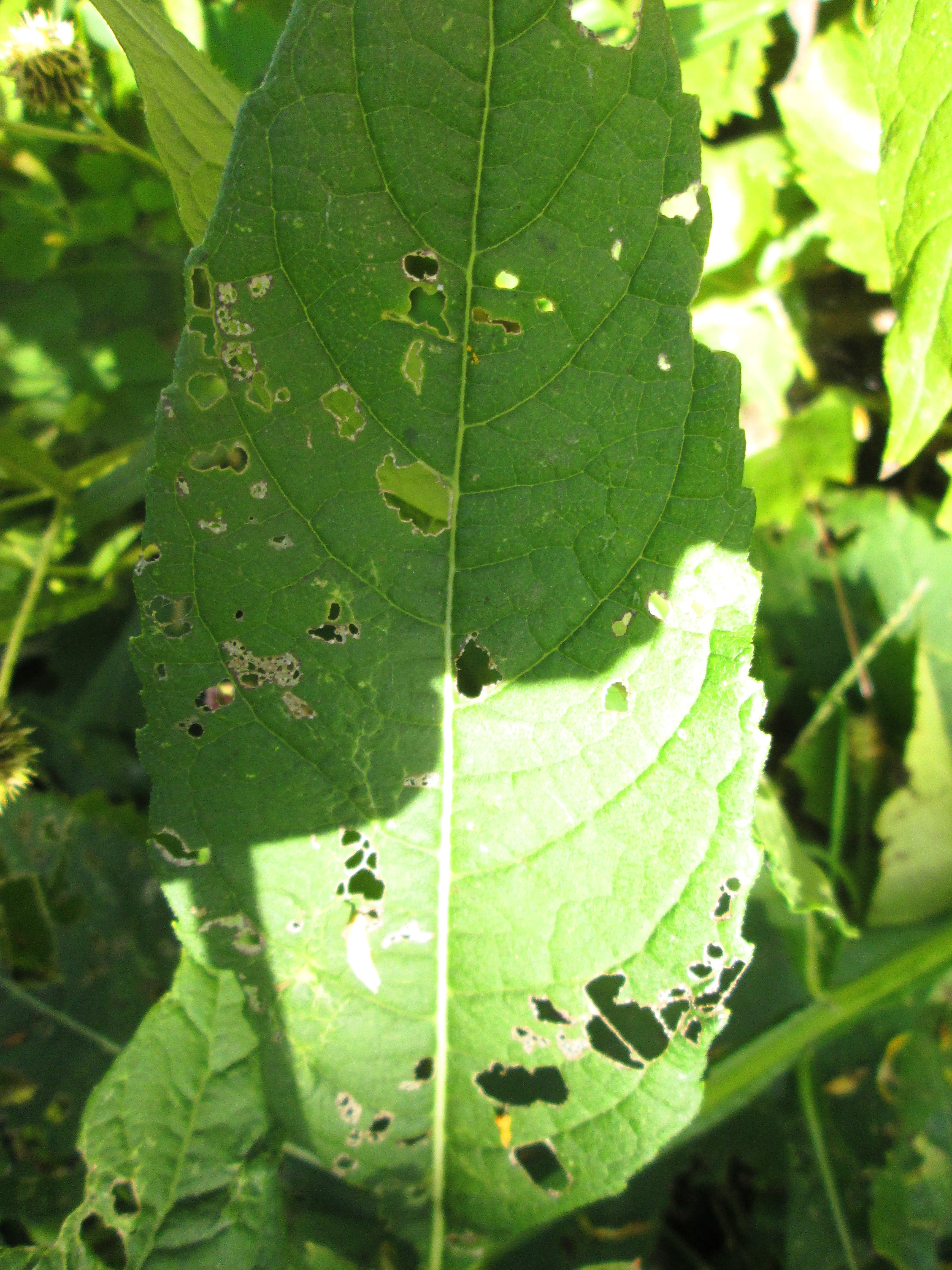

If some of these leaves are turned over, they will reveal eggs or larvae hiding on the underside.


Something hiding on a riverside silver maple

I know that our gardening instinct calls for perfect, unblemished  plants, but nature requires imperfection and transience. Plants must be chewed for animals to live, and we bipedal primates require the interaction of plants, animals, and microbes for our own thriving.

Filling a yard with "butterfly bush" is the equivalent of feeding a child a diet of nothing but gummy bears. 

The plant needs a new name. The real "butterfly bush" is an oak, but that is a subject for another post.


Sunday, October 3, 2021

O frabjous day!

 Whatever that delightful word invented by Lewis Carroll was meant to mean, it does convey a sense of exhilaration, and yesterday's planting of Phase Two of our riverbank habitat and Phase One of a nearby butterfly garden definitely left its volunteer workers with that sense (though maybe coupled with a bit of exhaustion). As recently as April, the riverbank was a giant swath of black plastic, while the area adjoining a brick sidewalk in a historic business district was home to some nice daffodils, a lot of weeds and scruffy, hard-to-mow grass, and not much else. Today, the situation is very different.

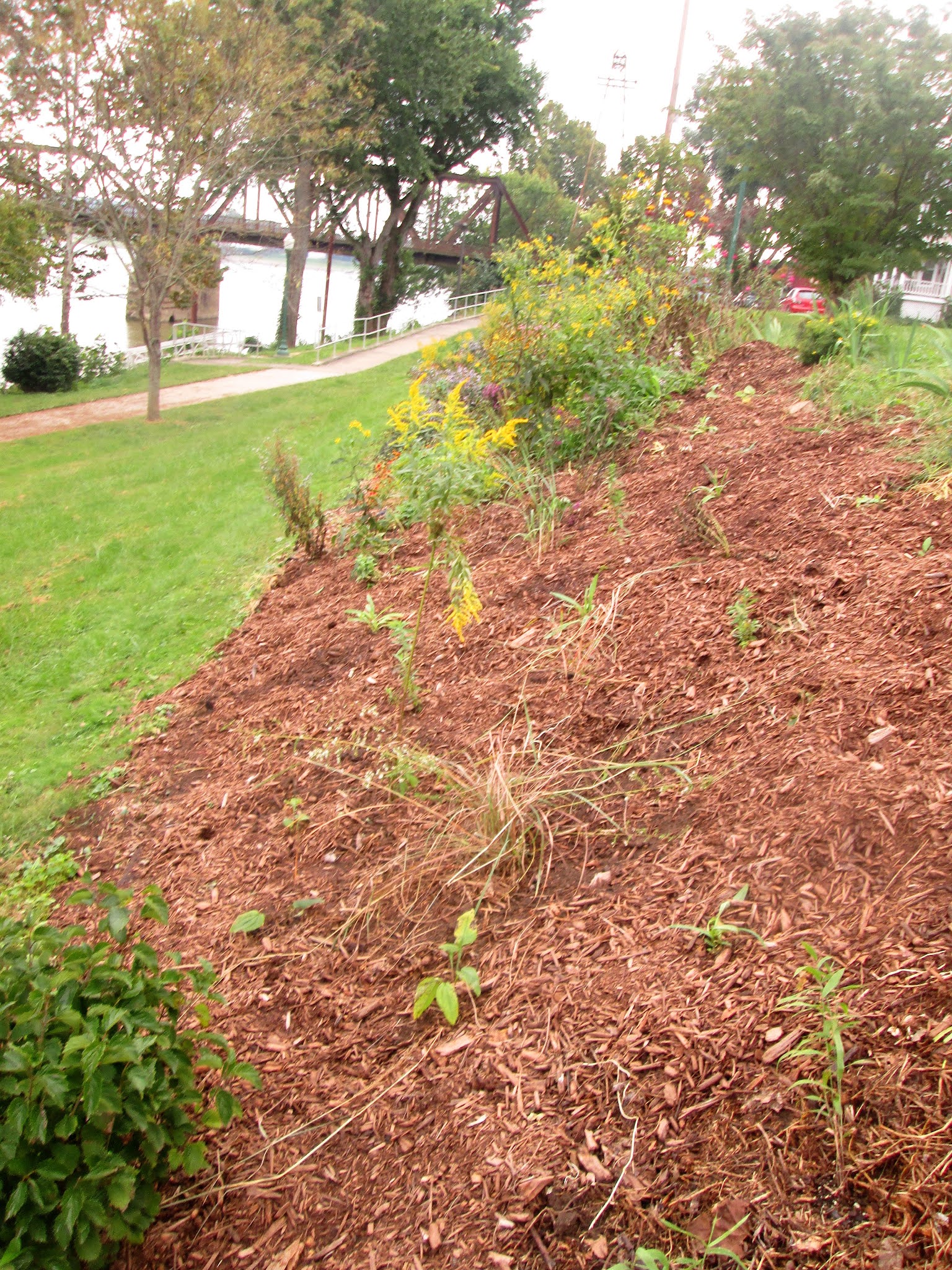
Phase One viewed from the river trail

Phase One, planted in May, is thriving, and yesterday nearly twenty volunteers at different times planted a 200-foot stretch of riverbank with a mix of Ohio native forbs and grasses and that neglected sidewalk bed with over 200 seedlings of bee balm, butterfly weed, and coneflower. The day was genuinely a community effort, with people from the neighborhood, other parts of town, two churches, a college, and a master naturalist group joining forces for several hours. The ages of the volunteers ranged from eight to seventy-plus, and the day's tasks included wrestling with the last of the solarization plastic


and digging a LOT of holes.


 Phase Two does not look particularly exciting at the moment,

The view from the steps


The view from below

but we anticipate a lot of activity a few months from now. The neighborhood bees, skippers, and finches have been making themselves at home for some time, and this year's South-bound monarchs have used the riverbank as a way station.  

With three species of milkweed planted yesterday and more to come, next year these iconic insects will be able to complete their life cycle on our little patch of riverbank, and human visitors to Historic Harmar will be able to enjoy these pockets of wildness while strolling our little town.


Sunday, March 7, 2021

Cemeteries

can be pretty lively places, especially when they adjoin a wooded ravine and the city has set aside a "growing, not mowing" zone in a currently-unused area. Marietta's Oak Grove Cemetery is known as a birding spot and there have been reports of a few early migrants on Facebook, so even though 2:00 PM is not generally a great time for birds, it was the warmest part of a sunny afternoon, so off I went.

Not much avian activity was noticeable in the lower portion of the cemetery, but unfamiliar bird calls were wafting down the hill. In need of exercise, up I went, and was rewarded with a life bird: a yellow-bellied sapsucker. Even though these little woodpeckers sometimes winter in southern Ohio, often pass through on migration, and leave signs of their sap-hunting on trees I have known, I had managed never to see the bird itself. This one I initially thought might be a hairy woodpecker working its way around a tree, but when it took off, its namesake yellow underparts revealed its true identity. I am not organized enough to keep a life list, but a new bird a few blocks from home is always a good thing.

The cemetery was also hosting its more usual denizens today. A blue jay was warning all and sundry of my presence while cardinals and chickadees were calling from various trees. A pair of tufted titmice may have been checking a tree for a nesting site, and robins were everywhere, as was their song. 

Heading home along the ravine, I spotted a red-bellied woodpecker, common in our area but not often at my home feeders. An unmistakable sign of spring was the gaggle of grackles hanging out in the evergreens along the sidewalk. And of course, there were scads of starlings, the local horde of which managed to consume the last suet cake in this winter's stash in less than twelve hours. 

The downy woodpeckers will have to make do with sunflower seed.

Tuesday, September 22, 2020

Finch Field

 It has been a really long time since I visited this blog. Pandemic brain is a real thing.

When poet Wendell Berry is overwhelmed with "despair for the world," he goes to lie down next to a marsh, or at least a pond, if his classic poem "The Peace of Wild Things" is to be taken literally (which poetry generally is not). I love both marshes and ponds, but lying down next to one in the middle of the night would not be a good idea for me. For no other reason, there is the little matter of getting up again, not an activity to be taken for granted by someone who has arthritis most places she has bone. Fortunately, the "grace of the world" can be experienced in a variety of places. One of my favorite spots is what I call Finch Field, just beyond Susan's Meadow on the Meadow Loop Trail at Wildwood Metropark.


The field may not be immediately aesthetically arresting, but it is on my top ten list of happy places. For several months every year, it is Goldfinch Paradise, and today did not disappoint. Today, this particular thistle was in motion from the at-least-three female finches having at its seed. I opted not to get close enough to photograph the girls, my little point-and-shoot not having sufficient capacity to get a good shot without disturbing them, but they were there for several minutes going about their business. Then, as is the way of goldfinches, they took off, leaving me free to examine the plant and ask, "Why this thistle, in a field full of them?"

No answer emerged, as to my human eye, this plant looked just like dozens of others nearby. But it was The One today.


Not only for the finches, but also for what seemed to be some very busy bumblebees.


Weedy and annoying as thistle can be, is any cultivated flower more beautiful than a thistle bloom bud?


Another highlight of Finch Field is the grasses. Indian grass comes into its own in September. This clump also got its share of goldfinch attention. You must imagine a little golden bird riding one of these five-foot blades to the ground, nibbling all the way.


And the sight of the tree I have named the Prairie Sentinel always lifts my spirits. This white oak on the edge of a mixed second-growth woodland is older than I and, barring human intervention, is likely to be here for at least a couple of centuries after all of us currently inhabiting the planet are gone.


Surrounded by so much life, pandemics, elections, and the deaths of much-loved leaders fade away.


Friday, June 19, 2020

Another reason to Leave the Leaf Litter

We all know by now that leaf litter is important for overwintering pollinators and other insects. (Right? We do all know that, don't we?) Those "dead" leaves are often home to lepidoptera eggs, which give us next season's butterflies and moths. Our human penchant for tidy lawns is almost certainly one reason why we see fewer colorful insects today than some of us remember from our childhoods.

Leaf litter hides seeds, dried berries, worms, and insects, serving as a buffet for the birds that eat such things. There is a reason some species are known as "thrashers."

And we know that leaf litter is natural mulch, reducing the need for water and cutting down on the gardener's work. Best of all (at least for those of a thrifty--not to say cheap-bent), it is free, letting us spend our money on more plants rather than on shredded hardwood. 

But today, walking at a favorite park, I was reminded of another Very Important Reason to Leave the Leaves: they provide shelter and protection from predators for small creatures. Admiring the baby sassafras and fading mayapples at this overlook,


I kept hearing rustling sounds and seeing tiny eruptions of leaves. Suspecting that wildlife was present but unable to see any (because of all that leaf litter), I hung around until finally being rewarded with the sight of the creature I thought was most likely responsible: a large and handsome chipmunk, who did not hold still long enough for a photograph. (Plants are so much more cooperative in that respect.)

This favorite park is home to some quite beautiful predators, including the Cooper's hawk sighted a few hundred feet away in a sunny area, but leaving the leaves for cover gives the little guys a chance. And when there are lots of them, that is good for the predators as well, not to mention good for those of us who delight in watching the critters.

A little laziness is a good thing.

Saturday, February 29, 2020

For the birds

This morning I was lucky enough to take part in a bird walk with CICY ornithologist Richard Feldman and a group of birding enthusiasts. Our intrepid group met at the botanical garden at 7:30 (late by birding standards, but quite sufficiently early for me, given travel from the beach to central Merida) and were treated to an introductory talk on resident and migratory birds before heading into the garden itself. I and at least one other member of our group had not known that well-fed birds in good condition can cross the Gulf of Mexico in less than 24 hours, a fact that gives me a whole other level of appreciation for the warblers and buntings that arrive in Ohio in May.

The Roger Orellana Botanical Garden, all six acres of it, is major bird habitat in a seriously deforested urban area, with 85 species confirmed here at different times. This dry forest, or selva seca, which makes up the central portion of the garden, is home to two motmot species, both of them showing off for us this morning.


Unfortunately, my point-and-shoot camera does not do well with greenish birds hanging out in leafy areas, even when said birds have definite turquoise eyebrows and most distinctive tails. This image from the Cornell Lab of Ornithology shows how gorgeous the turquoise-browed motmot, known to the Maya as the t'oh, really is.


Both species breed in this cave, found in the heart of the dry forest.


Our morning meander along the paths rewarded us with not only motmots but orioles (and a most glorious hanging nest), kiskadees, saltators, vireos, woodpeckers, flycatchers, blackbirds, two species of hummingbirds, a variety of doves, and of course gaggles of grackles. These handsome boys were showing off in Progreso, but you get the idea.


As the day warmed, the insects came out and swarmed the various trees that bloom this time of year. (Sorry, northern friends.) Seeing a dozen species of butterflies and lots of fat black bees working the late-winter flowers will definitely brighten a person's day. And a healthy insect population bodes well for the birds.

The good news in our time of so much bad environmental news: restoring even small sections of habitat can make a real difference for some of our feathered (and other) friends.

Wednesday, January 1, 2020

Local Wildlife in Merida

Today has been el dìa de los insectos. Being aware of the likelihood of afternoon heat, I opted to close my windows before heading out for the day, a process that in this particular guesthouse involves lifting a portion of screen. Unfortunately, sometime yesterday a colony of wasps had, unbeknownst to me, chosen to build a nest on the window ledge and did not take kindly to the disturbance. Fortunately, I escaped with only one sting, and this variety of Yucatecan wasp is not particularly venomous--nothing compared to Ohio's yellow jackets. (The wasp colony is no longer present.)

Being thus reminded that I am currently in the tropics, I purchased a botanical insect repellent before returning home, ready for an interval of reading in the garden. Needless to say, the spray missed a spot or two, and the mosquitoes found exactly those spots. Fortunately, the same garden that is home to the mosquitoes (despite efforts to leave no standing water and the like) is also home to some lovely butterflies--not that they would hold still to be photographed.

Then this evening, I discovered that a nearly-microscopic species of ant had discovered a way into a just-purchased package of tostadas. Tomorrow will involve the purchase of plain tortillas to be stored in the refrigerator (a place not conducive to crisp baked goods) and a supply of ziplock bags. The contest with the little beasts will be won.

A stroll to the city's main plaza revealed some more exotic wildlife,


like this camel that formed part of the municipal Nativity scene.

Other creatures at the Bethlehem stable would be right at home on a Mexican farm.


And the ubiquitous European rock doves (aka pigeons) were making themselves right at home in the hay the plaster animals were not using,


totally ignoring the rampaging elephant a few feet way.


Would that all creatures would coexist so peacefully.

Tuesday, March 12, 2019

For the birds

The first robins showed up a few days ago, and judging by all the singing, twittering, and general avian sounds emanating from every tree, shrub, fence, wire, and gutter in the neighborhood, we should start seeing baby birds in the not-too-distant future. But before that can happen, the parents-to-be of most species need to build some nests, a process that requires building materials.

Most of our common songbirds (and quite a few others) use small twigs and dried grass as the basis for their nests, but such things are in short supply in overly-manicured neighborhoods. Some humans try to compensate by leaving materials such as pet hair, dryer lint, and short pieces of yarn or twine where birds can find them, but the Cornell Lab of Ornithology advises against these items. What our birds need is more of this.


If you have managed to avoid completing your fall (ha!) yard cleanup, now is a good time to cut those clumps of dead grass and leftover plant stems and use them to create an avian Home Depot.  These in-demand items can be placed in suet cages and hung in likely spots, or just left in piles on the ground if no neighbors object. They will be put to good use.

Once the babies arrive, they will need food, which generally means caterpillars or small insects, with baby hummingbirds being particularly fond of nearly-microscopic flies and gnats. The average brood of baby chickadees will need anywhere from 6000-9000 caterpillars or other insect larvae before they can leave the nest, with other species being similarly voracious. Multiply that number by the number of bird pairs in your area, and the need for insect-friendly habitat becomes obvious.

This planting is only one example of an insect- (and therefore bird-) friendly flowerbed: native plants with landing pads, nectar, pollen, and eventually lots of seeds.


Put something like this near trees and shrubs, and your yard is going to make the birds and the bees very happy.

Saturday, October 27, 2018

Finding the right balance

Total strangers tend to strike up conversations in the parks around here. A few weeks ago, an athletic sixty-something guy preparing to do a little fishing at one of the Blue Creek quarries did just that. When I mentioned my fondness for Lucas County's Metroparks, however, a rant ensued. My conversational partner had recently moved back to the area after a thirty-plus-year career as a biologist and assured me that he had never lived anyplace where people despised nature as much as they do in Perrysburg, Ohio. Never having spent time in Perrysburg, I could not evaluate my new acquaintance's opinion but was troubled by his assertion that the area's parks all needed to have the word "preserve" removed from their names. After all, the county Metropark system contains over 12,000 acres; the parks found in individual cities, towns, and villages add several hundred additional acres of green space and the state and other nature preserves found in the county an additional thousand or so--between 13,500 and 14,000 acres of preserved greenspace in a county covering 596 square miles. In contrast, my home county, at 640 square miles, boasts only 1000 acres of city, county, or state-preserved land, in addition to portions of a national forest.

As my new acquaintance's complaints continued, it became clear that his objection was to what he saw as the commercial development of the county's parks . The park system is now selling t-shirts, allowing visitors to advertise their favorite parks. The riverside and lakefront parks feature boat launches, and some now have kayak concessions. In addition to the camping that has been done for decades at Oak Openings, some recently-acquired land is about to be home to a tree house village for an Ohio version of "glamping," and a 12-mile mountain bike trail has been added. The park system even has its own page of YouTube videos.

So, I get it. These 13,000+ acres are not pristine wilderness, and the park system managers would like to encourage people from other parts of the world to travel here and spend their money and encourage area residents to recreate here instead of traveling to other places for all their outdoor adventure. They would like people to bring their children to the playgrounds and pack a picnic lunch while they're at it. The goal is to have a Metropark within a five-minute drive of all 440,000 residents of this nearly-600-square-mile county, and for the parks to get even more visits than the four million or so they got last year. There is a danger of parks being "loved to death."

And yet: these relatively few sites in a single US county contain nearly 400 species of birds at various times of the year. People from all over the world flock (pun intended) to the area every May for the spring warbler migration. The Oak Openings and the remnants of the Great Black Swamp are home to rare plant species as well as healthy populations of common ones like the hoary puccoon used in earlier centuries as a dye plant


and wild spirea, or meadowsweet, here hosting an ailanthus webworm moth.


The plant diversity of the park system's forests, prairies, and meadows hosts an enormous variety of insect life, including butterflies like this Polygonia.


Because several of the Metroparks are in fact inside Lucas County's cities and towns, someone visiting the library in Whitehouse can walk a few hundred feet and watch the sun set over the Nona France Quarry.


Wildwood Metropark is bordered by busy roads (which can often be heard despite the park's over 450 acres) on three sides, but its trails can give the wanderer a real sense of isolation, as can much of the Swan Creek Preserve, surrounded by some of the busiest roads in South Toledo.


If there is a more peaceful autumn scene on earth, I do not know where.

More good news is that forests in the park system are regenerating. While young oaks are being shaded out by maples and hickories in much of their range, some of the Metroparks are home to young oak trees like this baby along the grassland trail at Wildwood.

    
Metroparks are maintained and therefore not truly wild, though it is the presence of sun along a trail edge or in a maintained clearing that allows young oaks to grow. Portions of most parks have also been made accessible to people with mobility challenges, with paved trails available. Some parks are on bus lines, rendering them accessible to people who do not drive or do not own a car.

We need wilderness, but most people cannot (and arguably, should not) go there. Still, all people should have access to wildness, whether it is a field full of butterflies and finches, a mayapple wood, an urban river harboring ducks and herons, or a second-growth forest sporting the brilliant red of baby oak leaves. I may be wrong, but it seems to me that the construction of buildings with meeting rooms and modern plumbing in addition to their Windows on Wildlife and the building of trails that allow wheelchair users to get close to natural areas are a reasonable compromise between the needs of people and the needs of other species. People who never see wild things are unlikely to love them, and as Senegalese environmentalist Baba Dioum said fifty years ago, "In the end, we will conserve only what we love."

Perhaps helping people learn to love thei local (even semi-) preserves is the best way to foster a society that wants to preserve more of life on earth.

Tuesday, August 28, 2018

Underestimating meadows

When most people think of dramatic landscapes, mountains or deep forests probably come to mind. A few may envision the wide-open spaces of the midwestern prairie, but I doubt that many people automatically get excited about the smaller patches of grassland we call meadows. (A young relative once referred to our meadow planting as "a weed bed.") A healthy meadow, however, is a thing of subtle beauty and, more importantly, a small-scale biodiversity hotspot.


This meadow, part of Wildwood Preserve in Toledo, was livelier this morning than either the trail through the floodplain forest or the Window on Wildlife this park uses to lure birds and other creatures close enough for easy observation. Because the bur oak on the edge of the meadow is one of my favorite trees, I generally take advantage of a well-placed bench to sit and commune with this old tree that I sometimes call the Prairie Sentinel (even though this area is not technically prairie as it is not dominated by tall warm-season grasses).

The most noticeable creatures were the goldfinches that seemed to be alighting in droves on every patch of thistle. This particular plant,


which looked perfectly ordinary to my human eyes, at one point had four male goldfinches (and probably a female or two that I did not see, seated as I was some distance away) darting in and out, as well as two hummingbirds (at the same time--not typical behavior for these aggressively territorial little birds), bees of various species, and several hummingbird moths.

The sea of goldenrod (which actually contained at least three species of Solidago) was providing hospitality to hordes of monarch butterflies, tanking up before their long migration to a Mexican forest they have never seen. Sulfurs, whites, and skippers were abundant, and one lovely ailanthus webworm moth was hanging out right next to the trail.


Yes, that little creature is a moth, and its caterpillars eat the ironically-named tree of heaven, so even though the extension of its range (formerly the American tropics from South Florida to Costa Rica) may be a troubling sign, any insect that will eat a noxious weed of a tree is in my estimation a good bug.

Goldenrod was not the only flower blooming today. Ironweed was going strong, accompanied by asters just starting to bud, a few liatris hanging on, and numbers of smaller, more subtle blooms interspersed among the dominant yellow. And while they were not noticeable, the grasses were there, sending their roots down several feet into the soil and helping to create the soil matrix that is the basis for all other terrestrial life. Some bird species require landscapes like this one, nesting on the ground and depending on the thick vegetation to protect their young and provide the insects that will feed them. Even birds we normally associate with trees make use of grasslands. Today, this scruffy cardinal (either molting or a particularly unfortunate adolescent male just getting his adult coloration) spent a good bit of time calling from the shrub dogwoods that form part of the edge between Wildwood's meadow and forest areas, then more time investigating the seed selection in the meadow plants.


Meadows may not get much press as exciting places to visit, but they should not be underestimated. Spending a little time in a meadow reveals much more than is visible at first glance.

Friday, February 9, 2018

A royal bird

I had intended to write about the great kiskadee, but a review of my photos revealed that the only decent shot of an MYB (Mid-sized Yellow Bird, the Yucatan equivalent of the LBB, or Little Brown Bird) was of a tropical kingbird.


These handsome flycatchers are almost as common here in the coastal Yucatan as chickadees are in Ohio, since their preferred habitat is open woodland, meaning that they do well in towns with trees. In this neighborhood, they are often found perched on utility wires, looking for the insects that are their primary food. (There is a reason they are called flycatchers.) Since the climate here is definitely tropical, insects are plentiful, as are insectivorous birds. The fact that these hungry little songbirds are also pretty and fun to watch is a plus.

Some good news for kingbirds: human-induced landscape changes (i.e. less dense forest and more trees scattered among human habitations) have allowed these birds to expand their range and increase their numbers. The International Union for the Conservation of Nature lists them as a Species of Least Concern. They venture into only a few parts of the US, though, so I will just have to enjoy them while I'm here.

Sunday, April 27, 2014

Elegant but deadly

This morning brought the opportunity for a quick jaunt along the walkway at the Williamstown Wetland, a jaunt that revealed what may be the apex predator of the park: the great blue heron. Everything about this bird is geared toward killing.

Large as it is, the great blue can almost disappear when still, its muted colors blending with those of the reflected vegetation.
With that long neck, it can reach underwater at speeds too great for most fish to escape, and that long bill can impale even small mammals.

This particular heron caught at least three fish in the few minutes that I observed it, and the wetland's other birds stayed well away from the heron's hunting spot. (I do understand that alligators sometimes eat herons, but reptiles of that size are blessedly rare in West Virginia.)

Watching a great blue as it goes about its deadly business, it is easy to see this elegant creature as the descendant of dinosaurs. It would not have surprised me to see a velociraptor rise out of the swamp grasses--except that dinosaurs are in short supply in the parking lots of local restaurants like the one adjoining our primeval-looking wetland.


Sunday, March 23, 2014

Back again

They're here. A glance out the window this morning revealed several of what I at first thought were starlings, but something wasn't quite right: these birds' bodies were too elongated, and the walk was different. A moment's thought (I being on only my first cup of coffee) clarified the situation: the grackles are back from wherever they spend the winter, and a flock/horde/cackle of them had returned to Chipmunk Ridge, where they were pecking around in the mulch and among the dried grasses. Luckily for them and the neighborhood robins, yesterday I broke out the string trimmer and had at the meadow and savannah gardens, leaving plenty of nesting material scattered about.

Spring has officially sprung.

Thursday, January 2, 2014

The benefits of messiness

It's fortunate for me that we have tolerant neighbors (referring specifically to neighborhood humans). I do try to keep the front yard up to reasonably civilized standards--easier to do since Piet Oudolf and James Van Sweden made ornamental grasses and seed heads not only respectable but trendy in some circles--but I am about as fond of raking leaves as I am of mowing grass or trimming yew hedges: that is, not at all. As a result, most of the front-yard leaves (of which there aren't many, as that's the sunny side of the lot) get raked under the rhododendron or out to the compost pile, but this year the back has not been raked.

There are reasons for this other than my general laziness. For one, we still have a scraggly, unattractive turfgrass mix left from the previous owner's attempt to grow lawn on the back slope, and the sooner it dies, the happier I will be. Turfgrasses do not like being smothered in leaves, so my hope is that we can accelerate the process of making the back yard more interesting.

Second, most of our leaves (with the exception of those from the neighbor's sycamore) come from oak or maple trees, trees which, according to entomologist Douglas Tallamy, attract more lepidoptera than almost any other plants (over 500 species!).  This means that a good percentage of those leaves are likely to contain butterfly eggs, eggs that will not hatch if we put their host leaves in plastic bags and send them to a landfill. The eggs might survive mowing the leaves so that they break down faster, but why risk the loss of next year's hairstreaks and duskywings?

Third, leaf litter has a number of important functions, especially in forest ecosystems (though our back quarter-acre hardly qualifies as "forest"). The spring wildflowers of the eastern woodlands require a rich soil in which nutrients break down slowly, and allowing leaves to decompose at their own pace is one of the best ways to create that soil. (One of my fantasies is to have soil that will support trilliums, which right now our yellow clay will not--but maybe in twenty years or so....) Some insects overwinter in leaf litter, including mourning cloak butterflies, wooly bear caterpillars, hummingbird moths, and certain bumblebee queens. I've never seen an amphibian in our yard, but if we ever get tree frogs, they prefer to spend the winter under leaves. This year, we have had brown thrashers thrashing in the leaf litter under the few remaining backyard yews (and despite my love for butterflies, I do not begrudge our thrashers anything they can find to eat).

My messiness, I must confess, extends to not whacking things back as early as many people do, but sometimes that hesitation is rewarded. We have birds feeding on seedheads in the meadow garden, and the wild tangle of our in-need-of-pruning lonicera sempervirens has become a favorite perch for wrens and juncos. The specimen on the compost area fence attracted the first fox sparrow I had ever seen.

The moral of the story: one species' mess is another species' home sweet home.

Friday, June 22, 2012

The return of Stumpy

I realize that I neglected to post about my first sighting of a near-tailless squirrel in the summer of 2011. In all honesty, I was a little worried about the poor guy. (Gal? I have no idea how to sex squirrels.) Given the enthusiastic use to which all the other neighborhood squirrels put their tails as they dash from the oaks to the hemlock to the pines, I feared that poor Stumpy (as we uncreatively dubbed our visitor) would be unable to out-maneuver the neighborhood predators, which include hawks, outside cats, and the occasional wandering dog (not that I've ever seen the dogs around here attack anything).

But this week, Stumpy appeared again at our tray feeder, as frisky and healthy-looking as ever. While I missed the acrobatics, he had climbed a metal pole to access a tray six feet off the ground. Curious about the life of a squirrel without the appendage that always defines "squirrel-ness" for me, I of course turned to the Internet and learned that squirrels are capable of ditching their tails to escape from predators. According to a 2010 New York Times article, "Part of a tail is sometimes lost to a grasping predator, but the thin covering of skin and muscle can be stripped away without mortal results, and a break-away tail can thus allow the squirrel to escape. The exposed bone eventually falls away and the stump heals" (C. Claiborne Ray. "Q and A: The Tale of the Tail." New York Times 5 July 2010). Evidently, a narrow escape is part of our squirrel's life story.
Stumpy making yet another escape, only a little the worse for wear.

Tuesday, March 13, 2012

A forgetful squirrel (or perhaps just an unlucky one)

Today I had the good luck to wander around the Toledo Botanical Gardens and my beloved Wildwood Metropark. There was much to observe and enjoy, enough for several blog posts. At the moment, though, I want to write about the fox squirrels (Sciurus niger) that were perhaps the most entertaining wildlife today.


The fox squirrel is the largest squirrel in eastern North America and has become my favorite, probably because we don't have any in Parkersburg (that wanting what you can't have thing again). Their reddish fur, tufted ears, and general hyperactivity (though they have nothing on the West Virginia fairydiddle, which we also don't have in Parkersburg) are endlessly amusing. Today the squirrels at the TBG were hauling around mouthfuls of dried leaves, evidently putting together this year's messy nests.


This particular guy couldn't seem to decide what he was doing.


This one was having a delightful time prowling for something among the pachysandra.


But one unfortunate squirrel in the Manor House gardens at Wildwood was engaged in a serious search for something that it was not finding. Of course, I had the binoculars but not the camera for that particular encounter, but here's how it went:
  • Squirrel looks around, digs intently in the mulch for a few seconds, finds nothing.
  • Squirrel moves over a few inches, digs intently in the mulch for a few seconds, finds nothing.
  • Repeat several times.
I suspect the rodent in question was looking for cached acorns, but none were to be found. Either its walnut-sized brain has a faulty memory, or some other being(s) found the stash and made off with it. In any case, the squirrel eventually gave up and bounded off. This photo is of a different squirrel, but the picture was basically the same.

Saturday, February 20, 2010

Small pleasures

Today brought two unexpected delights--three, if you count the sun finally coming out after how many days (weeks? months?). Walking home from the grocery store, I heard bird sounds in an unexpected place--the edge of a parking lot just a few yards from Emerson Avenue. The area is urban for Parkersburg: behind several businesses, next to the parking lot of an apartment complex, on the edge of the enormous parking lot belonging to a bowling alley and music store. But there was a little piece of urban nature, providing everything small songbirds need.

The melting snow had left deep puddles in low places in the parking lots, and the planting area hiding the parking lot has been neglected. The tall yellow daisies (some kind of perennial helianthus, maybe?) and goldenrod that I remembered from fall had been left standing, providing a seed source, and there was an enormous twiggy rose of some kind, probably multiflora, given the setting--not an inspiring piece of wilderness, by any means. But the bush was full of song sparrows, fluttering and twittering away, and maybe other LBBs that I couldn't see. Something in that scraggly shrub was to their liking, and the action continued as I walked away.

Another delight, in another urban neighborhood off another busy street. Walking home, my husband and I were brought to a standstill by an almost overwhelming quantity and variety of birdsong . Someone had planted a small front yard with multiple trees and festooned them with feeders, while a closer look revealed that several neighbors had also chosen fruiting or other native tree species, one elderly dogwood being particularly lively. Cardinals, sparrows of various sorts, doves, and at least one wren surrounded us, making a February afternoon feel more like spring.