- The year began with the horror of the Elk River chemical spill, but the end of the year brought good news: the (insert your favorite insulting noun) officers of the company responsible for the disaster have been indicted on a variety of criminal charges, with one of them facing nearly seventy years in prison if convicted. While my less-than-charitable side objects to public funds being used to support the being whose negligence has already cost millions of taxpayer dollars and who knows how many non-human lives (couldn't we just submerge him in the Elk River in, say, late January, and leave him there?), I am gratified to think that he is likely never again to enjoy his ill-gotten gains.
- At least one fairydiddle found its way to Parkersburg.
- I learned what baby mourning doves look like.
- I finally got to experience Magee Marsh during the spring warbler migration.
- The grass garden came into its own, as documented in a variety of posts.
About Me
- Rebecca
- I'm a woman entering "the third chapter" and fascinated by the journey.
Wednesday, December 31, 2014
The Year in Review
2014 was the year of slackery on this blog. It got off to a good start during the polar vortex and the following much-welcomed spring, but a busy semester and general brain fog led to a slowing down once the fall term began. A review of what did find its way into writing, however, reveals that life did indeed happen.


Thursday, December 18, 2014
They're here
The juncos, that is. The appearance of little white-bellied ground-feeders is a sure sign that winter is here, even though the calendar gives us a few more days until the solstice. Accompanying the slate-colored winter residents are white-crowned sparrows and what I think may have been a pine siskin, along with the usual suspects: chickadees, cardinals, titmice, doves, and the no-longer-very-golden goldfinches.
 While I know that brown is indeed a color, I am already tired of it. Sigh. Daffodil season is a long time away.
Thursday, December 4, 2014
Am I the only one?
Am I the only person distressed at the sight of bags of leaves lining nearly every street on trash day? I get that cleanliness is next to godliness and that wet leaves pose a hazard when walking, but--every leaf rounded up, encased in black plastic, and sent to a landfill? Do most people know what is in those bags?

- Leaves are the providers of fertility. That wonderful deep soil of the world's great forests was provided by millennia of fallen leaves, broken down by thousands of generations of all the tiny organisms that provide decomposition services and keep the planet from becoming one great reeking mass of corpses. Few of us live in cabins in forest clearings anymore, but that fertility can be shared with our own gardens, just by finding a place where those leaves can break down naturally.
- Leaves are habitat. Millions of small creatures live in leaf litter, including salamanders, toads, and baby bumblebee queens, who get only one shot at surviving the winter and establishing a new colony in the spring. If we freeze or landfill all the new queens, there will be no bumblebees for next year's pollination. In addition, many of the birds that so many people love to watch rummage through leaf litter in search of insects and spiders. Birds need protein, not just the seeds we put in our feeders when we remember to do so.
- Leaves are the nurseries of life. Entomologist Doug Tallamy notes in Bringing Nature Home that oaks alone support 534 species of lepidoptera (that's butterflies and moths, folks). Eggs are laid on leaves, overwinter, and in the spring hatch into caterpillars that sometimes become butterflies and sometimes become bird food. Baby chickadees are 100% dependent on caterpillars for food. When we trash our leaves, we are ending millions of lives before they even get to start.
Tuesday, November 25, 2014
Endings and Beginnings
Yet another fall is bringing yet more endings. A colleague's spouse died last week--just in her sixties, but after a long struggle with Alzheimer's. Another colleague, still in her fifties, died a few days later from a stroke, her youngest grandchild only three weeks old. At today's funeral home visitation, everyone still looked shell-shocked, not having expected that the bubbly woman we had left planning the college's fall craft show would be hit that night with major brain trauma from which she would never recover. A dear friend lost her father to heart failure earlier in the month, while a church friend and yet another coworker are battling cancer. Too much loss. Too much grief.
But this is a time of beginnings, too. Besides the aforementioned grandchild, who today was being doted on by a variety of people, a pair of former students announced yesterday that they are expecting a child. Even the long-suffering spouse and I are starting over, preparing to leave Chipmunk Ridge for a flat in a downtown duplex. As much as we would love to transplant our entire block, we are ready to abandon what has come to feel too much like suburban living: I had not realized the degree to which I would miss streets with wide planting strips between the sidewalks and the cars, and the option of walking anywhere I need to go (with the exception of work, the college being where it is). Downsizing and heading back to the town where I had lived for a quarter-century feels right.
But transplanting is happening. While our move won't take place until the new year, our lawn strips are already home to some favorite plants. This particular new beginning is our first pollinator bed, which next summer should add a little color and life to an old neighborhood.

Stay tuned to see who shows up for the seed and nectar feast.
But this is a time of beginnings, too. Besides the aforementioned grandchild, who today was being doted on by a variety of people, a pair of former students announced yesterday that they are expecting a child. Even the long-suffering spouse and I are starting over, preparing to leave Chipmunk Ridge for a flat in a downtown duplex. As much as we would love to transplant our entire block, we are ready to abandon what has come to feel too much like suburban living: I had not realized the degree to which I would miss streets with wide planting strips between the sidewalks and the cars, and the option of walking anywhere I need to go (with the exception of work, the college being where it is). Downsizing and heading back to the town where I had lived for a quarter-century feels right.
But transplanting is happening. While our move won't take place until the new year, our lawn strips are already home to some favorite plants. This particular new beginning is our first pollinator bed, which next summer should add a little color and life to an old neighborhood.
Stay tuned to see who shows up for the seed and nectar feast.
Saturday, November 15, 2014
Winter ys icumen in
I won't follow up with Ezra Pound's profane comment on the return of cold weather, but we, like everyone else, it seems, have been suffering through a bout of what seems unseasonable cold. If we had any pumpkins, the frost would definitely be on them. But there are compensations for the cold:
- Outside work slows down. If the plants aren't growing, they don't need to be mowed, deadheaded, or weeded.
- The birds put on a show, feasting on the seedheads of the now-dead perennials and coming to the feeders in greater numbers.
- A few trees keep their leaves after most of the others have gone, extending the fall show and making us appreciate them more than when everyone is showing off.
- Sycamores come into their own when we can see their elegant bark.
- The juncos come back from the boreal forest to spend their winters with us.
Sunday, November 2, 2014
Fall color
We all ooh and ah over the look-at-me color changes trees go through, but this fall has brought color changes much closer to the ground to my awareness. This was the first year that I had noticed that liatris leaves turn red (lousy photo, but this one shows the truest color).

Aromatic aster and muhlenbergia capillaris put on quite a show

though the muhly does all right by itself.

Aromatic aster, by the way, is a great favorite with late bees, and clump-forming grasses like the muhlenbergia make good hideaways for young bumblebee queens, who need someplace warm to spend the winter.
My favorite outdoor chair faces the savannah garden, a late-afternoon view that would inspire me to Impressionist-style painting if I had any artistic talent.

It's amazing what a little sunlight does for a few fading perennials.
Aromatic aster and muhlenbergia capillaris put on quite a show
though the muhly does all right by itself.
Aromatic aster, by the way, is a great favorite with late bees, and clump-forming grasses like the muhlenbergia make good hideaways for young bumblebee queens, who need someplace warm to spend the winter.
My favorite outdoor chair faces the savannah garden, a late-afternoon view that would inspire me to Impressionist-style painting if I had any artistic talent.
It's amazing what a little sunlight does for a few fading perennials.
Wednesday, October 15, 2014
The little late ones
It has been way too long since I last found my way to this blog. Much has been happening that may or may not get written about someday, but it is worth noting that many things are generally happening in any given ecosystem, in this case, the planting bed along our driveway.
Our New England aster and "Fireworks" goldenrod started blooming well before fall flowers are supposed to bloom, and the cold snap we had did in most of the blossoms, including all the "Autumn Joy" sedum. But a few have hung on, and a few plants that had gone dormant seem to have been revived by the cold. We have rudbeckia flowering again and will have a few obedient plant spikes in bloom if the frost waits a while.
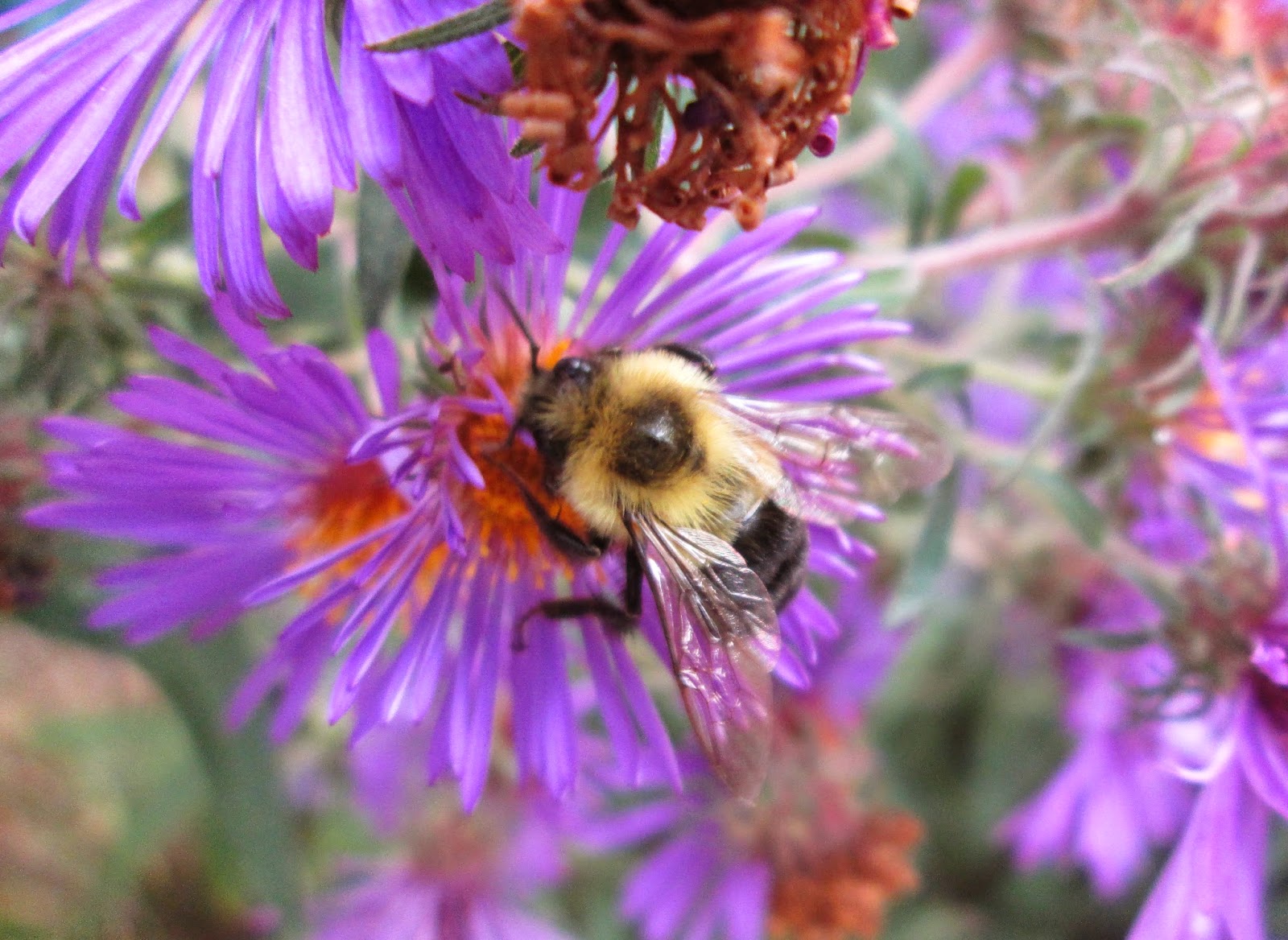
More interesting than the late plants are the insects that are hanging on into the fall. Bumblebees are still active, and I get a little sad each time I see one of the fuzzy girls going about her business. Worker bumbles live only a single season, so the bees buzzing around right now have only a few more weeks to live. They probably don't know this fact of insect life, so they keep doing what they do up until the end. There is probably a message there.
Our New England aster and "Fireworks" goldenrod started blooming well before fall flowers are supposed to bloom, and the cold snap we had did in most of the blossoms, including all the "Autumn Joy" sedum. But a few have hung on, and a few plants that had gone dormant seem to have been revived by the cold. We have rudbeckia flowering again and will have a few obedient plant spikes in bloom if the frost waits a while.
More interesting than the late plants are the insects that are hanging on into the fall. Bumblebees are still active, and I get a little sad each time I see one of the fuzzy girls going about her business. Worker bumbles live only a single season, so the bees buzzing around right now have only a few more weeks to live. They probably don't know this fact of insect life, so they keep doing what they do up until the end. There is probably a message there.
Subscribe to:
Posts (Atom)