About Me

My photo
I'm a woman entering "the third chapter" and fascinated by the journey.

Saturday, June 30, 2018

Pollinators and Puddlers

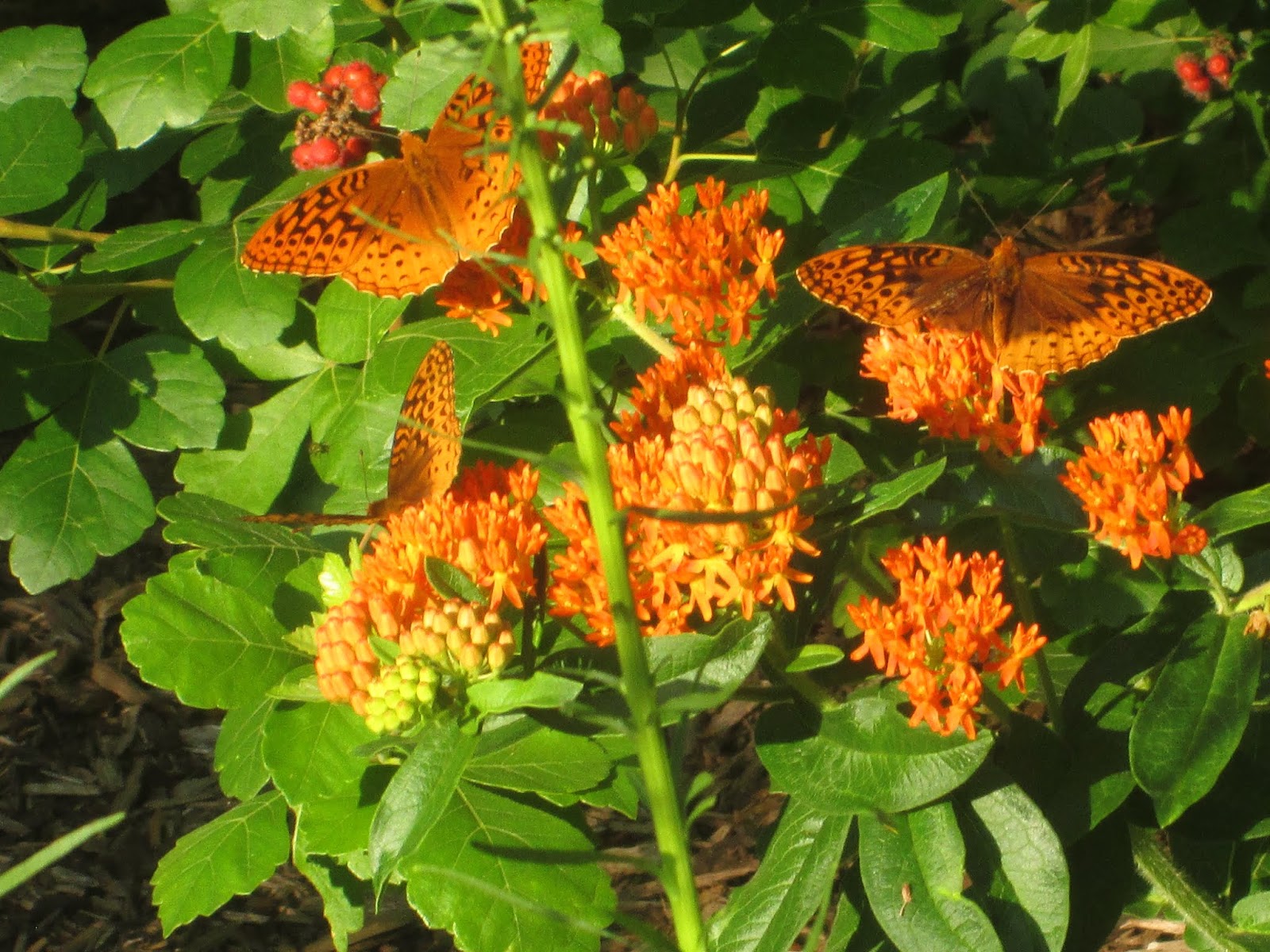
Today was a good day for insect observation. Most obvious were the fritillaries found everywhere a patch of any sort of milkweed could be found,


but the skippers were also out in abundance.


I do find their little club antennae ridiculously cute. 

The rain garden at Mallard Lake in Oak Openings Metropark is becoming an insect magnet. Created  to capture runoff from a parking area, 


it is hardly pristine habitat, and yet habitat it definitely is. 


In just a few minutes of watching, I observed not only fritillaries and skippers but several kinds of bees and wasps, some of them new to me. The plants were nothing out of the ordinary, an assortment of the yellow daisies ubiquitous to Ohio summers and a swath of small-flowered thistle, all of the clumps working with pollinators going about their business. The takeaway: if you plant it, they will come.

This was also a good day for puddling pollinators, though the boys I saw were using an area where the gravelly sand appeared dry (and visibly-damper paths were nearby). Still, this battered fritillary (out of whom someone seems to have taken a bite)


and this sootywing were finding something to their liking.


In nature, there is evidently something for everyone.

Friday, June 29, 2018

Another reason to love milkweeds (as if we needed any)

I suspect that by now nearly everyone knows about milkweeds and monarchs, though far too many people still shy away from plants that have "weed" as part of their common name, and Aesclepias syriaca does indeed have a tendency to spread itself around. In my downtown yard, wandering monarchs have to make do with swamp and butterfly milkweeds, which thus far have exhibited no expansionist tendencies. But monarchs are not the only gorgeous insects with a fondness for these plants.

This morning, the common milkweeds along the multipurpose trail at Oak Openings Metropark were being mobbed by great spangled fritillaries, often several on a single bloom cluster.


I have learned that this behavior is common in this particular butterfly, which seems to enjoy sharing meals with friends, but the sight of gaggles of orange butterflies making use of swaths of pink poofy blossoms is an impressive one (not that my point-and-shoot has enough zoom to get details of the gaggles--you will need to do your own meadow-strolling for that). The larvae of this handsome butterfly eat violets, but the adults definitely like their milkweed nectar.


Male fritillaries are reputed to enjoy the occasional snack of dog poop, but none was on offer today.

Saturday, June 23, 2018

Not your usual wildlife area

Last week found me back in Tampa for the 2018 Advanced Placement reading for English language: 1600 English teachers scoring around a million and a half essays--in eight days--in one room. Both the convention center and the hotels in which the readers were ensconced are on the Tampa Riverwalk, which is definitely not the downtown Tampa of the late seventies, when I was a student at USF and the city was in the midst of a wave of violent crimes. Today the Riverwalk is lined with high-rise hotels, office complexes, and expensive condos, with people still enjoying the view and the amenities most nights when I fell asleep, with other intrepid souls jogging even before sunrise. A lovely place, but not where one would expect particularly good wildlife-watching opportunities.


And yet, some of my fellow readers were blessed with porpoise and manatee sightings in the Hillsborough River, a shallow estuary that in my student days was seriously polluted but is returning to health, thanks to forward-thinking city governments and lots of citizen involvement. I did not get to see any aquatic mammals, but laughing gulls were the background track to every  walk, and my lunchtime view on the last day was of a pair of ospreys swooping about. Every evening at sunset, great blue herons glided overhead, returning to their nearby rookery, and a particular set of bridge supports became the roost for a diversity of area avians: not only the ubiquitous pelicans but white ibis, great egrets, and snowy egrets, along with several scruffy grayish birds with a wading-bird form, possibly some of the smaller herons.

Seeing places working on ways to coexist with wildlife makes me happy.

Sunday, May 27, 2018

'Tis the Season

After the Winter That Would Not End (most of which, admittedly, I missed by being in Mexico), the Mid-Ohio Valley moved into a truncated spring in which all sorts of things seemed to be happening at once. I, at least, do not expect the bloom seasons of irises and trilliums to overlap,

but this year, they did, the trilliums not venturing above the snow until early May and the first bearded irises opening a week or so later.  Nor do I remember yellow lady's slipper orchids


blooming at the same time as the year's first antique rugosa, but there they were at the Toledo Botanical Gardens last week


not that this phenomenon is cause for particular complaint.

Of course, when plants do their spring thing, the birds and the bees also become active, like this bumblebee nectaring on a front yard baptisia.


 There is lots of bird activity in the neighborhood, with the red-shouldered hawks nesting again in the old sycamore on the next block.


Messy yards like mine, where oddments of twigs and dried grass are to be found, have proven useful to the robins, which are frequently seen departing with beakfuls of materials for their second nest in the lawn strip kousa dogwood. A pair of cardinals has chosen the red maple next to the kousa, while something small and brown has built a nest high in the walled garden's Norway spruce, a tree I would never plant but which the neighborhood birds have claimed for themselves.

Spring took forever to arrive, but it is definitely here.

Thursday, May 17, 2018

Woodland magic

Mid-spring is a great time to be in the woods. In our more-or-less northern region (Minnesotans and Canadians, I have learned, tend to think of even northern Ohio as the South), the literal snowbirds like warblers and tanagers have returned from their winter homes, and the spring ephemerals and early understory shrubs are giving it their all.

Today's ramblings took me through the shade garden at the Toledo Botanical Garden and along the upland woods trail at Toledo's Wildwood Metropark, two of my favorite places in the world.

Edge of the woodland garden at the TBG

This year's bloom schedule has been unpredictable, given the Winter that Would Not End, and I managed to miss trillium season at the TBG, which grows multiple varieties of that signature Ohio wildflower. But the rhododendron walk was coming into its own,


A favorite specimen

and the Bluebell Wood was in full bloom, not that I could get a decent picture. The shooting stars (Dodecathon media) were putting on quite a show,


blooming in large stands of their own, as well as accompanying neighbors like wild geranium


and yellow lady's slipper.


The ephemerals are going strong at Wildwood as well. A few trilliums are hanging on, along with both common and white violets. 


Perhaps my favorite see-it-while-you-can beauty our woods, though, is mayapple, currently covering hillsides throughout its range. A swath of mayapple leaves may not produce much reaction from the average human viewer,


but there is something magical about a flower found underneath the leaves, not bothering to flaunt itself for the likes of us.


It's almost enough to make a person believe in fairies.

Friday, April 27, 2018

Happy to Be on the Planet

     Spring is finally springing, though I am not yet sprung from a most annoying mobility problem that has been going on for far too long. Still, this week is finding me back in the Oak Openings region, one of my favorite places on the planet (despite the folks who think that flattish parts of the world are lacking in dramatic landscapes), and today I opted to see how far my feet would take me in a favorite park.
     The answer, unfortunately, is not as far as I would like, but being forced to slow down has its rewards. For starters, noticing details. Normally, I would not check out a tiny access trail to a picnic area, but today, I did, and found it spangled with clumps of hepatica, one of the spring ephemerals that has a season even shorter than springtime in Ohio generally is.


An understory shrub (which, unfortunately, I have not yet identified) with tiny yellow flowers was in bloom along the creek that feeds Mallard Lake.


And while I am not generally a fan of manmade lakes (okay, I'm a landscape snob), the lake today was perfectly fine as a reminder of how lovely this planet can be.


     When I decided to sit for a few minutes, the conveniently-located ledge was next to a dandelion, providing an opportunity to view the intricate blossoms up close.


In my not-so-humble opinion, nothing this beautiful or this useful to a multitude of species can fairly be called a weed.

     The animals were out in force along this only-slightly-over-a-half-mile trail: chipmunks giving alarm calls (whether because of the proximity of humans or the hawk drifting overhead, I don't know), fox squirrels looking for cached nuts, woodpeckers drumming, chickadees and goldfinches going at the feeders, LBJs galore, and an eastern phoebe gathering nesting materials. This handsome fellow


and his lady are already incubating a clutch of eggs, and a few pollinating insects were buzzing about.

     Sometimes, being forced to limit one's routine is perfectly fine.

The title of this post, by the way, comes from a song by the fabulous Deirdre McCalla. If you don't know her work, you should.

Tuesday, March 20, 2018

Satan's food

at least, according to John Milton in Paradise Lost, in which the fallen angels eat apple of Sodom, instead of the actual apples that they had forfeited. "Apple of Sodom" is the provocative name of Calotropis procera, a tropical shrub in the milkweed family. The plant is commonly cultivated here in coastal Yucatan, and in bloom, it is gorgeous.


This six-foot plant grows in almost pure sand, in shallow soil, in dryland areas. It tolerates salt, hence its popularity in some beachside communities. Its taproot holds soil. As a member of the milkweed family, it can host monarch butterfly caterpillars. In its native range of parts of Africa and Asia, it has served as a cover crop and green manure and has long been used in traditional medicines. Beautiful, tough, useful: what's not to like?


Plenty, it turns out.

First, it spreads. This lovely plant produces lots of seeds, nestled in silk and carried away on the winds. Given its propensity for growing in areas where most plants struggle, it is now found throughout the tropics and in many subtropical areas, including Hawaii.

Second, because it attracts butterflies and can host monarchs, Calotropis shows up on lists of good butterfly plants, and from what I have read (and the numbers of monarchs I am seeing here), it does indeed feed monarch cats and other lepidoptera. However, like all invasives, Calotropis displaces native species and disrupts already-fragile ecosystems. Enough habitats are at risk already; we do not need to make the situation worse because of our fondness for pretty flowers and orange butterflies. 


 Third, Calotropis, like all milkweeds, contains toxic alkaloids, a trait that helps to keep it from being eaten (and increases its invasiveness). However, in the dryland areas where the plant is most likely to spread, hungry goats and sheep have been known to browse it, with unfortunate (though fortunately not generally fatal) effects. Still, endangering the livestock and livelihoods of small farmers is not a good idea. The plant is so toxic and so invasive that South Africa and Australia have not only banned its cultivation but have ordered its eradication wherever it is found.


I would not go so far as to call this lovely thing Satanic, but it does seem to be a baleful beauty.