About Me

My photo
I'm a woman entering "the third chapter" and fascinated by the journey.

Wednesday, August 25, 2021

Happenings at the Habitat

 Our little riverbank pollinator habitat has come a long way since Phase One was planted back in May. There is very little bare soil (well, mulched soil) visible now because the plants have done so well (though we did lose one liatris and something that was moved when its neighbors became too enthusiastic). This has replaced the weedy tangle of last year and the black plastic that covered the site through the winter.

The human neighbors report being happy with the progress, and our table at a recent festival drew lots of positive comments, along with an expanded volunteer list. Even more importantly, the site is drawing lots of pollinators and other small living things. 

While they have refused to pose for a photograph, goldfinches are regular visitors to the zinnia patch, where they scarf down the seeds. We expect the liatris and echinacea to start getting some avian attention soon, but in the meantime, they are popular with insects.

This was a popular plant that morning.


Skipper on liatris


Some creatures I with which I was unfamiliar have found their way to our little patch of riverbank. This noble scolid wasp (Scolia nobilitata) is supposedly common and widespread, but I had never noticed one before. Its larvae feed on beetle grubs, so I suspect they will find plenty of food in the turfgrass planted next to our site.


And while leafhoppers can be a problem in some settings, this little guy (possibly a candy-striped leafhopper, though there are several species that look basically alike to an eye as untrained as mine) struck me as ridiculously cute. 


You never know who will be out for a stroll.


Sunday, August 15, 2021

Changes

 Today I discovered that Finch Field is no more. Oh, the field is still there, 


and it was plenty lively, with lots of bees, a scattering of butterflies, and even this adorable ailanthus webworm moth,

but not the hordes of goldfinches that led me to give this portion of the Wildwood Metropark meadow its name. I think I know why, and the reason is not necessarily one to lament. 

In prior years, the walking path through this particular field was lined with thistle, a giant, utterly gorgeous pollinator magnet with finch-loved seeds and thistledown for the making of finch nests.

Thistle buds are among the loveliest of immature flowers, in my humble opinion.


However, it turns out that most of the thistles most commonly found in Ohio in fact originated in Europe, and even though they have made themselves at home and a variety of our native birds and insects have made use of them, non-native thistles are now listed as invasive plants, even as noxious weeds. I don't know if the Metropark system deliberately eradicated some of its Cirsium or if natives like the ironweed and Joe-Pye that are currently proliferating simply outcompeted the European biennial, but more native flowers and grasses in a public preserve are always a good thing.

The goldfinches will adjust. I am reasonably certain they predate the European conquest of Ohio.


Monday, July 26, 2021

Cup of gold

 Silphium perfoliatum, our native cup plant, is no shrinking violet. Native to fields, prairies, roadsides, and ditches, this enthusiastic yellow composite can reach heights of ten feet, making it one of Ohio's most striking wildflowers. As tough as it is beautiful, the specimen in my old yard survived at least two years heeled in in a pot much too small for its root system, the gnarled result having to be cut out of its broken container when I finally got around to planting it (hence my Wildlife Gardeners title of "Official Silphium Abuser"). The clump below survived by pushing its way through the solarization plastic on the slope intended to house Phase Two of the Fort Street Pollinator Habitat. (In our volunteers' defense, we got the site in November, when the silphium had already collapsed into a mass of dried stems, so we did not know what a treasure we had.)


While this particular yellow daisy can be a bit much for some tastes and is, admittedly, not well-suited to a small urban garden, it is a fabulous wildlife plant. The common name refers to the "cup" formed by the leaves growing from the stem, which is a drinking water source for small birds after a rain.

Goldfinches seem as fond of cup plant seeds as they are those of its cousin, the annual sunflower, and this beauty comes back on its own every year. It is a favorite pollen source for bees, 

and some species of leafcutter bees nest in the hollow stems that remain at the end of the growing season. It also serves as a larval host for some moth species.

Besides, cup plant is attractive in all stages of growth. The leaves are lush, the blossoms are undeniably impressive, and the buds and opening blooms are just plain fun.


Yes, we're going to have to keep an eye on our golden Silphiums to be sure they don't take up too much room, but we suspect the Joe-Pye weed going in this fall will be able to hold its own.


Tuesday, July 13, 2021

Small things

     This is hardly optimal wildlife habitat,

being a roughly 15x20-foot patch bordered by two sidewalks, a driveway, and a fairly busy street. Of course, being a plant nerd, I pack a lot into the space,


including things that probably shouldn't grow there, like Joe-Pye weed, which I do at least whack it to keep it short(ish). But how can any garden not welcome any plant that does this?


Joe is such a sociable plant.

    My little space attracts all the usuals--skippers, swallowtails, fritillaries, crescents, bees, predatory wasps, the occasional monarch--but things new-to-me have also been known to visit. These swamp milkweed beetles were getting a bit frisky on the whorled milkweed.


And this spotted thyris moth was like nothing I had ever seen before.


All this adult insect activity indicates that larval hosts must be somewhere nearby, and they are. My little patch sits across the street from the city arboretum, home to oaks, maples, and tulip poplars more than fifty feet tall, along with younger specimens of a good many species. All those native trees, coupled with the "enthusiastic" planting on my corner, provide homes for a lot of "the little things that run the world," as Half-Earth Project founder E. O. Wilson describes insects.

    And all those insects provide a lot of bird food. The species nesting in the trees on our perhaps-tenth-acre lot include robins, chickadees, titmice, wrens, cardinals, and at least two kinds of sparrows. The dozens of trees in our block of the arboretum provide homes for others, not to mention a sizable population of squirrels. The red-shouldered hawks that make their home less than a block away seem to be finding plenty of food, as do the bats, swallows, and nighthawks that come out at dusk. The number of adult fireflies lighting up the neighborhood are an indication that their carnivorous larvae are eating something. 

    This area is not pristine wilderness, but it is definitely habitat. Small spaces can provide food and shelter for a myriad of small creatures, and those small creatures make up a big part of our shared world.


Tuesday, June 29, 2021

Beauty, are you not enough?

 So asked the poet Sara Teasdale in her 1915 poem, "Spring Night," and while the speaker in the poem never answers her own question, I would have to say "No." Of course, the sorrowful young woman in the poem is moping about because of her lack of a love interest, while I am complaining about a physically lovely plant that is verging on becoming an invasive in our yard. 

I refer to the Asian kousa dogwood, widely planted in the US because of its resistance to the anthracnose that plagues our native Cornus florida. This small tree is definitely a beauty, blooming several weeks after its cousin and possibly for a longer period.


But.


The areas underneath our trees are liberally sprinkled with baby kousas every year. Sometimes they hide behind other plants, and are a foot or more tall before I notice them. When we moved in, several years after the decline and death of the home's previous inhabitant, the walled garden near the house was home to two volunteer kousas nearly as tall as I. But free trees are a good thing, right?

Not always, and not in this case. One reason for Cornus kousa's "success" in North American landscapes is that it is not particularly attractive to North American wildlife. Pileated woodpeckers have been reported to feed on the strawberry-sized fruit, and I have seen squirrels nibbling on them, but this Asian dogwood's fruits are too big for most songbirds. The much smaller berries of our native dogwoods are more suited to our birds, which did, after all, co-evolve with them. 

The real problem with this tree, though, is that it feeds zero caterpillar species, and caterpillars are essential to most terrestrial food webs. Nearly all songbirds feed their young a diet composed mostly of lepidoptera larvae, so no larvae=no baby birds. In ecosystem terms, kousa is not only invasive but basically useless. In contrast, Cornus florida, the common eastern dogwood, supports 117(!) moth and butterfly species, which in turn support birds and other wildlife. Deciding which tree to plant should be pretty much a no-brainer.

Beauty is absolutely not enough.

Monday, June 21, 2021

Another nearly perfect plant

 It has been a while since I wrote about particular plant species, but this week has brought the first peak bloom of Coreopsis verticillata, specifically the cultivar "Zagreb," in the front yard. (Why a North American native composite bears the name of an Eastern European city is a mystery for another day.) As far as I can tell, "Zagreb" differs from the straight species primarily in being more compact. The bees certainly have no problem using it.


Zagreb has been on my list of Nearly Perfect Plants for some years now, for a number of reasons. First, it is nearly indestructible, unless one does foolish things like feed and water it, though watering it in extended periods of 90-degree drought is acceptable. This little yellow daisy thrives on benign neglect.

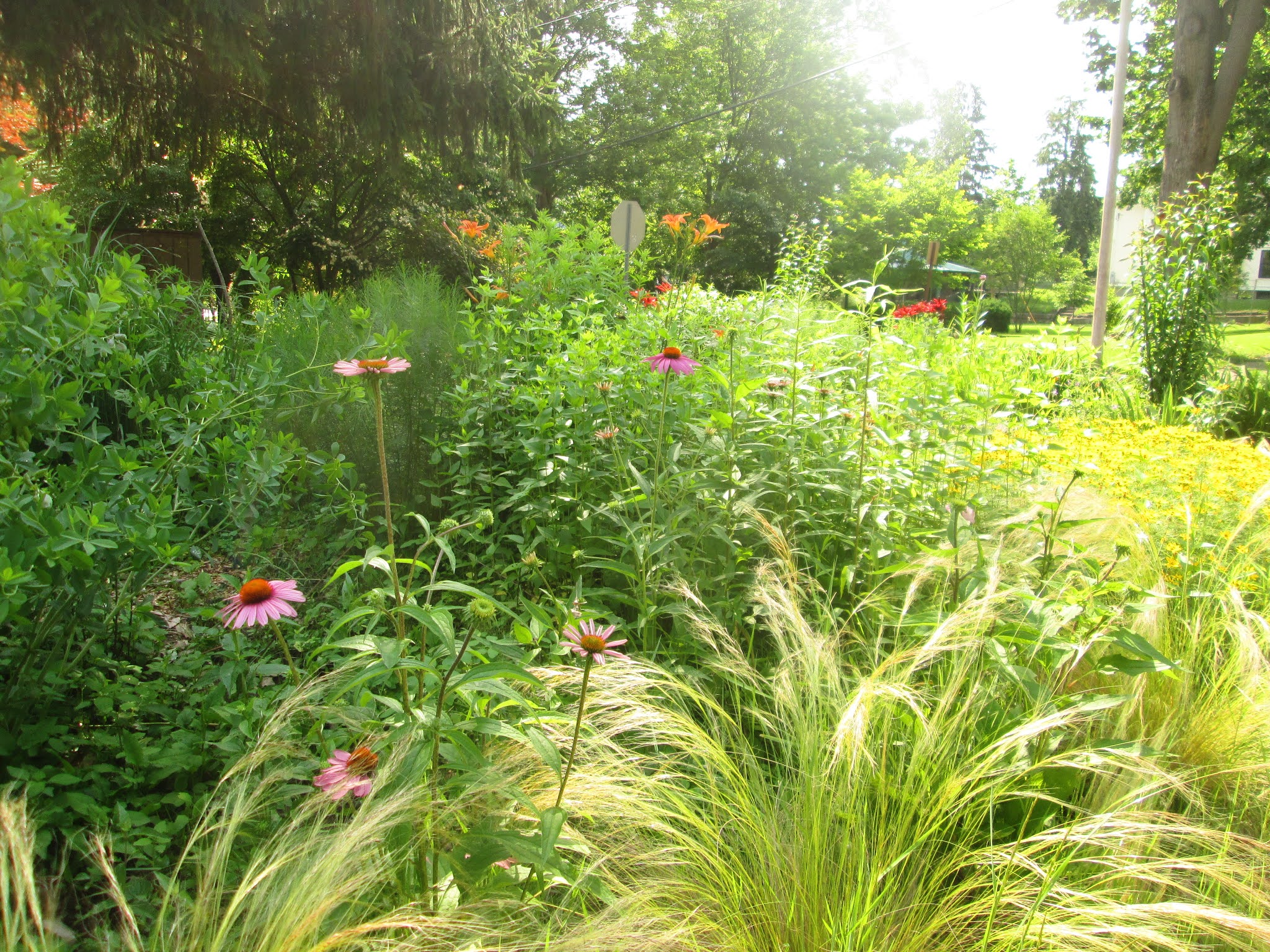
Second, it plays well with others. It grows happily in our streetside "hellstrip" with feather grass and assorted native perennials (plus a ditch lily that keeps coming back no matter how many times it gets removed). 


I am particularly fond of late afternoon sun hitting this green-and-gold combination.


Zagreb is a pollinator magnet, and one that starts blooming in early summer before the heavy hitters like goldenrod and Joe Pye weed even have buds. It blooms for several weeks, making  butterflies and bees and those of us who like them very happy.

It is also reasonably well-behaved. (Note that I did say "reasonably.") A clump will indeed grow larger every year, but this shallow-rooted plant is easy to divide, meaning that one good start of it will allow for easy propagation. Gardeners on a budget particularly appreciate this trait, which enables the plopping of clumps of golden daisies in multiple places.

Cheerful, useful, friendly--what's not to like?


Friday, June 11, 2021

It takes a village

to green a city. The original Harmar Riverbank Pollinator Project is coming along nicely (or at least the plants we planted have all lived--though the plants we don't want are making an enthusiastic return and the best poison ivy remedies are a frequent discussion topic among volunteers). The city has made water available and a neighbor has given us a spot to store a hose, so the recent hot, dry spell seems to have done no harm. The annuals tucked in for some immediate color and nectar are blooming, the perennials are considerably larger and fuller than they were, with a few blooms showing up on the early species, and more plants have been donated to the site. These are Good Things.


Perhaps even better news than plants that have not died is the support from residents. People walking past regularly stop to chat with volunteers, and the garden team is growing. Surprise support shows up.  On a recent work day, an artist walking her dog ran back to her home for items to make that day's edging task easier--and trusted that we would get them back to her. It's that kind of place.

Perhaps even better is that another pollinator-friendly public garden is taking shape literally just around the corner, again created by volunteers, including a city council member and the owner of a floral design shop. Again, the neighborhood stepped in. In the middle of what is to be a flowering walkway was an old post that once held a sign that no one seems to remember. The post had been largely dug out by an intrepid volunteer, but it was set in concrete, and that day's team tended toward gray hair and joints not what they once were. 

Then, out of an apartment across the street, emerged a guy who literally wrestled the post out of the ground and onto the sidewalk. Another neighbor brought a chainsaw, and the ancient post quickly became history. (Apologies for the blurry photograph.) 

Yes, it is that kind of place. Stay tuned for further developments.