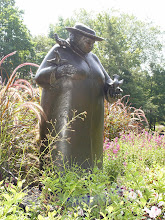
One might think that this would be a peaceful place.
Yesterday morning, however, it was not. The prairie was alive not with the sound of music but with the sound of traffic. In a 500+-acre preserve, several hundred yards from the nearest road, the background roar was such that I found myself unable to concentrate on enjoying one of my favorite places. The same was true when I left the prairie trail for the woods, where the wind in the trees often muffles traffic noise.
But not yesterday. The urban park felt more urban than park.
In recent weeks I have become progressively more annoyed with machine noise. Second Street, where I live in an often-seemingly-idyllic small town that regularly appears on places-you-have-to-visit lists, is not a truck route, but Third Street is, and the bridge on the cross street carries truck traffic to the factories and injection wells on State Route 7. (Some times of the day, walking the street that leads to the bridge is not a good idea because the diesel fumes are so overwhelming that a bronchodilator is necessary, but that is a different rant.) The recent fracking boom has led to increased traffic and of course increased noise. Porch-sitting, one of my favorite outdoor non-activities, is no longer a joy. You can't yell "Get out of my neighborhood!" to a brine truck, and those big engines can only be quieted so much. Even the sounds of ordinary cars leave me irritable these days.
So I took advantage of a few days with nothing scheduled to get away. Unfortunately, my favorite northwest Ohio park was no haven, sitting as it does between three busy roads. However, Lucas County is full of parks, so off I went to another several miles outside of town where the roads are much less busy than they are in the city.
There, a park employee was using a gas-powered leaf blower to remove approximately twenty-five leaves from the extensive walkways surrounding the parking lot and nature center. He had hearing-protection equipment. I did not.
But at least I had remembered my inhaler.
About Me
- Rebecca
- I'm a woman entering "the third chapter" and fascinated by the journey.
Monday, October 21, 2019
Friday, September 13, 2019
Life and Death in the Meadow (not for the squeamish)
It is obvious that meadows (and their prairie relatives) are full of life. Flowers, grasses, butterflies, and birds are everywhere.
This little cutie is a silver-spotted skipper.
And we musn't forget the bees, who love meadows.
This particular spot near Wiregrass Lake was hosting dozens of swallows, swooping and twittering the whole time I was there,
and the grasses near the Meadowhawk Shelter were indeed hosting meadowhawks, this one a male ruby.
But all that life comes at the expense of other life. Dragonflies this year are so numerous that they show up on National Weather Service radar, and, gorgeous as they are, dragonflies are consummate predators. A few yards away in the same meadow, this handsome fellow was having an insect snack.
The unfortunate prey vanished in only a few seconds.
The same meadow plants that attract pollinators also attract pollinator predators. Meandering along, I saw what at first seemed to be a bumblebee spending an unaccountably long time perched on a bare stick but proved to be a bumblebee captured by a praying mantis.
Mantis carnivory is not pretty.
Even those lovely, swooping swallows were hunting as they made their loops over the meadow, and the butterflies nectaring on the blossoms were also looking for places to lay eggs, where their caterpillars could chew holes in the leaves of their chosen hosts-
-if, that is, they manage not to become food for the baby birds dependent on caterpillars for their first diet.
Nature can be beautiful, but she is not particularly kind to individuals.
Wednesday, August 28, 2019
The magical meadow morning
I love lots of places, but one special favorite is a spot on the meadow loop trail at Toledo's Wildwood Metropark, just beyond its intersection with the floodplain trail and near the paved bike path. This small section of a very busy park is not wilderness, but I have spent as long as half an hour there without encountering another human.
One of the attractions of my favorite bench is the view of this white oak, which I always think of as the Prairie Sentinel (even though this meadow is technically not prairie). When I first encountered the tree in 2010, a man was seated on one of its spreading branches making notes about something below, but the discovery of nesting bobolinks led to the closure of that trail.
This little patch of restored grassland was a lively place this morning, filled with the hum of cicadas and the hovering of meadowhawks, those lovely-to-us dragonflies that are no doubt the terror of other insects. Hawks of the avian variety occasionally rode the thermals overhead, though their presence did not seem to make the smaller birds particularly nervous.
A pair of hummingbirds rested briefly on a dead limb just a few feet from my bench; as is the way of hummingbirds, they didn't stay long in one place. The stars of today's show, however, were the goldfinches, which were everywhere, swooping above the meadow in their unmistakeable flight pattern. It has always intrigued me that a bird this showy can very nearly disappear when feeding, but the males' breeding plumage is the color of many of our summer flowers, and the females' olive drab blends right into flower stalks, allowing them to forage unseen. (Let's hear it for evolution!) Of course, this trait makes photographing the little lovelies impossible with the limited zoom on my pocket-sized point-and-shoot.
Particularly amusing were what seemed to be Goldfinch Wars over a particular patch of thistle. The meadow has been invaded by quite a bit of Cirsium, but today everyone seemed to want this specific group of plants; none of the others would do, so much diving, chasing, and twittering ensued.
The decision of the human to walk over to see what all the fuss was about led the quarreling finches to explore other parts of the meadow, but the thistle patch was most satisfactory, anyway. Thistle bloom is quite lovely, despite the weediness of so many plants in the genus,
and today, after the goldfinches left, the pollinators took over the patch.
Not a bad way to spend part of one's morning.
Saturday, July 13, 2019
A possible cure for the insect apocalypse?
The last few months have brought alarming reports on declining insect populations, a phenomenon that has been dubbed the "insect apocalypse." Given that insects are an essential part of all terrestrial food webs (and that a lot of human food depends on insect pollination), this news is beyond alarming. Out for a walk through Toledo's Wildwood Metropark yesterday, I was deeply troubled to find almost no insects in Susan's Meadow, an area generally buzzing with life. (Sorry--I couldn't resist.)
There were a few butterflies flitting here and there, some tiny flies, and an interesting creature I could not identify on a monarda,
but none of the clouds of bees usually found there. Nor were there any goldfinches, whereas last year they were swooping around in what looked like aerial dances. An Ohio summer without insects is Not Normal.
Leaving the meadow and heading toward the manor house (Wildwood having been part of a wealthy family's estate at one time), I decided to check out the rain garden and found where at least some of the bees and other buzzing insects had gone; they were all over a blooming buttonbush (Cephalanthus occidentalis).
This cousin of coffee, gardenia, and sweet woodruff(!), it turns out, was once a major nectar source for a beekeeping industry in the southern US, and is an important larval host for several showy moth species. The Xerces Society (and if you aren't familiar with this organization, you need to remedy that situation immediately) regularly includes buttonbush on its lists of plants for bees and butterflies. In addition to being useful to insects, buttonbush produces fruits eaten by more than fifty species of birds.
These need to ripen for a few months.
This common native plant takes a fair amount of space and water, occurring as it does in wetlands and damp woods, but in the right setting, it seems to garner more insect attention than anything else in the vicinity. Something else to add to your "if you plant it, they will come" list.
Thursday, May 16, 2019
"Admire me I am a violet!"
Something no self-respecting violet would ever say, according to poet John Keats in a letter to a friend; in his view, "retired" flowers like violets and primroses would lose their beauty if they called attention to themselves. With all due respect to Keats, when the common blue violet is in bloom in its thousands in an Ohio April, the spectacle is pretty attention-getting. I have never taken a photo that does justice to the show, but the swaths of deep purple resting just above the deepest spring green in every Marietta park are not exactly shy about making their presence known.
And why should they be? Violets are not only an indestructible ground cover, they are the sole larval host for the great spangled fritillary, one of our most beautiful butterflies, and a major early pollen source. They deserve to strut their stuff.
But the flowers we think of when we hear the word "violet" are not the only types. Besides numerous species of purple violets that I am not in good enough shape to identify (since me crawling around on the ground with a magnifying glass would be a whole other kind of spectacle), Ohio also boasts violets of other colors. For several decades now I have looked forward to the shy blooming of the white violets descended from the patch in a deceased friend's yard. Unlike their common cousins, white violets do not spread aggressively but keep within bounds and play well with others.
And yesterday I saw my first specimens of a violet I had not known existed, the (supposedly) common yellow violet (Viola pubescens), growing in several areas of Wildwood Metropark. This little beauty is pickier about siting than Viola sororia, preferring to grow in relatively undisturbed soil in forested areas.
As far as I know, this particular violet does not grow in England, but it behaves much more like those Keats described. Those of us who want to appreciate it will need to seek it out; it won't shove itself in our faces.
Friday, April 12, 2019
Following my nose to a new discovery
The Toledo Botanical Gardens are not as colorful this spring as they have sometimes been. Yet another Winter That Would Not End has delayed quite a few of the spring bloomers, though the daffodils are being their usual cheerful selves and looking quite lovely amidst the birches.
Walking along the path next to the walled garden, though, I was hit by a sweet scent too powerful to be coming from a few ground-level narcissi, so of course, I had to follow my nose. The scent was coming from a shrub I had never seen before.
Given that Abeliophyllum is as easily propagated as its yellow cousin, there is no excuse for wild collection of this plant. Any branch that touches dirt can be rooted by simply pegging it to the soil or even placing a brick to keep it in contact, so if you feel the need to acquire white forsythia, please make sure that it was nursery-propagated and not wild-collected.
The scent is wonderful, but allowing this plant to become extinct in the wild would not be sweet.
Walking along the path next to the walled garden, though, I was hit by a sweet scent too powerful to be coming from a few ground-level narcissi, so of course, I had to follow my nose. The scent was coming from a shrub I had never seen before.
This not-particularly-impressive-looking thing was the source of a spicy sweetness noticeable several yards away. My first thought (after "what is that thing?") was that it looked like a white forsythia, and a little snooping revealed that this is more or less what it is. White forsythia is one of the common names of Abeliophyllum distichum, a Korean endemic now listed as "endangered" in the wild, with fewer than 4000 specimens remaining. The International Union for the Conservation of Nature lists habitat loss from deforestation and "ruthless collection" as contributors to the species' precipitous decline in its natural habitat.
Given that Abeliophyllum is as easily propagated as its yellow cousin, there is no excuse for wild collection of this plant. Any branch that touches dirt can be rooted by simply pegging it to the soil or even placing a brick to keep it in contact, so if you feel the need to acquire white forsythia, please make sure that it was nursery-propagated and not wild-collected.
The scent is wonderful, but allowing this plant to become extinct in the wild would not be sweet.
Wednesday, April 10, 2019
A fine day
Yesterday was a good day to wander a couple of favorite parks. Not much is blooming yet in northwest Ohio, but the trilliums are beginning to show themselves,
and the chionodoxa at the botanical gardens are at their peak.
Not quite an English bluebell wood, but not bad for a public park in an ordinary neighborhood.
And when the warblers are warbling, the peepers are peeping, and the spring colors are this fresh, we can wait a while for the flowers to take over the show.
Subscribe to:
Posts (Atom)
