Emily Dickinson had it wrong--at least, when she described the late-summer insect chorus in this way:
Further in Summer than the Birds
Pathetic from the Grass
A minor Nation celebrates
Its unobtrusive Mass.
Now, it is entirely possible that the insects of August in late 19th-century Massachusetts were very different from those in early 21st-century Ohio, but I suspect that the difference may have been in the mood of the beholder. Yes, summer is winding down, especially for those of us still bound by the academic calendar, and many of our summer insects are nearing the end of their lives, but the calls of the dog-day cicada do not seem particularly sad to me. You can check out the sounds of the bugs currently making a racket outside our house in this YouTube clip.
Groups of insects seem to be singing at each other, those across the street in the arboretum starting the chorus, which is then picked up by the boys in the lawn-strip maple. Not to be outdone, those in the walled garden come in as the others fall silent, and when their verse ends, the next movement starts in a different neighborhood tree.
Based on the sound, I have tentatively identified our singers as Tibecen winnemana, commonly known as the scissor-grinder or dog-days cicada. These large bugs are part of a group known as annual cicadas, related to the red-eyed seventeen-year cicadas with which many of us were inundated earlier in the summer. Unlike their cousins, however, broods of winnemana emerge every year, although individual specimens may spend as much as five years underground before emerging for their month-long songfest.
According to certain old wives, the first frost should occur about six weeks after the annual cicadas begin to sing. October 1 seems too early for frost, but after the heat of the last couple of weeks, maybe a frosty morning wouldn't be so bad.
About Me
- Rebecca
- I'm a woman entering "the third chapter" and fascinated by the journey.
Monday, August 15, 2016


Friday, August 12, 2016
Not just the rubber capital
Embarrassing as it is for someone who has always considered herself a nature lover
to admit, I do not spend much (any?) time in really wild places. Being
sixty years old, overweight, asthmatic, and arthritic, I avoid places
where I am likely to fall down the side of a mountain and lie there for days until
someone less clumsy finds me or I am eaten by bears or panthers. My
adventures are all of the soft kind. Sigh.
Fortunately, some visionary soul a few centuries ago invented the idea of public parks, and Ohio is full of them. Last weekend found me visiting Akron, which in my early years always sounded like a thoroughly dismal place. I mean, "The Rubber Capital of the World"? It turns out, however, that F. A. Sieberling, the man who founded the Goodyear Tire Company in 1898, was also a great lover of his city and donated hundreds of acres and millions of dollars to improve the quality of life in Summit County. (Sieberling, by the way, also lived in perhaps the ultimate Tudor Revival home, Stan Hywet, the gardens of which were designed by Ellen Biddle Shipman.)
One park created from former Sieberling land is Nature Realm, which sits on the edge of town and contains a variety of my favorite things: tallgrass prairie, wet meadow, woodland lake, formal gardens, and this lovely little ravine, over which a suspension walkway has been built. We saw no bears or panthers.
 .
.
This summer, Akron's Metroparks have been combining their natural loveliness with children's poetry reproduced on signs along the walkways

and public art, like this sculpture near the entrance to the herb garden

and this Thomas Wilmer Dewing painting from 1900, Symphony in Green and Gold.

(No such romantic figures were musing by the park's lake, only geriatric couples, young families, and lots of birds. But it is a gorgeous lake, anyway.)

Fortunately, some visionary soul a few centuries ago invented the idea of public parks, and Ohio is full of them. Last weekend found me visiting Akron, which in my early years always sounded like a thoroughly dismal place. I mean, "The Rubber Capital of the World"? It turns out, however, that F. A. Sieberling, the man who founded the Goodyear Tire Company in 1898, was also a great lover of his city and donated hundreds of acres and millions of dollars to improve the quality of life in Summit County. (Sieberling, by the way, also lived in perhaps the ultimate Tudor Revival home, Stan Hywet, the gardens of which were designed by Ellen Biddle Shipman.)
One park created from former Sieberling land is Nature Realm, which sits on the edge of town and contains a variety of my favorite things: tallgrass prairie, wet meadow, woodland lake, formal gardens, and this lovely little ravine, over which a suspension walkway has been built. We saw no bears or panthers.

This summer, Akron's Metroparks have been combining their natural loveliness with children's poetry reproduced on signs along the walkways

and public art, like this sculpture near the entrance to the herb garden

and this Thomas Wilmer Dewing painting from 1900, Symphony in Green and Gold.

(No such romantic figures were musing by the park's lake, only geriatric couples, young families, and lots of birds. But it is a gorgeous lake, anyway.)

Saturday, August 6, 2016
Living on the edge
And no, I do not mean living dangerously. A woman of my age, girth, and general laziness is unlikely to do any such thing unless forced, and my life has been going along pretty smoothly of late. No, I am referring to edge habitat, those areas where two different habitat zones run into each other. While habitat fragmentation is problematic for many species, particularly large land predators, many forms of life do quite well on the edge, where species from different habitat zones can mix and mingle successfully.
Wetlands, such as marshes and riparian forests, are lively as well as lovely places.

Wading birds like the great blue heron hunt in water, but require trees for roosting and nesting.

Marshes and ponds provide happy hunting grounds for small predators as well as large ones. Dragonflies are not generally found in mid-ocean or deep forest, but instead in those places where water meets land-based vegetation.

An ordinary twig on the edge of a well-traveled waterside path gives these deadly little insects a good perch for hunting.
Moving to a different kind of edge, I must confess to being startled the first time I noticed a red-tailed hawk hanging out along Interstate 77, not having realized that hawks make use of the wooded edges of our highways. From a raptor's perspective, a high perch next to a mowed area helps in the search for tasty little rodents.
Not all edges are created equal, however. In general, mowed areas are not as good for wildlife as areas left in a somewhat wilder state.

This butterfly garden, while quite a fine thing, has limited use for small mammals because of the large, closely-mowed area that separates it from an adjoining grassland; chipmunks and rabbits venturing across that expanse would be easy pickings for a hawk (one of which was circling overhead when this picture was taken, no doubt hoping that some unwary creature would do exactly that).
Perhaps my favorite edges are grasslands adjoining woods, which seem to make everybody happy: trees, shrubs, forbs, insects, birds, rabbits and rodents--they're all there, wandering around gorgeous tangles like this one near Akron.

Wetlands, such as marshes and riparian forests, are lively as well as lovely places.

Wading birds like the great blue heron hunt in water, but require trees for roosting and nesting.

Marshes and ponds provide happy hunting grounds for small predators as well as large ones. Dragonflies are not generally found in mid-ocean or deep forest, but instead in those places where water meets land-based vegetation.

An ordinary twig on the edge of a well-traveled waterside path gives these deadly little insects a good perch for hunting.
Moving to a different kind of edge, I must confess to being startled the first time I noticed a red-tailed hawk hanging out along Interstate 77, not having realized that hawks make use of the wooded edges of our highways. From a raptor's perspective, a high perch next to a mowed area helps in the search for tasty little rodents.
Not all edges are created equal, however. In general, mowed areas are not as good for wildlife as areas left in a somewhat wilder state.

This butterfly garden, while quite a fine thing, has limited use for small mammals because of the large, closely-mowed area that separates it from an adjoining grassland; chipmunks and rabbits venturing across that expanse would be easy pickings for a hawk (one of which was circling overhead when this picture was taken, no doubt hoping that some unwary creature would do exactly that).
Perhaps my favorite edges are grasslands adjoining woods, which seem to make everybody happy: trees, shrubs, forbs, insects, birds, rabbits and rodents--they're all there, wandering around gorgeous tangles like this one near Akron.

And as many of us have discovered, sometimes to our great annoyance, the edge habitats we have created in our yards are just perfect for deer.
Sunday, July 31, 2016
And another
Someone (possibly one of the fine folks on the Wildlife Gardeners forum) recommended the mountain mints as tough, pollinator-friendly plants, so when I found some at a plant sale, I nabbed one. (Note to Ohio gardeners: Natives in Harmony offers healthy plants at good prices.) The plant is in its first summer and so has not come into its full glory, but hoary mountain mint (Pycnanthemum incanum) seems to be another winner.
First, I love the coolness of its white leaves on the hottest summer days.

A blogger on The Natural Web describes says the upper leaves look "as if they had been lightly but evenly dusted with powdered sugar," a description that is not far off.
Second, like all mints, this one is deer-resistant, a plus even though deer have not yet found their way to our neighborhood.
Third, the plant is drought-resistant, a plus for those of us looking for garden plants that can fend for themselves. (I have read that it can become invasive, but given that in my yard it has to share space with rudbeckia hirta and hardy ageratum, two favorite thugs, I am not worried about it taking over.)
Fourth, mountain mints are reputed to be pollinator magnets. Each of the plant's many heads is actually an infloresence of dozens of tiny flowers, each containing nectar.

For all that this is our lone specimen's first summer, it seems to be doing its job.

First, I love the coolness of its white leaves on the hottest summer days.
A blogger on The Natural Web describes says the upper leaves look "as if they had been lightly but evenly dusted with powdered sugar," a description that is not far off.
Second, like all mints, this one is deer-resistant, a plus even though deer have not yet found their way to our neighborhood.
Third, the plant is drought-resistant, a plus for those of us looking for garden plants that can fend for themselves. (I have read that it can become invasive, but given that in my yard it has to share space with rudbeckia hirta and hardy ageratum, two favorite thugs, I am not worried about it taking over.)
Fourth, mountain mints are reputed to be pollinator magnets. Each of the plant's many heads is actually an infloresence of dozens of tiny flowers, each containing nectar.

For all that this is our lone specimen's first summer, it seems to be doing its job.

Saturday, July 30, 2016
Another new favorite
But then there are alliums. Who could resist an utterly, improbably gorgeous plant that also happens to be called Star of Persia? Or Purple Sensation? I grow both, along with the lovely oddity called Bulgarian allium. All these members of the onion family are reasonably carefree (although it is possible to drown them), and Ohio does boast a few species of its own. The most decorative is probably nodding onion, allium cernuum, a beauty that I managed not to bring from the old house. Intending to order some, I somehow ordered a Western native, allium amplectens, instead. And I am in love.
This allium is blooming now, months after most of its cousins have gone dormant for the year, adding puffballs of cool white to the midsummer lawn strip.

Playing well with others is an important trait in a flower, and this one does. It is holding its own with (and having its tatty foliage, a common allium failing, hidden by) echinacea, asters, wild ageratum, and whatever else we have growing. Its tiny flowers, several dozen of which make up a single flower head, are also intricate and lovely.

Perhaps its most important benefit in a wildlife garden, however, is that it is a magnet for bees and butterflies. A single globe can host several pollinating insects at once, making it a plant that more than earns its keep. Skippers seem particularly fond of it, and no garden can have too many skippers.

And did I mention that deer leave it alone? Unlike humans, deer seem not to like spicy food.
Could a plant be more perfect?
Tuesday, July 19, 2016
A guilty pleasure
One of many, I'm afraid. In this case, it's daylilies. I grow quite a few varieties and would grow more if we had the room.
I am well aware that the old-fashioned ditch lily, hemerocallis fulva, is an invasive species. One need only look at Ohio roadsides for confirmation. (In fact, the classic summer combination of orange tawny daylily, blue chicory, and white Queen Anne's lace is composed of three plants from the national invasive species database. Sigh. I love them all, but then I, too, am a member of what is arguably the most invasive species of them all.)
But daylilies are not all bad, for all that they are Asian invaders brought here by 17th-century Europeans who loved their flagrant beauty too much to do without them. For one, they are hummingbird magnets, and any plant that attracts hummingbirds has at least that redeeming quality. For another, they attract butterflies, also a good quality. Daylilies are also hard to kill, a positive for negligent gardeners, and they grow fast and are easy to propagate, although their toughness contributes to the invasive qualities of the straight species. To control the population, one could always eat them, although I have never sampled the plants myself.
No, I grow daylilies for their utter gorgeousness and indestructibility. The current favorite in my yard is a heavily-scented once-bloomer finally identified as "Chance Encounter."

But the daylily walk at the Toledo Botanical Gardens has inspired serious plant lust. Here are a few that would greatly benefit the Second Street collection:
and one that I must have.
So many plants, so little space.
I am well aware that the old-fashioned ditch lily, hemerocallis fulva, is an invasive species. One need only look at Ohio roadsides for confirmation. (In fact, the classic summer combination of orange tawny daylily, blue chicory, and white Queen Anne's lace is composed of three plants from the national invasive species database. Sigh. I love them all, but then I, too, am a member of what is arguably the most invasive species of them all.)
But daylilies are not all bad, for all that they are Asian invaders brought here by 17th-century Europeans who loved their flagrant beauty too much to do without them. For one, they are hummingbird magnets, and any plant that attracts hummingbirds has at least that redeeming quality. For another, they attract butterflies, also a good quality. Daylilies are also hard to kill, a positive for negligent gardeners, and they grow fast and are easy to propagate, although their toughness contributes to the invasive qualities of the straight species. To control the population, one could always eat them, although I have never sampled the plants myself.
No, I grow daylilies for their utter gorgeousness and indestructibility. The current favorite in my yard is a heavily-scented once-bloomer finally identified as "Chance Encounter."

But the daylily walk at the Toledo Botanical Gardens has inspired serious plant lust. Here are a few that would greatly benefit the Second Street collection:
 | |||
| Skinwalker |
 |
| Frances Joiner |
 |
| Almost Indecent |
 |
| Double Bourbon |
 | |
| Raspberry Goosebumps |
Monday, July 18, 2016
Life happens just about everywhere
Today found me at another favorite park, this one Sidecut Metropark in Maumee, Ohio. The trail where I took my brief meander runs along the Maumee River, which, while on some levels not as impressive as the Ohio, is certainly gorgeous


(even with the US 20 bridge and a War of 1812 monument visible from some spots).

Despite the proximity of lots of humans and dogs, lots of wild life was going on this afternoon. Geese and swallows were doing their avian thing in great abundance, as were butterflies (mostly cabbage whites, but dancing white butterflies are still a cheering sight, and there were a few tiger swallowtails and an exquisite tiny blue of some kind). Everyplace, even the edge of a well-traveled paved trail, was bursting with life.
The forest floor (if tiny patches of second-and third-growth woods can be called forest) was covered with greenery that thrives under low-light conditions, and every patch of sun found something blooming, even if much of it was European wild mustard (which plant was doing a lot of business with butterflies, sweat bees, and tiny flies).
A dead tree stump was host to a colony of quite handsome fungi.
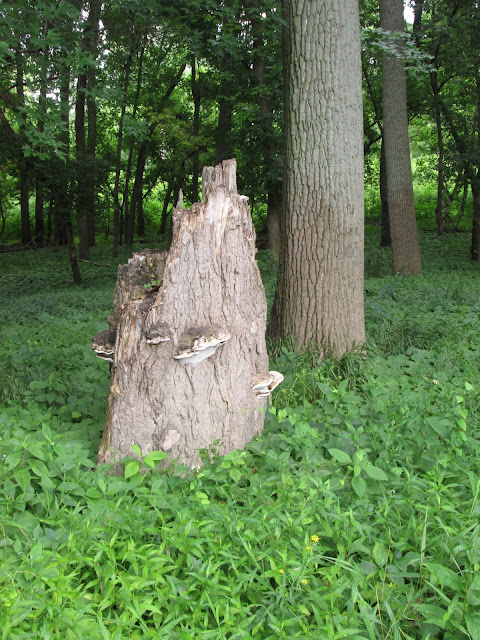
Some kind of polypore, maybe?

In the water, the remnants of a dead tree's roots have formed their own small ecosystem.

It didn't find its way into the picture, but when I approached, a northern water snake, which had been sunning itself on the flat section of tree on the lower right, plopped itself back into the river before the large potential predator (me) could get too close.
Today brought nothing exotic, nothing exciting, no life birds or rare plants--but lots of the kinds of life that goes on in very ordinary places every day.


(even with the US 20 bridge and a War of 1812 monument visible from some spots).

Despite the proximity of lots of humans and dogs, lots of wild life was going on this afternoon. Geese and swallows were doing their avian thing in great abundance, as were butterflies (mostly cabbage whites, but dancing white butterflies are still a cheering sight, and there were a few tiger swallowtails and an exquisite tiny blue of some kind). Everyplace, even the edge of a well-traveled paved trail, was bursting with life.
The forest floor (if tiny patches of second-and third-growth woods can be called forest) was covered with greenery that thrives under low-light conditions, and every patch of sun found something blooming, even if much of it was European wild mustard (which plant was doing a lot of business with butterflies, sweat bees, and tiny flies).
A dead tree stump was host to a colony of quite handsome fungi.

Some kind of polypore, maybe?

In the water, the remnants of a dead tree's roots have formed their own small ecosystem.

It didn't find its way into the picture, but when I approached, a northern water snake, which had been sunning itself on the flat section of tree on the lower right, plopped itself back into the river before the large potential predator (me) could get too close.
Today brought nothing exotic, nothing exciting, no life birds or rare plants--but lots of the kinds of life that goes on in very ordinary places every day.
Subscribe to:
Posts (Atom)