About Me

My photo
I'm a woman entering "the third chapter" and fascinated by the journey.

Thursday, July 14, 2016

Where Life Begins

I love marshes of all varieties. (And yes, I realize that the distinctive "salt marsh smell" is not for everyone.) Something about a spread of waving grass and water mesmerizes me. This beauty is on Hatteras Island, North Carolina.


I would not recommend walking on those lovely tussocks of grass, as we suspected water underneath..
 

This particular marsh is an estuary, a lively place where fresh and salt water meet. Areas like this are probably where the first tetrapods emerged from the sea, leading to the variety of land-dwelling vertebrates we have today. Estuaries are rich ecosystems, providing places for fish to spawn, insects to lay eggs, and migrating birds to rest and feed. Without marshes, the fish populations on which so many human cultures have depended for food would undergo an even sharper decline than they have.

 The largest grass clumps here are spartina, a plant that has evolved to expel salt from its tissues. Most grass would die quickly under these conditions, but not spartina. The roots of this tough plant hold onto whatever soil they can grab and form part of the matrix of the shoreline. Without plants like marshgrass and mangrove, the flow of all that water might well eventually turn Ohio into oceanfront property.


For all their toughness, however, marshes are globally threatened--often by development. Some of this development results from our human desire to control water, particularly the desire to pave over places where water wants to be. Often, though, the threat comes from being loved to death. People tend to like having views like these off their decks and porches. (I certainly would, and we did indeed spend a couple of nights on this island.)


 This doesn't look so bad. Surely the occasional house or hotel or boardwalk can't hurt anything as primeval and ubiquitous as a marsh.

However, just a few miles away, on the edge of a preserve, this is the view:
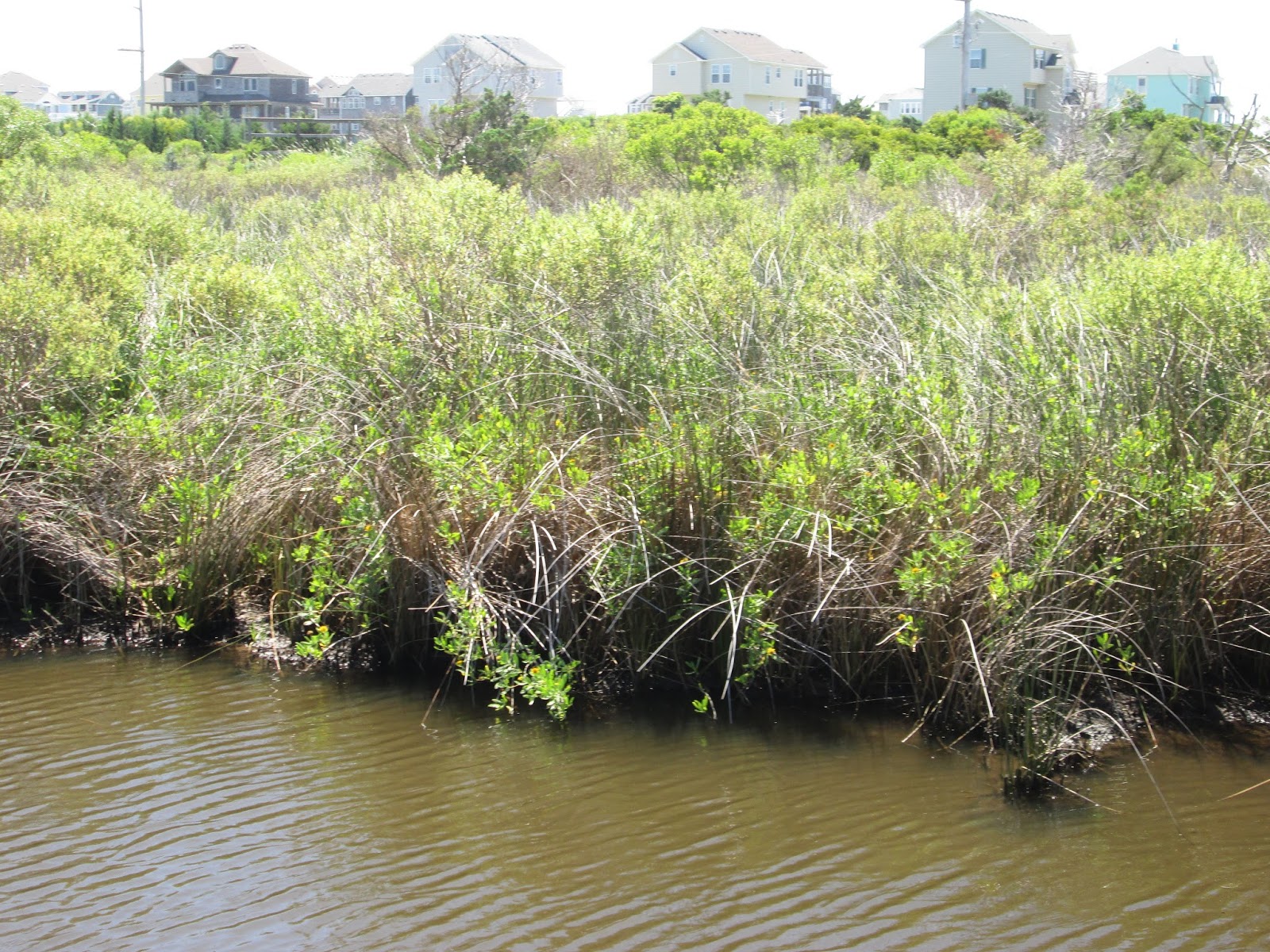

Hatteras Island is considered relatively undeveloped, but I doubt that any fish are spawning or herons hunting in neighborhoods like the one in the distance.

Wednesday, July 6, 2016

Urban gardening

has its challenges. Foremost is the lack of space, given that the area is (no surprise) heavily populated with humans and contains the roads on which humans like to drive their motor vehicles. Plants have to be tucked into the areas between buildings, sidewalks, and streets. What I have discovered, however, is that many don't mind. Our front lawn strip has become quite a lively, colorful place.This bed of mostly native plants and their cultivars is always busy with butterflies, bees, and other pollinators.


Because I have no discipline when it comes to plants, another bed between the sidewalk, street, and stop sign is home to daylilies, irises, and other lovelies that I can't resist (and that attract hummingbirds). 


Tough plants like rudbeckia, monarda, and echinacea ask for almost nothing and put on quite a show. They really don't seem to mind being three feet from the sidewalk.


A streetside garden is a strange mix of public and private. Before such a garden can exist, someone has to decide to create it, hoping that the neighbors won't mind. Once it exists, it becomes an object of public comment and, one hopes, enjoyment. Many conversations have taken place while puttering in the garden, and I have enjoyed the sight of total strangers taking photographs, not realizing that the gardener was weeding, hidden behind a tall plant.

Of course, the public nature of an urban garden can have disadvantages. This Orienpet lily lost the top two feet of its bloom stem when a passerby decided to remove it and take it home.


But the plant keeps blooming, anyway. There is probably a message there.

Monday, July 4, 2016

Evidently...

birds can't read. All the standard information about hummingbirds indicates that they have a preference for tubular flowers, particularly those in the red-to-hot-pink color range, and that they are usually seen in flight. The hummers in our neighborhood have not gotten the memo.

In the old neighborhood, two red flowers fought for the title of Best Early Hummingbird Magnet. The red monarda "Jacob Cline" probably won for most intense activity,


and its ridiculous-looking flowers certainly tick all the boxes for "traits that attract hummingbirds." Just look at those tubes!


But our native honeysuckle, lonicera sempervirens, is no slouch. It climbs high, has a long bloom season, and sports blossoms that are usually the equivalent of an "eat here" sign for hummingbirds and clearwing moths.


And we have lots of it, rambling over a fence, and have had for some weeks.
 

However, we saw our first 2016 hummingbird just a few days ago. It zoomed in and perched for several minutes on the top branch of a kousa dogwood, then swooped over to a white rose of sharon, an old-fashioned variety with flattish blossoms, where it spent the next several minutes evidently finding something to its liking.

No accounting for tastes.

Tuesday, June 28, 2016

A trash tree?

Some people hate catalpas. They have enormous leaves, which they shed in great numbers, and equally enormous seed pods, which children used to use in pretend sword fights. (Do children still do such things?) They are also the host of great numbers of catalpa sphinx caterpillars, at one time a popular fish bait in the South. (Do people still catch their own bait?) Sometimes, the caterpillars are so numerous as to defoliate the tree, leaving a thirty-foot stick until the new leaves grow. In other words, catalpas will make a mess in any tidy landscape.

But a blooming catalpa is quite a sight, perhaps especially edging a wooded path. This one is at an entrance to the University Parks Trail in West Toledo.


I certainly am not capable of begrudging a few leaves, pods, or caterpillars, especially when the bloom clusters are the most tropical-looking things native to Ohio.


Wouldn't they look right at home in a rain forest?

Those gorgeous blossoms are also attractive to pollinators. A close look reveals guide marks for bees, helping them find their way where the plant wants them to go, which also happens to be where the bees get what they need. Not only gorgeous, but helpful.


Catalpas may be gaudy, but I would never call them trashy.

Saturday, June 25, 2016

Getting it right

Today found me accompanying the spouse to the Hidden Gems "mini-festival" at Pearson Metropark in Oregon, Ohio, specifically at the Johlin Cabin wetland restoration area.


At the time of its construction in the mid-1800s, this cabin was an isolated outpost in a marshy clearing of the Great Black Swamp (Northwest Ohio's major ecosystem until the mid-19th century); today it is part of a 600-acre preserve surrounded by residential, industrial, and commercial development, visible in the background of this photo.


Just a few hundred feet from this part of the preserve is a new subdivision of what looks like very expensive housing, while the main commercial strip of Oregon lies just beyond the park's southwestern boundary. In other words, this is truly a metropark.


One inspiring aspect of this place is the vision that created it. During the Great Depression, Toledo Blade reporter George Pearson led a fundraising drive to purchase and preserve the last few hundred acres of the Great Black Swamp. In the early years of our century, 320 acres of farmland were purchased and are currently being restored as wetland; already, after only a decade, the preserve has become a regular stop on the long-distance migrations of many bird species, including the warblers that draw thousands of people to the nearby Magee Marsh every May for The Greatest Week in Birding.


Today, the recreated wetland that was a farm not too many years ago is home to muskrats and mink. Despite the disruption of the park festival going on, the swallows and swallowtails were everywhere, and we were treated to the sight of white herons circling overhead and then vanishing into stands of cattail. Hawks are plentiful, as are dragonflies.

The place is not what it once was, when the swamp stretched for a hundred miles, but it shows what nature can do when humans step back and give it just a little room.

Tuesday, June 21, 2016

Critters everywhere!

We live in the middle of town. Okay, it's a smallish town of around 15,000 people, but it has houses and cars and pavement, our street, connecting downtown and the fairgrounds, is heavily traveled, and our yard is small: a walled garden of around twenty by sixty feet or so and lawn strips  wrapping around a corner lot--nothing like the suburban half-acre we left behind in West Virginia. We do have trees--maples, dogwoods, and sweet gum--and are across the street from the city arboretum, but this place is not a pristine ecosystem. It is, however, home to a fair amount of wildlife, even if one does not include the omnipresent squirrels.

Goldfinches and titmice are common (okay, we cheat by providing easy access to sunflower seed),


and every morning a handsome cardinal makes himself heard from the highest branch of the sugar maple in the walled garden. Today, a young robin that had figured out how to leave the nest but had not quite mastered the flying thing spent several minutes hopping around on our patio, trying to figure out how to get off the ground. (One must love adolescents, of whatever species.) By the time the camera was retrieved, the bird had flown.

Our tiny pond seems to be hosting frogs, despite having been drained and cleaned in early spring. Something that is not a cicada makes quite a racket at night. Checking frog calls online, I am suspecting some sort of tree frog or peeper, though the American toad is a possibility. Given the number of hostas and their accompanying slugs in that part of the yard, toads would be welcome guests.

The pond is also home to mosquito larvae, despite the fact that I gave in and tossed in a mosquito dunk this month. The good news about that is that we now have lots of dragonflies and damselflies darting about, engaging in the sort of aerial combat that makes me glad I am too small to interest them as prey. This little beauty, I think a blue-fronted dancer, held still long enough to be photographed.


We would never know that bee populations are declining from the action in our lawn strip. I am not good at bee identification but in the last two days have verified at least honeybees, two types of bumbles, and a very handsome green sweat bee.


 I do love the cute little pollen pouches that foraging bees collect on their legs.


We are also starting to get quite a few butterflies. This gorgeous fritillary has been feasting on our coneflower and rudbeckia the last couple of days.


 I suspect that this lovely creature began its life very near here, as fritillary caterpillars feed only on violets, which are found in the thousands in our lawn strip and the arboretum's grassy areas. (Note: if you want butterflies, don't get rid of your violets.)

One last shot of a well-fed fritillary.


Who would have expected a wildlife refuge here?


Wednesday, June 8, 2016

Not your usual wildlife area

 As much as I love actual nature preserves, it is no secret that the Toledo Botanical Garden  is also a favorite place. This 60+-acre public park is home not only to spectacular plantings (including one of my absolutely favorite trees, a magnificent copper beech) but also to a number of arts organizations and a variety of small animals, including a sizeable population of the ever-amusing fox squirrel.


Who wouldn't love that tail?

In addition to the shady garden with its impressive rhododendron and hosta collections, the TBG also hosts several formal gardens. Such places are Not Generally My Style as designing them requires traits like discipline and restraint, neither of which I have in my relationships with plants. But a disciplined garden is not a bad thing (not that I am likely ever to live with one).


The contrast between this exuberant native baptisia and the classical statue is amusing.


This time of year many of the visual standouts are old roses


 and some knockout peonies,

but the highlight of my June 1 visit was the scent of the hedge of white rugosa.


These plants do not have the visual "oomph" of some of their companions, but the scent carries a long way and is one of the delights of summer. Walking past the rugosa hedge also provides aural amusement as the unmistakable buzz of large bees is everywhere. A formal English-style planting is not the first image  that springs to mind when one thinks of pollinator gardens, but this hedge is a magnet for bees of all sorts. I was fortunate enough to witness a brief skirmish between two bees interested in the same 
blossom


and the dance of what I could not help but think was a very happy bumblebee.


Not where one might expect to find wild ecstasy, but I'll take it.