Something you have to love about West Toledo: nearly everyone gardens to some degree or other, and the place is tree-crazy. The apartment complex across the street left a pocket woodland screening its tennis court, so there are always birds (and a FINE specimen of poison ivy clambering fifteen feet up a silver maple), and the Catholic elementary school on the corner has put in a butterfly garden near its playground. Even some of the businesses on the busy commercial street at the end of our block have put in streetside gardens. One of those caught my eye this morning with what seemed at first like an anomaly: perfect specimens of milkweed at the beginning of September.
By now, all varieties of milkweed at our place in Parkersburg (those that have survived the drought, anyway), are thoroughly caterpillar-nibbled. This year has brought nothing like the total monarch-caused defoliation of 2010, but I'm happy to say that our plants are pretty scruffy-looking. These, on the other hand, were perfect: big, fat, gorgeous leaves of asclepias syriaca with not a bug-chomped edge anywhere. Being the worrying kind, I couldn't help but wonder if this milkweed perfection this late in the season signalled a shortage of monarchs, but then I noticed the eggs, small, whitish deposits on many of the leaves. Given that the time from egg to adult monarch is around a month, bringing us into October, I hope that this generation hatches and gets on its way to Mexico before the first frost.
About Me
- Rebecca
- I'm a woman entering "the third chapter" and fascinated by the journey.
Monday, September 3, 2012


Sunday, September 2, 2012
The beauty of bark
Some days it doesn't take much to amuse me. The other day, tired from dragging hoses around to our dozens of drought-stricken trees and shrubs (and getting ready for the house-sitter, who is even now babysitting the cats and plants so I can enjoy my sabbatical in Toledo), I happened to notice the slant evening light on a backyard white oak.


 the skinlike bark of holly



A little later, the sunset actually turned the bark red:

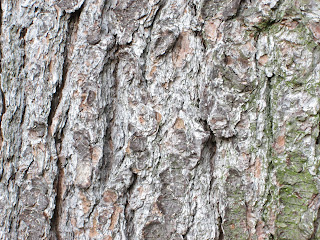
Being a longtime treehugger (sometimes literally), I had to see what was happening with the bark of some of the other tree species inhabiting the yard and discovered the following:
 the skinlike bark of holly
and the wonderful cragginess of white pine.


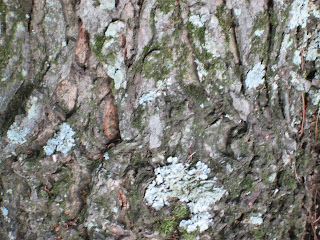
A further meander revealed that red maple bark

sometimes grows its own ecosystem.

Being easily amused isn't such a bad thing.
Thursday, August 30, 2012
Up close and personal
Our local deer herd continues to grow, at least for now. Walking near the city wildlife refuge a few days ago, a glance at the side of the road revealed a smallish doe and two fawns, browsing the grass between the reserve and the street. It would not be fair to describe her as totally unconcerned (though a common description of the deer around here is "tame as dogs"), but she certainly wasn't particularly alarmed at my presence or that of a car turning out of a driveway across the street. The babies were a little more nervous, retreating into the shade of the trees as the car went past and I got closer.
I'm not sure about the health of this growing deer herd. This doe wasn't quite Scrawny Momma (the name we gave to a stray tabby who took up residence on our back deck at a previous house), but she certainly wasn't overweight. She was so small that her ears were her largest and most notable feature. Her ribs were more hinted at than visible, but they contrasted with the swollen udder that was obviously well-used. I had no idea that deer developed such visible udders, never having been this close to a nursing mother of that species before. She and I stood observing each other for a minute or two, at which point I decided that I really did need to get home, and she took a few steps away from the street into the protection of the posted refuge. The browsing of the new growth along the refuge edge continued.
I'm not sure about the health of this growing deer herd. This doe wasn't quite Scrawny Momma (the name we gave to a stray tabby who took up residence on our back deck at a previous house), but she certainly wasn't overweight. She was so small that her ears were her largest and most notable feature. Her ribs were more hinted at than visible, but they contrasted with the swollen udder that was obviously well-used. I had no idea that deer developed such visible udders, never having been this close to a nursing mother of that species before. She and I stood observing each other for a minute or two, at which point I decided that I really did need to get home, and she took a few steps away from the street into the protection of the posted refuge. The browsing of the new growth along the refuge edge continued.
Monday, August 27, 2012
To wear the purple
I generally associate purple with spring and fall flowers, but a recent walk showed lots of purple happening in August. Some of it was found on the usual suspects, like ironweed

and liatris

and aster,

and a tiny flower that I still haven't identified.

But there was also purple in unexpected places, like the stems of milkweed and a shrub dogwood (red osier, maybe?).


Even the grasses were getting into the act, not only the aptly named purple lovegrass

 but the big bluestem was blooming in purple.
And while it probably comes as no surprise to anyone that thistle blossoms are purple,

I have to confess to being astounded at the beauty of this common "weed" viewed up close and personal.

It's a good time to put a little purple in your world.
Tuesday, August 14, 2012
This week's visitors
I wish I were better at capturing animals in photographs; unfortunately, they're not as cooperative as plants about holding still. Perhaps my favorite photo-I-didn't-get was a chipmunk on the front stoop, practically nose-to-nose with Mirabel the Menace, in her youth the most mischievous of our cats. By the time the camera is out of its case, the creature is generally gone. Sigh.
We've had our share of wildlife this summer, not only the skunk that did pose for photographs and the chipmunk that didn't, but the fawn that exploded out of the meadow garden, Stumpy, our regular visitor, butterflies of all shapes and sizes, and the usual assortment of sparrows, finches, chickadees, titmice, cardinals, nuthatches, wrens, and woodpeckers. We also had what may have been our first hawk, perched on the feeder pole and surveying the yard (and of course, not catching anything that way). It may have been the same bird I saw a few blocks away later in the week: that time, the bird, possibly a juvenile red-tailed hawk, was standing in the middle of Plum Street, only flying away when I moved closer to get a better look. I suspect that an adult hawk with more experience would not have found the street a good place to look for food.
The front-yard liatris has proven to be a butterfly magnet, and butterfly brains (if they have them--Biology 101 was a LONG time ago) are so small that the insects don't seem to process me as potential danger. Of course, I'm much too large to be taken for a bird or a spider, so maybe butterflies are smarter than I'm giving them credit for.

This skipper (possibly a fiery skipper?) went about its business unconcernedly last evening, allowing me to snap several pictures.
 Squirrels are a different matter. If you look in the lower right corner of this photo, you will see a black squirrel running away.
 Monday, August 13, 2012
The colors of August
I'm not a particularly good photographer, but August is a good month for color around here.


And this


zinnia and physocarpus

coreopsis "Red Shift," a white echinacea, and a deer-chomped liatris
 |
| agastache "Tutti Frutti" |
 |
| helenium and liatris |

 |
| wild ageratum (eupatorium coelestinum) |

gaillardia and aster "Purple Dome" (We go for gaudy sometimes.)
 |
| agastache "Tutti Frutti" and physocarpus "Coppertina" |
 |
| senescent echinacea of a forgotten variety |
 |
| echinacea "Sundown" |

is a baby one of these (yes, these blossoms are on the same zinnia plant at the same time).

I officially forgive June and July for all the heat.
Wednesday, August 8, 2012
Another happy ending
This morning as I was returning from putting laundry out to dry, there was a noise from the compost area, a fenced former dog run that also houses a nifty double rain-barrel setup crafted by my crafty spouse. It was the kind of noise that makes any bird-lover (or adult bird) take notice: the distress call of a (probably young) songbird. Investigating, I found a young robin (possibly the same adventurous juvenile stranded in the rhododendron a couple of days ago?) caught in some leftover bird netting that hadn't been put away after its last stint protecting some plant or other but tossed under the rain barrel frame. (Yes, I need to be more systematic about such things.)
This young turdus migratorius had managed to get a foot caught in the net and, in its struggles, create a huge knot of plastic netting that tied its toes together and caught the leg at the knee. (Do birds have knees? What do we call the joint that bends in the middle of a bird leg?) Attempting to tease the knots out quickly convinced me that this wasn't a good plan as I was all-too-able to imagine a broken leg or worse. Then: technology to the rescue!
A pair of scissors quickly cut enough plastic threads to free the bird's foot and leg, enabling it to scramble away as it still didn't seem to have the flying thing quite mastered. A quick look later in the day found no bird inside the fence, so this young robin seems to have survived another of the hazards of life in suburbia.
This young turdus migratorius had managed to get a foot caught in the net and, in its struggles, create a huge knot of plastic netting that tied its toes together and caught the leg at the knee. (Do birds have knees? What do we call the joint that bends in the middle of a bird leg?) Attempting to tease the knots out quickly convinced me that this wasn't a good plan as I was all-too-able to imagine a broken leg or worse. Then: technology to the rescue!
A pair of scissors quickly cut enough plastic threads to free the bird's foot and leg, enabling it to scramble away as it still didn't seem to have the flying thing quite mastered. A quick look later in the day found no bird inside the fence, so this young robin seems to have survived another of the hazards of life in suburbia.
Subscribe to:
Posts (Atom)