About Me

My photo
I'm a woman entering "the third chapter" and fascinated by the journey.

Sunday, October 3, 2010

A long journey

I have to confess that fall always makes me a little sad, even though I love the crisp air and the satisfying crunch of walking through fallen leaves.  So much is ending, and at this stage of my life, there seem to be more endings than beginnings.  Over the last few weeks, news of deaths and advancing illness have made this fall, still in its beginning phase, seem even more intense than usual.

My usual habit of turning to the outside world for solace has brought yet more meditation on endings.  This was a good year for butterflies, but the brevity of their lives has contributed to my autumn melancholy.  They add so much beauty to the world, but few of them live more than a few weeks.

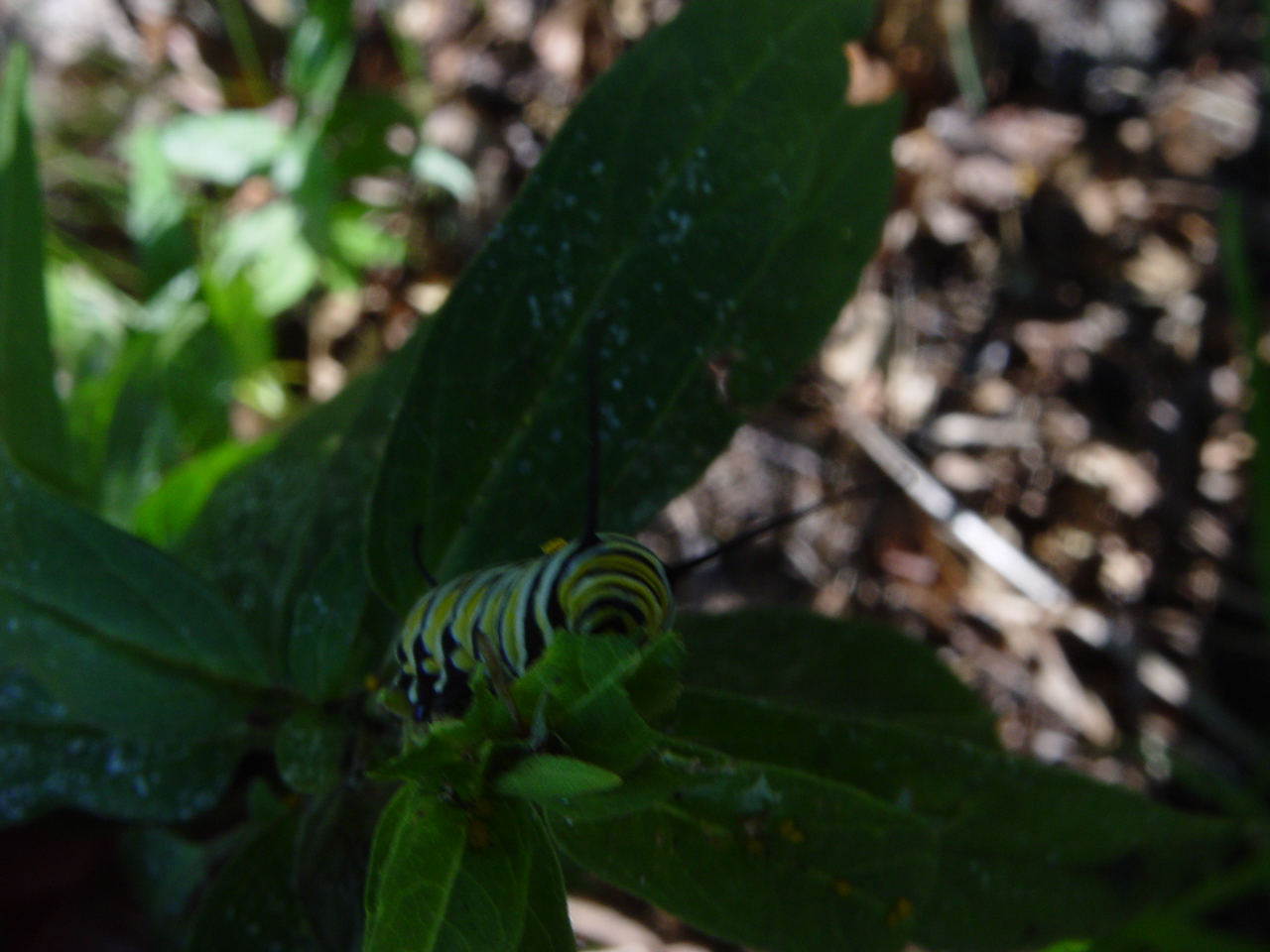
One exception is the year's last generation of monarchs, which fly south to Mexico to overwinter, then start north in February or March, lay their eggs in the southern U.S., and die, leaving that next generation to complete the migration to our West Virginia hills and fields.  Knowing that the caterpillars busily defoliating our backyard milkweeds a few weeks ago were the last generation of 2010 led me to commemorate them.


The defoliated plant that led to the discovery


of the VERY hungry caterpillar
 caught in the act of chewing.


Waiting...
The last generation, who got to fly away.

Sunday, September 5, 2010

An urban haven

Today my other half and I discovered a truly amazing place in the center of Toledo--Wildwood Preserve Metropark.  This 500+-acre estate includes woods, meadows, part of the Ottawa River, remnant tallgrass prairie, a formal garden designed by Ellen Shipman, and the 32,000-square-foot house of a 20th-century spark plug magnate. While the noise of busy Central Avenue was generally audible as at least a background hum, and while the park was well-used--on this Labor Day weekend, the parking lots were nearly full, dozens of dogs were being walked, and picnics were happening at just about every table--sometimes it was possible to forget, at least momentarily, that we were in a city of more than 300,000 people. Here is a picture that gives some idea of how tall some of the grasses were.  This clump of big bluestem is much taller than my 5'6".

This monarch butterfly was totally oblivious to our presence, as was the Ottawa River in the following shot.


The Toledo Metropark system has impressed me in the short time I've been even vaguely familiar with it. This Rust Belt city seems to have made a concerted effort to make green space available to all its residents; five large parks are accessible by city bus, and many of the paths are wheelchair-accessible. At Wildwood, the water fountains include ground-level fountains for the dogs that people bring with them. While it is unlikely that much of any of the parks is pristine wilderness, I was heartened by the variety of plant and animal species we noticed in just a few hours at a time far from prime for wildlife-watching. It seems that vibrant urban life can coexist with a fair amount of wild nature.


In case this post seems too sweetness-and-light, let me report that there was a literal snake in the garden. We saw this juvenile beauty pursuing a toad just below an elegant iron gazebo in the formal garden. The toad escaped.

Saturday, August 28, 2010

Transitions

I woke this morning to heavy mist, the kind that seems to signal some kind of change in the weather.  In this case, the two days of reasonably cool days and cooler nights that we've had are supposedly giving way to several more days of heat. (I guess the warm upper air that let the fog form is going to descend on us--oh joy.)  Fog, besides demonstrating atmospheric transition, has always seemed mysterious to me; as a girl, I loved walking, and even driving, in swirling mist.

This morning's fog seems an appropriate marker of the state of my life, since this has been a summer of transitions.  The shift in certain people's health statuses has caused different caregiving responsibilities, with additional and different check-ins.  We may have inherited a cat whose human can no longer care for her, bringing our total to five, way over the "one cat per human" guideline followed for most of my adult life.  (Anyone out there want a declawed, one-eyed, geriatric calico cat who wants to be an only feline?) There is the obvious transition of adjusting to life in a new place with what should have been a new garden, though the deer and the poor soil have left some of our plants in a pitiful state.  Here's hoping that the decrease in level in the compost bin signals that compost is in fact happening.

The major transition has been my husband's finding of the job he's always wanted, in a city five hours away.  Two committed adults with computers and cell phones can of course maintain contact under such conditions, but this was not a change we had planned for. Helping him get settled, I have found much to like about the new location, not least the abundant city green space, great birding, and mass transit, and his new dean has noted that there are likely to be positions in my field next year. This possibility seems worth exploring. The future right now is as misty and mysterious as the back yard.

Sunday, July 18, 2010

Extravagance

Today I want to praise extravagance. Since the go-go years on Wall Street that brought about our current economic woes, and since more of us have become aware of our ecological footprints, extravagance has gotten a bad name, but there are multiple extravagances, and it is some of those that I wish to praise, in no particular order.


• This morning, the deep green of the dogwood leaves was broken by the arrival of a male cardinal, extravagantly red, noisy, and exuberantly checking out the state of the dogwood berries, or whatever else in the tree might have been edible. Other birds manage to attract mates without being quite so eye-catching (and as Julie Zickefoose has noted, being eye-catching is often dangerous for cardinals), but such colorful perfection was this morning’s blessing.

• Berries themselves. The next time someone complains about the seeds of blackberries, raspberries, or strawberries, remind them that the fruits we and the birds crave are really seed dispersal mechanisms. Those luscious berries lure us in so that seeds can be spread more widely than the parent plants can spread them, and aren’t we lucky that the universe opted for this extravagant method of plant reproduction?

• Seeds in general. Those of us who aren’t faithful deadheaders of spent blossoms find that birds help themselves to our coneflowers and coreopsis, and in the process, scatter seed and make new plants. If we don’t immediately sweep up all the purchased seed spilled under our birdfeeders, we are rewarded by free sunflowers and millet. Let’s hear it for the extravagant generosity of free plants.

• The extravagant laziness of house cats. Is there anything more totally relaxed than a fat middle-aged cat sacked out on the sofa? (Or more generally graceful than cats, anyway?)

• The energy and generosity of certain young humans. This afternoon, I was privileged to attend a benefit for a cancer patient, organized by her young adult children and their friends. They had acquired donations of goods and services ranging from massages to meals to football weekends, and people who knew the woman in question packed the town hall and opened their hearts and their wallets. Love is always a good kind of extravagance.

Thursday, July 8, 2010

Taking nothing for granted

Having planned to do a lot of writing this summer, I find that life (along with my general lack of organization) got in the way, as it tends to do. But I’m in good company: Eric T. Freyfogle, editor of The New Agrarianism, a collection of essays I’m currently enjoying, notes that “agrarians have typically been happier to live their lives than to write about them” (xviii). And while I’m hesitant to describe myself as agrarian, having been contentedly ensconced in one town or another for the last thirty-five years, the low-key pleasures of a localized and semi-outdoorsy life have become increasingly important as I move toward old age.


This has been an unexpectedly rough summer, emotionally. An old friend, a highly competent Renaissance man active in educational, environmental, and artistic circles, is fading away from Alzheimer’s; a longtime acquaintance, a woman about my age, is experiencing serious unspecified neurological problems; a troubled relative in her early fifties, after decades of erratic behavior, has recently been diagnosed with a progressive neurological disease, always fatal and always hideous. Part of my next few years will involve helping this individual die as peacefully as possible. My own good luck—being reasonably healthy, gainfully employed, and happily enmeshed in a web of relationships—seems more and more a kind of amazing grace.  All I can do in response, it seems, is to pay attention as much as possible.

In our immediate corner of the world, this has been a good week: the yard drainage project has been completed, creating not one but three new planting beds in the process (though the heat and dry weather have not yet revealed whether or not the basement will remain dry). Friends and acquaintances have offered plants to fill in some of the new spaces, so a friendship garden is being created. (Not that there aren’t already plants with stories in the existing beds—these daylilies                            
were acquired by my Bulgarian friend Milena in 2007, from a nursery owner who gave her far larger clumps than those offered to other purchasers that day. We suspect an infatuation with her accent.)
Other joys of the week include these:
  •  Meals in which nearly all the food was locally raised.  Sitting down to a meal in which the chicken, the potatoes, the green beans, the tomatoes, the blueberries, and the wheat for the cookies all originated within a twenty-minute drive of our dining room is a reminder of what a rich area the Mid-Ohio Valley truly is.  Now if only chocolate, coffee, and grapes for Chardonnay could be grown somewhere nearby, I could truly be a locavore. . .

  • The serendipitous combination of rose "Lady Elsie May" blooming with a nameless bicolor daylily that has accompanied me to three houses 

  • •Sightings of two of the Black Squirrels of North Parkersburg

  •  Chipmunks becoming regular visitors to our feeders, and (drum roll, please)

  • •The return of the goldfinches!  The ratibida, sunflowers, and silphium are blooming just in time.


Wednesday, June 23, 2010

(Some of) the joys of summer

Yesterday I saw a hummingbird for the first time this year. It was not at the red honeysuckle, or the penstemon, or the lantana, or at any of the other hummingbird- attracting plants dotted around the yard. No, it was two blocks from here, in a front yard, on a manicured street, darting between a pink saucer magnolia of some kind and a shrub with no discernible flowers. Birds have minds of their own.


This is proving to be a good year for fireflies. Our laxness in mowing the back yard has allowed some of the grasses to start going to seed, and the yard at twilight is filled with tiny blinking lights. Visitors from Florida last week had to stand at the window and comment on the sheer number of the little insects.

And the daylilies are blooming.  Life is good.

Wednesday, June 9, 2010

From a different window

This week I am viewing the world from a different window, this one in Oneonta, New York, at a conference in honor of John Burroughs. This part of New York is superficially similar to the mid-Ohio Valley—Victorian towns, rolling hills, small farms, lot of trees—but it’s the differences that have stood out for me. The air has a crispness that we lack (perhaps because the air here is cleaner), and the light is different; Thomas Cole and the other Hudson River School painters had it right, or maybe Washington Irving in the opening of “Rip Van Winkle,” when he wrote of the “fairy mountains” with their ever-changing appearance.

Vegetation differences are striking. The most apparent roadside tree is birch, rare in southern Ohio and west central West Virginia. The white birch bark shines when seen from the interstate, but up close the bark of the gray birches (or whatever birch has smooth gray bark) is perhaps more beautiful. It’s so much like skin that I had to touch the tree on the parking lot trail around the campus pond; it’s easy to forget that bark is alive. The evergreens are different as well: spruce and fir that don’t do well in our hot, humid summers are common here, and the white pines are different somehow, perhaps fewer low branches.

The season is less advanced here. Enormous lilacs are still blooming in a few places, and peonies and poppies are still in full bloom, while at home they’ve been finished for weeks. But there are anachronisms—roses are everywhere here, though they’re rugosas and old shrub roses.

I stumbled across a magic garden today, Brookwood outside of Cooperstown, that was full of just such anachronisms. It was part of an historic estate, now in ruins, but a group of volunteers is attempting to maintain and restore the garden. Things that shouldn’t be blooming at the same time were, and the experience came close to bringing a sensory overload. Entering through a stone gate with a medieval-looking wooden door, the traveler finds a lawn flanked by weedy but spectacular perennial borders. Peonies of all types dominated on three sides, interspersed with pale foxgloves, amsonia, and purple alliums, with daisies interspersed and ragged orange poppies for spice. At the end of the lawn was a hedge of rosa alba and a tall pink rose that may have been Maiden’s Blush (or as the French called it, “Thigh of a Passionate Nymph”). Protected as the garden was by walls, the scents of the flowers stayed close and mingled—almost intoxicating. Passing beyond the rose hedge requires stepping down into a small garden with a pool surrounded by lady’s mantle and billowing catmint. Hidden behind ostrich ferns in a secret garden next to an old fountain, tiny pink primroses were blooming. But the real surprise was on the stone porch of the old school building that houses the group responsible for the garden today—nicotiana in full, heady, tropical-scented bloom. Pure magic.

I have a meeting to go to, so I won’t get started on the wild swamp walk to which the garden path leads.